







Question: Please make a quality 300 word maximum posting here before Sunday midnight of week 3 related to any aspect of the Hamer v. Sidway case
Please make a quality 300 word maximum posting here before Sunday midnight of week 3 related to any aspect of the Hamer v. Sidway case found on page 250. Utilize the ABCD format I have outlined below. For purposes of this assignment only, you can assume facts not in evidence. After carefully reading case, please provide question, answer, legal lesson, and conclusion as per my 4 part example.
I will go first by way of example:
Hamer v. Sidway:
A- My question after reading the case: If the parties were both named Story, why is this famous case known as Hamer v. Sidway?
B- My answer to my question: The nephew apparently got tired of waiting so he signed over the financial rights to his uncle's promise to Hamer. The executor Sidway of the uncle's estate only wants to pay valid legal claims, thus the need for the lawsuit.
C- Legal lesson from case: An act or a failure to act (forbearance to act) can qualify as consideration Nephew did not use tobacco, swear, play cards or billiards for money until after 21. This is legal consideration/
D- My conclusion and why: Nephew not only likely was spared gambling losses and improved his health during his early youth, but his designee is entitled to the money from his deceased uncle's estate. This is because the nephew was under no legal duty to adhere to the uncle list of don'ts.
Other questions that might be raised include:
- If the promise was made in 1869, why is this 1891 case?
- Why didn't the rich uncle's death terminate the offer as a matter of law?
- How much would the uncle's promise mean in 2018 dollars assuming 5% interest per annum?
- Could the uncle have unilaterally amended the promise to include no crazy dancing?
- What if the nephew did these prohibited things but never told the uncle? Does he still get paid?
You may use your imagination and create your own, but try not to duplicate what others have already posted.
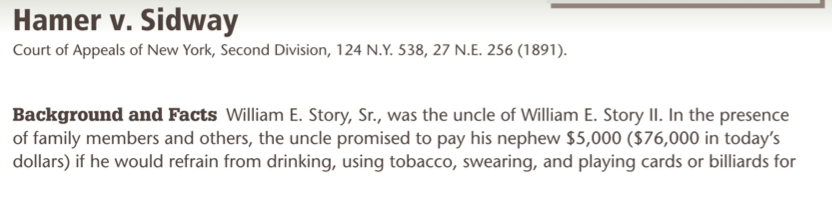
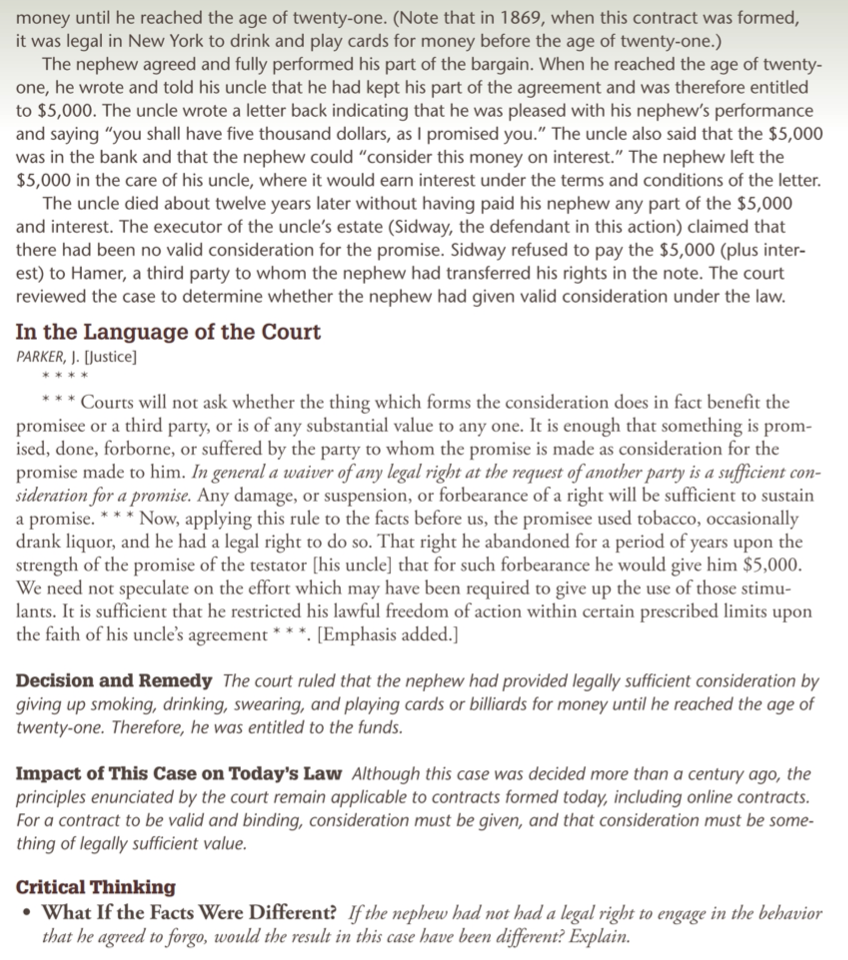
Hamer v. Sidway Court of Appeals of New York, Second Division, 124 N.Y. 538, 27 N.E. 256 (1891). Background and Facts William E. Story, Sr., was the uncle of William E. Story II. In the presence of family members and others, the uncle promised to pay his nephew $5,000 ($76,000 in today's dollars) if he would refrain from drinking, using tobacco, swearing, and playing cards or billiards for money until he reached the age of twenty-one. (Note that in 1869, when this contract was formed, it was legal in New York to drink and play cards for money before the age of twenty-one.) The nephew agreed and fully performed his part of the bargain. When he reached the age of twenty- one, he wrote and told his uncle that he had kept his part of the agreement and was therefore entitled to $5,000. The uncle wrote a letter back indicating that he was pleased with his nephew's performance and saying you shall have five thousand dollars, as I promised you." The uncle also said that the $5,000 was in the bank and that the nephew could consider this money on interest." The nephew left the $5,000 in the care of his uncle, where it would earn interest under the terms and conditions of the letter. The uncle died about twelve years later without having paid his nephew any part of the $5,000 and interest. The executor of the uncle's estate (Sidway, the defendant in this action) claimed that there had been no valid consideration for the promise. Sidway refused to pay the $5,000 (plus inter- est) to Hamer, a third party to whom the nephew had transferred his rights in the note. The court reviewed the case to determine whether the nephew had given valid consideration under the law. In the Language of the Court PARKER, J. (Justice] *** Courts will not ask whether the thing which forms the consideration does in fact benefit the promisee or a third party, or is of any substantial value to any one. It is enough that something is prom- ised, done, forborne, or suffered by the party to whom the promise is made as consideration for the promise made to him. In general a waiver of any legal right at the request of another party is a sufficient con- sideration for a promise. Any damage, or suspension, or forbearance of a right will be sufficient to sustain a promise. *** Now, applying this rule to the facts before us, the promisee used tobacco, occasionally drank liquor, and he had a legal right to do so. That right he abandoned for a period of years upon the strength of the promise of the testator [his uncle] that for such forbearance he would give him $5,000. We need not speculate on the effort which may have been required to give up the use of those stimu- lants. It is sufficient that he restricted his lawful freedom of action within certain prescribed limits upon the faith of his uncle's agreement ***. [Emphasis added.] Decision and Remedy The court ruled that the nephew had provided legally sufficient consideration by giving up smoking, drinking, swearing, and playing cards or billiards for money until he reached the age of twenty-one. Therefore, he was entitled to the funds. Impact of This Case on Today's Law Although this case was decided more than a century ago, the principles enunciated by the court remain applicable to contracts formed today, including online contracts. For a contract to be valid and binding, consideration must be given, and that consideration must be some- thing of legally sufficient value. Critical Thinking What If the Facts Were Different? If the nephew had not had a legal right to engage in the behavior that he agreed to forgo, would the result in this case have been different? Explain. Hamer v. Sidway Court of Appeals of New York, Second Division, 124 N.Y. 538, 27 N.E. 256 (1891). Background and Facts William E. Story, Sr., was the uncle of William E. Story II. In the presence of family members and others, the uncle promised to pay his nephew $5,000 ($76,000 in today's dollars) if he would refrain from drinking, using tobacco, swearing, and playing cards or billiards for money until he reached the age of twenty-one. (Note that in 1869, when this contract was formed, it was legal in New York to drink and play cards for money before the age of twenty-one.) The nephew agreed and fully performed his part of the bargain. When he reached the age of twenty- one, he wrote and told his uncle that he had kept his part of the agreement and was therefore entitled to $5,000. The uncle wrote a letter back indicating that he was pleased with his nephew's performance and saying you shall have five thousand dollars, as I promised you." The uncle also said that the $5,000 was in the bank and that the nephew could consider this money on interest." The nephew left the $5,000 in the care of his uncle, where it would earn interest under the terms and conditions of the letter. The uncle died about twelve years later without having paid his nephew any part of the $5,000 and interest. The executor of the uncle's estate (Sidway, the defendant in this action) claimed that there had been no valid consideration for the promise. Sidway refused to pay the $5,000 (plus inter- est) to Hamer, a third party to whom the nephew had transferred his rights in the note. The court reviewed the case to determine whether the nephew had given valid consideration under the law. In the Language of the Court PARKER, J. (Justice] *** Courts will not ask whether the thing which forms the consideration does in fact benefit the promisee or a third party, or is of any substantial value to any one. It is enough that something is prom- ised, done, forborne, or suffered by the party to whom the promise is made as consideration for the promise made to him. In general a waiver of any legal right at the request of another party is a sufficient con- sideration for a promise. Any damage, or suspension, or forbearance of a right will be sufficient to sustain a promise. *** Now, applying this rule to the facts before us, the promisee used tobacco, occasionally drank liquor, and he had a legal right to do so. That right he abandoned for a period of years upon the strength of the promise of the testator [his uncle] that for such forbearance he would give him $5,000. We need not speculate on the effort which may have been required to give up the use of those stimu- lants. It is sufficient that he restricted his lawful freedom of action within certain prescribed limits upon the faith of his uncle's agreement ***. [Emphasis added.] Decision and Remedy The court ruled that the nephew had provided legally sufficient consideration by giving up smoking, drinking, swearing, and playing cards or billiards for money until he reached the age of twenty-one. Therefore, he was entitled to the funds. Impact of This Case on Today's Law Although this case was decided more than a century ago, the principles enunciated by the court remain applicable to contracts formed today, including online contracts. For a contract to be valid and binding, consideration must be given, and that consideration must be some- thing of legally sufficient value. Critical Thinking What If the Facts Were Different? If the nephew had not had a legal right to engage in the behavior that he agreed to forgo, would the result in this case have been different? ExplainStep by Step Solution
There are 3 Steps involved in it

Get step-by-step solutions from verified subject matter experts
 Study Help