







Question: please need good answer for these two questions Mobile Payments: Fintech vs. the Bank Giants early every day, it seems, a new mobile payment system

please need good answer for these two questions
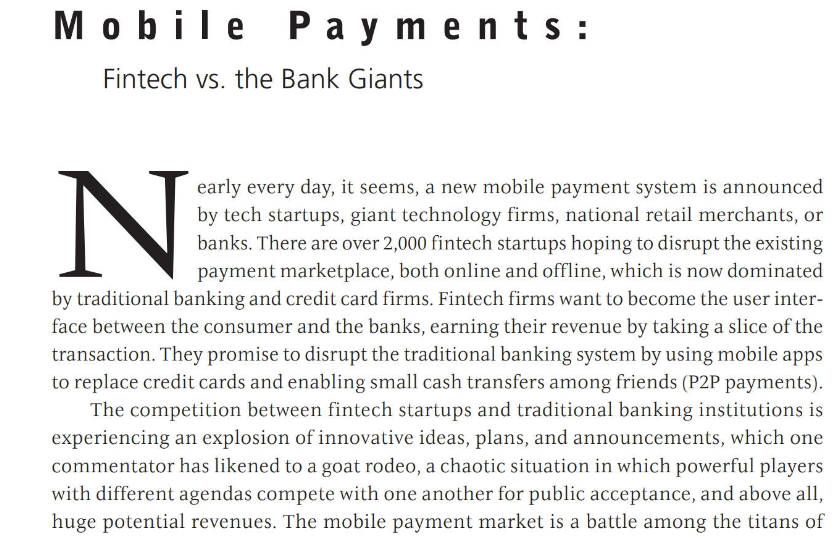
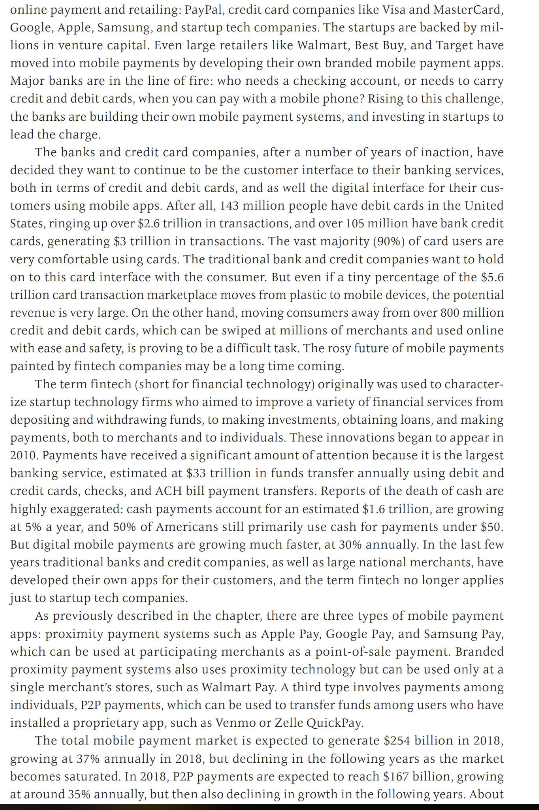
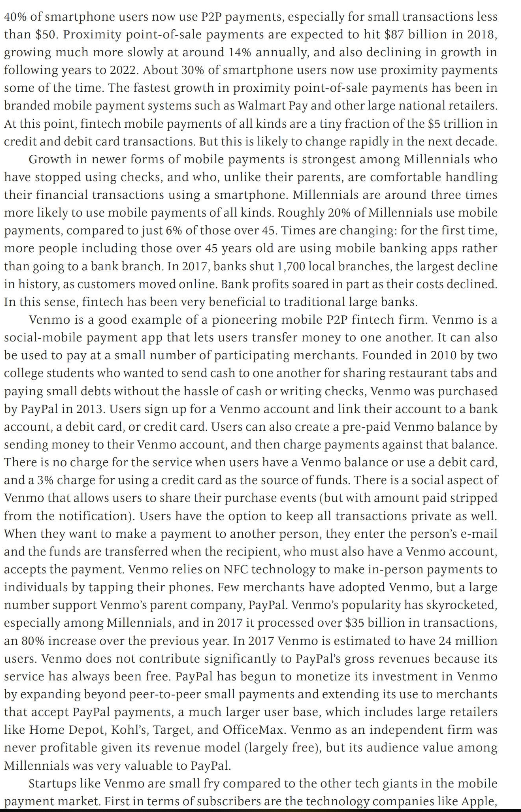
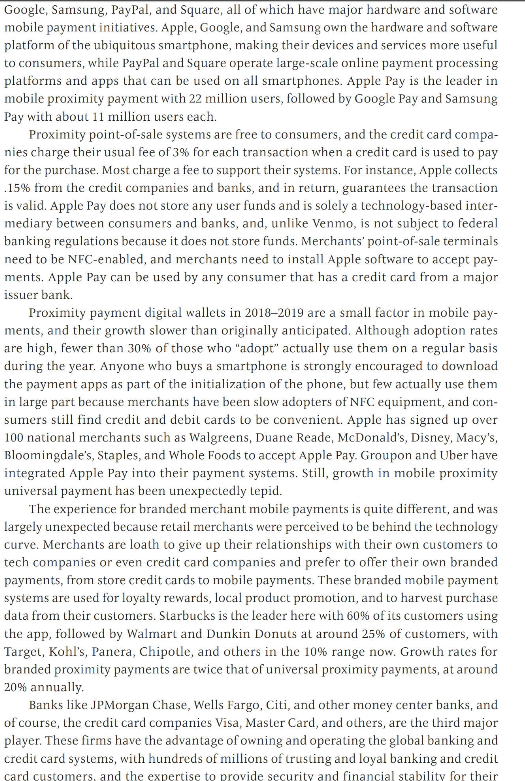
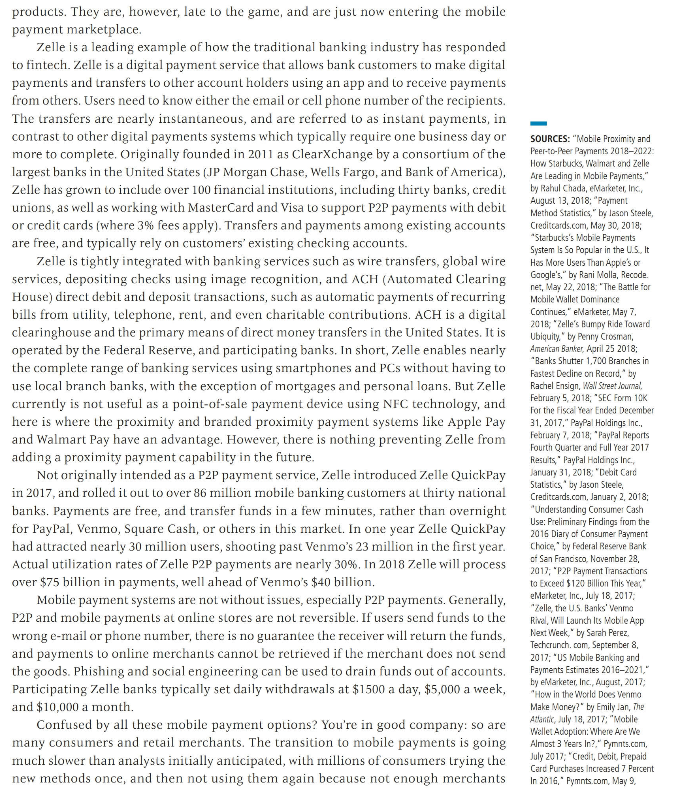
Mobile Payments: Fintech vs. the Bank Giants early every day, it seems, a new mobile payment system is announced by tech startups, giant technology firms, national retail merchants, or banks. There are over 2,000 fintech startups hoping to disrupt the existing payment marketplace, both online and offline, which is now dominated by traditional banking and credit card firms. Fintech firms want to become the user inter- face between the consumer and the banks, earning their revenue by taking a slice of the transaction. They promise to disrupt the traditional banking system by using mobile apps to replace credit cards and enabling small cash transfers among friends (P2P payments). The competition between fintech startups and traditional banking institutions is experiencing an explosion of innovative ideas, plans, and announcements, which one commentator has likened to a goat rodeo, a chaotic situation in which powerful players with different agendas compete with one another for public acceptance, and above all, huge potential revenues. The mobile payment market is a battle among the titans of online payment and retailing: PayPal, credit card companies like Visa and MasterCard, Google, Apple, Samsung, and startup tech companies. The startups a lions in venture capital. Even large retailers like Walmart, Best Buy, and Target have moved into mobile payments by developing their own branded mobile payment apps. Major banks are in the line of fire: who needs a checking account, or needs to carry credit and debit cards, when you can pay with a mobile phone? Rising to this challenge, the banks are building their own mobile payment systems, and investing in startups to lead the charge. The banks and credit card companies, after a number of years of inaction, have decided they want to continue to be the customer interface to their banking services, both in terms of credit and debit cards, and as well the digital interfa comers using mobile apps. After all, 143 million people have debit cards in the United States, ringing up over $2.6 trillion in transactions, and over 105 million have bank credit cards, generating $3 trillion in transactions. The vast majority (90%) of card users are very comfortable using cards. The traditional bank and credit on to this card interface with the consumer. But even if a tiny percentage of the $5.6 trillion card transaction marketplace moves from plastic to mobile devices, the potential revenue is very large. On the other hand, moving consumers away from over 800 million credit and debit cards, which can be swiped at millions of merchants and used online with ease and safety, is proving to be a difficult task. The rosy future of mobile payments painted by fintech companies may be a long time coming The term fintech (short for financial technology) originally was used to character ize startup technology firms who aimed to improve a variety of financial services from depositing and withdrawing funds, to making investments, obtaining loans, and making payments, both to merchants and to individuals. These innovations began to appear in have received a significant amount of attention because it is the largest banking service, estimated at $33 trillion in funds transfer a credit cards, checks, and ACH bill payment transfers. Reports of the death of cash are highly exaggerated: cash payments account for an estimated $1.6 trillion, are growing al 5% a year, and 50% of Americans still primarily use cash for payments under $50. But digital mobile payments are growing much faster, at 30% annually. In the last few years traditional banks and credit companies, as well as large national merchants, have developed their own apps for their customers, and the term fintech no longer applies just to startup tech companies. As previously described in the chapter, there are three types of mobile payment apps: proximity payment systems such as Apple Pay, Google Pay, and Samsung Pay, which can be used al participating merchanis as a point-of-sale payment. Branded proximity payment systems also uses proximity technology but can be used only at a single merchant's stores, such as Walmart Pay. A third type involves payments among individuals, P2P payments, which can be used to transfer funds among users who have installed a proprietary app, such as Venmo or Zelle QuickPay. The total mobile payment market is expected to generate $254 billion in 2018, growing al 37% annually in 2018, but declining in the following years as the market becomes saturated. In 2018, P2P payments are expected to reach $167 billion, growing at around 35% annually, but then also declining in growth in the following years. About 40% of smartphone users now use P2P payments, especially for small transactions less than $50. Proximity point-of-sale payments are expected to hit $87 billion in 2018, growing much more slowly at around 14% annually, and also declining in growth in following years to 2022. About 30% of smartphone users now use proximity payments some of the time. The fastest growth in proximily point-of-sale payments has been in branded mobile payment systems such as Walmart Pay and other large national retailers. At this point, fintech mobile payments of all kinds are a tiny fraction of the $5 trillion in credit and debit card transactions. But this is likely to change rapidly in the next decade. Growth in newer forms of mobile payments is strongest among Millennials who have stopped using checks, and who, unlike their parents, are comfortable handling their financial transactions using a smartphone. Millennials are around three times more likely to use mobile payments of all kinds. Roughly 20% of Millennials use mobile payments, compared to just 6% of those over 45. Times are changing: for the first time, more people including those over 45 years old are using mobile banking apps rather than going to a bank branch. In 2017, banks shut 1,700 local branches, the largest decline in history, as customers moved online, Bank profits soared in part as their In this sense, fintech has been very beneficial to traditional large banks. Venmo is a good example of a pioneering mobile P2P fintech firm. Venmo is a social-mobile payment app that lets users transfer money to one another. It can also be used to pay at a small number of participating merchants. Founded in 2010 by two college students who wanted to send cash to one another for sharing restaurant tabs and paying small debts without the hassle of cash or writing checks, Venmo was purchased by PayPal in 2013. Users sign up for a Venmo account and link their account to a bank account, a debit card, or credit card. Users can also create a pre-paid Venmo balance by sending money to their Venmo account, and then charge payments against that balance. There is no charge for the service when users have a Venmo balance or use a debit card, and a 3% charge for using a credit card as the source of funds. There is a social aspect of Venmo that allows users to share their purchase events (bul with amount paid stripped from the notification). Users have the option to keep all transactions private as well. When they want to make a payment to another person, they enter the person's e-mail and the funds are transferred when the recipient, who must also have a Venmo account, accepts the payment. Venmo relies on NFC technology to make in-person payments to individuals by tapping their phones. Few merchants have adopted Venmo, but a large number support Venmo's parent company, PayPal. Venmo's popularity has skyrocketed, especially among Millennials, and in 2017 il processed over $35 bil an 80% increase over the previous year. In 2017 Venmo is estimated to have 24 million users. Venmo does not contribute significantly to PayPal's gross revenues because its service has always been free. PayPal has begun to monetize its investment in Venmo by expanding beyond peer-to-peer small payments and extending its use to merchants that accept PayPal payments, a much larger user base, which includes large retailers like Home Depol, Kohl's, Targel, and Office Max. Venmo as an independent firm was never profitable given its revenue model (largely free), but its audience value among Millennials was very valuable to PayPal. Startups like Venmo are small fry compared to the other tech giants in the mobile payment market. First in terms of subscribers are the technology companies like Apple, Google, Samsung, PayPal, and Square, all of which have major hardware and software mobile payment initiatives. Apple, Google, and Samsung own the hardware and software platform of the ubiquitous smartphone, making their devices and services more useful to consumers, while PayPal and Square operate large-scale online payment processing platforms and apps that can be used on all smartphones. Apple Pay is the leader in mobile proximity payment with 22 million users, followed by Google Pay and Samsung Pay with about 11 million users each. Proximity point-of-sale systems are free to consumers, and the credit card compa- nies charge their usual fee of 3% for each transaction when a credit card is used to pay for the purchase. Most charge a fee to support their systems. For instance, Apple collects 15% from the credit companies and banks, and in return, guarantees the transaction is valid. Apple Pay does not store any user funds and is solely a technology-based inter- mediary between consumers and banks, and, unlike Venmo is not subject to federal banking regulations because it does not store funds. Merchants' point-of-sale terminals need to be NFC-enabled, and merchants need to install Apple software to accept pay- ments. Apple Pay can be used by any consumer that has a credit card from a major issuer bank Proximity payment digital wallets in 2018-2019 are a small factor in mobile pay- ments, and their growth slower than originally anticipated. Although adoption rates are high, fewer than 30% of those who "adopt" actually use them on a regular basis during the year. Anyone who buys a smartphone is strongly encouraged to download the payment apps as part of the initialization of the phone, but few actually use them in large part because merchants have been slow adopters of NFC equipment, and con sumers still find credit and debit cards to be convenient. Apple has signed up over 100 national merchants such as Walgreens, Duane Reade, McDonald's, Disney, Macy's, Bloomingdale's, Staples, and Whole Foods to accept Apple Pay. Groupon and Uber have integrated Apple Pay into their payment systems. Still, growth in mobile proximity universal payment has been unexpectedly Lepid. The experience for branded merchant mobile payments is quite different, and was largely unexpected because retail merchants were perceived to be behind the technology curve. Merchants are loath to give up their relationships with their own customers to tech companies or even credit card companies and prefer to offer their own branded payments, from store credit cards to mobile payments. These branded mobile payment systems are used for loyalty rewards, local product promotion, and to harvest purchase data from their customers. Starbucks is the leader here with 60% of its customers using the app, followed by Walmart and Dunkin Donuts al around 25% of customers, with Targel, Kohl's, Panera, Chipotle, and others in the 10% range now. Growth rates for branded proximity payments are twice that of universal proximity payments, at around 20% annually. Banks like JPMorgan Chase, Wells Fargo, Citi, and other money center banks, and of course, the credit card companies Visa, Master Card, and others, are the third major player. These firms have the advantage of owning and operating the global banking and credit card systems, with hundreds of millions of trusting and loyal banking and credit card customers, and the expertise to provide security and financial stability for their products. They are, however, late to the game, and are just now entering the mobile payment marketplace. Zelle is a leading example of how the traditional banking industry has responded to fintech. Zelle is a digital payment service that allows bank customers to make digital pavments and transfers to other account holders using an app and to receive payments from others. Users need to know either the email or cell phone number of the recipients. The transfers are nearly instantaneous, and are referred to as instant payments, in contrast to other digital payments systems which typically require one business day or more to complete. Originally founded in 2011 as ClearXchange by a consortium of the largest banks in the United States (JP Morgan Chase, Wells Fargo, and Bank of America), Zelle has grown to include over 100 financial institutions, including thirty banks, credit unions, as well as working with MasterCard and Visa to support P2P payments with debit or credit cards (where 3% fees apply). Transfers and payments among existing accounts are free, and typically rely on customers' existing checking accounts. Zelle is tightly integrated with banking services such as wire transfers, global wire services, depositing checks using image recognition, and ACH (Automated Clearing House) direct debit and deposit transactions, such as automatic payments of recurring bills from utility, telephone, rent, and even charitable contributions. ACH is a digital clearinghouse and the primary means of direct money transfers in the United States. It is operated by the Federal Reserve, and participating banks. In short, Zelle enables nearly the complete range of banking services using smartphones and PCs without having to use local branch banks, with the exception of mortgages and personal loans. But Zelle currently is not useful as a point-of-sale payment device using NFC technology, and here is where the proximity and branded proximity payment systems like Apple Pay and Walmart Pay have an advantage. However, there is nothing preventing Zelle from adding a proximity payment capability in the future. Not originally intended as a P2P payment service, Zelle introduced Zelle QuickPay in 2017, and rolled it out to over 86 million mobile banking customers at thirty national banks. Payments are free, and transfer funds in a few minutes, rather than overnight for PayPal, Verimo, Square Cash, or others in this market. In one year Zelle QuickPay had attracted nearly 30 million users, shooting past Venmo's 23 million in the first year. Actual utilization rates of Zelle P2P payments are nearly 30%. In 2018 Zelle will process over $75 billion in payments, well ahead of Venmo's $40 billion. Mobile payment systems are not without issues, especially P2P payments. Generally, P2P and mobile payments at online stores are not reversible. If users send funds to the wrong e-mail or phone number, there is no guarantee the receiver will return the funds, and payments to online merchants cannot be retrieved if the n the goods. Phishing and social engineering can be used to drain funds out of accounts. Participating Zelle banks typically set daily withdrawals at $1500 a day, $5,000 a week, and $10,000 a month. Confused by all these mobile payment options? You're in good company: so are many consumers and retail merchants. The transition to mobile payments is going much slower than analysis initially anticipated, with millions of consumers trying the new methods once, and then not using them again because not enough merchants SOURCES: "Mobile Proximity and Peer-to-peer Payments 2018-2022 How Starbucks, Walmart and Zelle Are Leading in Mobile Payments," by Rahul Chada, eMarketer, Inc August 13, 2018: "Payment Method Statistics," by lason Steele, Creditcards.com, May 30, 2018 "Starbucks's Mobile Payments System Is So Popular in the US, It Has More Users Than Apple's or Google's," by Rani Molla, Recode. net, May 22, 2018; "The Battle for Mobile Wallet Dominance Continues." Marketer, May 7. 2018 Zelle's Bumay Ride Taward Ubiquity, by Penny Crosmani, American Banter, April 25 2018; Banks Shutter 1.700 Branches in Fastest Decline on Record, by Rachel Ensign, Wall Street Journal February 5, 2018 SEC Form 10K For the Fiscal Year Ended December 31, 2017," PayPal Holdings Inc., February 7, 2018 PayPal Reports Fourth Quarter and Full Year 2017 Resuits, PayPal Holdings Inc., January 31, 2018, Debit Card Statistics by Jason Steele, Creditcards.com, January 2, 2018; "Understanding Consumer Cash Use: Preliminary Findings from the 2016 Diary of Consumer Payment Choice" by Federal Reserve Bank of San Francisco, November 28, 2017, P2P Payment Transactions to Exceed $120 billion This Year eMarketer, Inc., July 18, 2017: Zelle, the U.S. Banks' Venma Rival, Will Launch Its Mobile App Next Week by Sarah Perez. Techcrunch.com, September 8, 2017; US Mobile Banking and Payments Estimates 2016-2021," by eMarketer, Inc., August, 2017; "How in the World Does Venmo Make Money?" by Emily.an, The Atlantik July 18, 2017: "Mobile Wallet Adoption: Where Are We Almost 3 Years In?." Pymats.com, July 2017, "Credit, Deoit. Prepaid Card Purchases increased 7 Percent in 2016," Pymnts.com, May 9, 3. Why are digital wallets provided by Apple, Google, and Samsung not growing as fast as expected? 4. What is Zelle and why did it grow so fast in the last few yearsStep by Step Solution
There are 3 Steps involved in it
1 Expert Approved Answer
Step: 1 Unlock

Question Has Been Solved by an Expert!
Get step-by-step solutions from verified subject matter experts
Step: 2 Unlock
Step: 3 Unlock
 Study Help