







Question: *********Please provide detailed Explanation with step by step ********** 6.9 Consider the following three CPU organizations: CPU SS: A two-core superscalar microprocessor that provides out-of-order
*********Please provide detailed Explanation with step by step **********
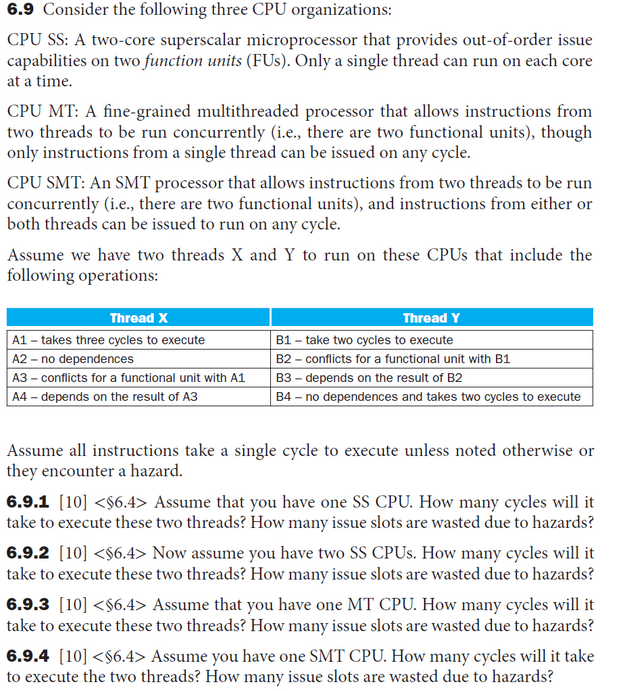
6.9 Consider the following three CPU organizations: CPU SS: A two-core superscalar microprocessor that provides out-of-order issue capabilities on two function units (FUs). Only a single thread can run on each core at a time CPU MT: A fine-grained multithreaded processor that allows instructions from two threads to be run concurrently (i.e., there are two functional units), though only instructions from a single thread can be issued on any cycle CPU SMT: An SMT processor that allows instructions from two threads to be run concurrently (i.e., there are two functional units), and instructions from either or both threads can be issued to run on any cycle Assume we have two threads X and Y to run on these CPUs that include the following operations Thread X Thread Y A1 takes three cycles to execute A2 - no dependences A3-conflicts for a functional unit with A1 A4 - depends on the result of A3 B1 take two cycles to execute B2 conflicts for a functional unit with B1 | B3-depends on the result of B2 B4-no dependences and takes two cycles to execute Assume all instructions take a single cycle to execute unless noted otherwise or they encounter a hazard. 6.9.1 [10] Assume that you have one SS CPU. How many cycles will it take to execute these two threads? How many issue slots are wasted due to hazards? 6.9.2 [10] Now assume you have two SS CPUs. How many cycles will it take to execute these two threads? How many issue slots are wasted due to hazards? 6.9.3 [10]
Step by Step Solution
There are 3 Steps involved in it

Get step-by-step solutions from verified subject matter experts
 Study Help