







Question: Please read the article and answer questions 1 and 2. The Tobacco Companies and Product Safety E D G E O ON THE In June
Please read the article and answer questions 1 and 2.
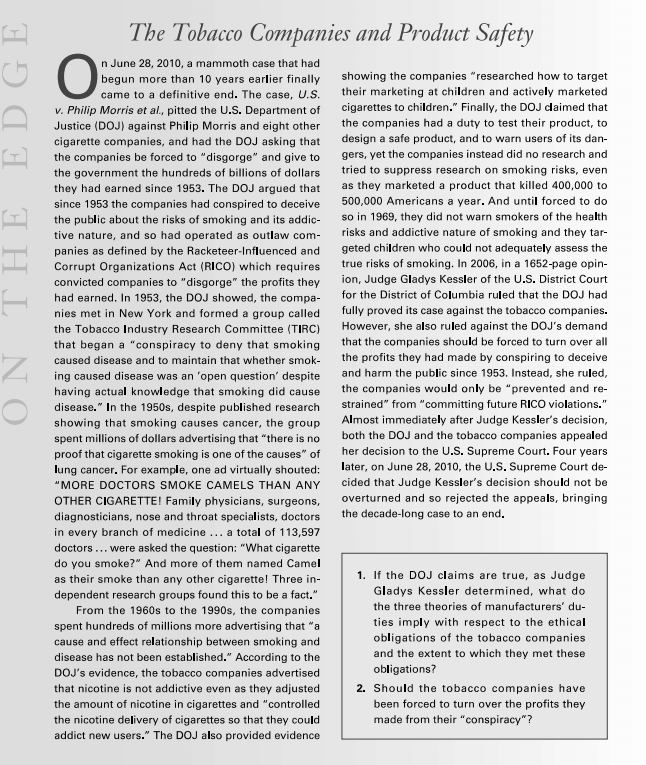
The Tobacco Companies and Product Safety E D G E O ON THE In June 28, 2010, a mammoth case that had begun more than 10 years earlier finally came to a definitive end. The case, U.S. v. Philip Morris et al., pitted the U.S. Department of Justice (DOJ) against Philip Morris and eight other cigarette companies, and had the DOJ asking that the companies be forced to "disgorge" and give to the government the hundreds of billions of dollars they had earned since 1953. The DOJ argued that since 1953 the companies had conspired to deceive the public about the risks of smoking and its addic- tive nature, and so had operated as outlaw com- panies as defined by the Racketeer-Influenced and Corrupt Organizations Act (RICO) which requires convicted companies to "disgorge" the profits they had earned. In 1953, the DOJ showed, the compa- nies met in New York and formed a group called the Tobacco Industry Research Committee (TIRC) that began a "conspiracy to deny that smoking caused disease and to maintain that whether smok- ing caused disease was an 'open question despite having actual knowledge that smoking did cause disease." In the 1950s, despite published research showing that smoking causes cancer, the group spent millions of dollars advertising that "there is no proof that cigarette smoking is one of the causes of lung cancer. For example, one ad virtually shouted: "MORE DOCTORS SMOKE CAMELS THAN ANY OTHER CIGARETTE! Family physicians, surgeons, diagnosticians, nose and throat specialists, doctors in every branch of medicine ... a total of 113,597 doctors ... were asked the question: "What cigarette do you smoke?" And more of them named Camel as their smoke than any other cigarette! Three in- dependent research groups found this to be a fact." From the 1960s to the 1990s, the companies spent hundreds of millions more advertising that "a cause and effect relationship between smoking and disease has not been established. According to the DOJ's evidence, the tobacco companies advertised that nicotine is not addictive even as they adjusted the amount of nicotine in cigarettes and "controlled the nicotine delivery of cigarettes so that they could addict new users." The DOJ also provided evidence showing the companies "researched how to target their marketing at children and actively marketed cigarettes to children. Finally, the DOJ daimed that the companies had a duty to test their product, to design a safe product, and to warn users of its dan- gers, yet the companies instead did no research and tried to suppress research on smoking risks, even as they marketed a product that killed 400,000 to 500,000 Americans a year. And until forced to do so in 1969, they did not warn smokers of the health risks and addictive nature of smoking and they tar- geted children who could not adequately assess the true risks of smoking. In 2006, in a 1652-page opin- ion, Judge Gladys Kessler of the U.S. District Court for the District of Columbia ruled that the DOJ had fully proved its case against the tobacco companies. However, she also ruled against the DOJ's demand that the companies should be forced to turn over all the profits they had made by conspiring to deceive and harm the public since 1953. Instead, she ruled, the companies would only be "prevented and re- strained" from "committing future RICO violations." Almost immediately after Judge Kessler's decision, both the DOJ and the tobacco companies appealed her decision to the U.S. Supreme Court. Four years later, on June 28, 2010, the U.S. Supreme Court de- cided that Judge Kessler's decision should not be overturned and so rejected the appeals, bringing the decade-long case to an end. 1. If the DOJ claims are true, as Judge Gladys Kessler determined, what do the three theories of manufacturers' du- ties imply with respect to the ethical obligations of the tobacco companies and the extent to which they met these obligations? 2. Should the tobacco companies have been forced to turn over the profits they made from their "conspiracy
Step by Step Solution
There are 3 Steps involved in it
1 Expert Approved Answer
Step: 1 Unlock

Question Has Been Solved by an Expert!
Get step-by-step solutions from verified subject matter experts
Step: 2 Unlock
Step: 3 Unlock
 Study Help