Question: please read the article and summarize it. Why the U.S. needs a $15 minimum wage How the Raise the Wage Act would benefit U.S. workers
please read the article and summarize it.
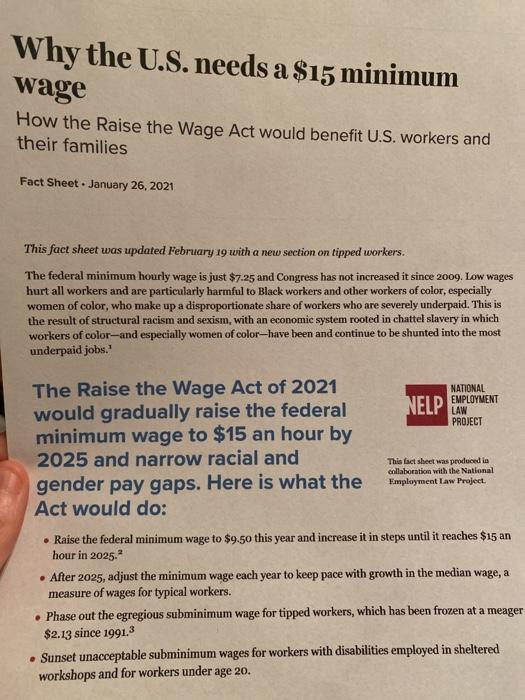
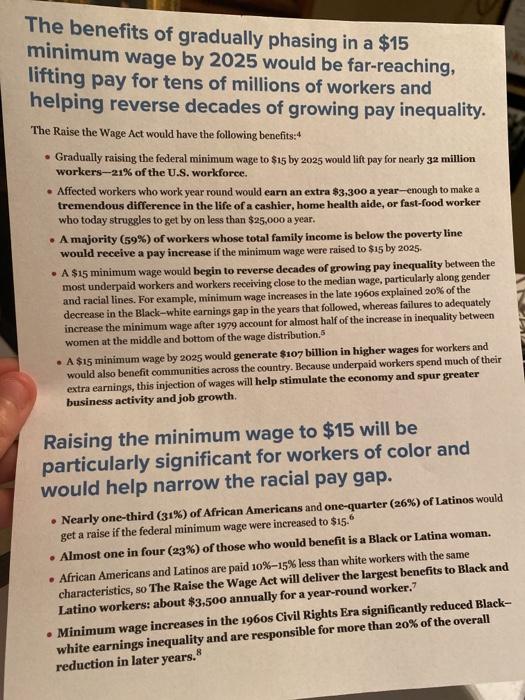
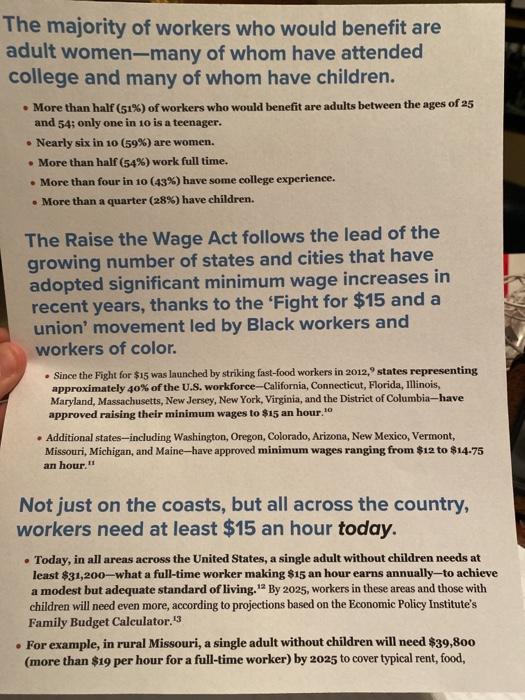
Why the U.S. needs a $15 minimum wage How the Raise the Wage Act would benefit U.S. workers and their families Fact Sheet . January 26, 2021 This fact sheet was updated February 19 with a new section on tipped workers. The federal minimum hourly wage is just $7.25 and Congress has not increased it since 2009. Low wages hurt all workers and are particularly harmful to Black workers and other workers of color, especially women of color, who make up a disproportionate share of workers who are severely underpaid. This is the result of structural racism and sexism, with an economic system rooted in chattel slavery in which workers of color and especially women of color--have been and continue to be shunted into the most underpaid jobs. This fact sheet was produced in collaboration with the National Employment Law Project The Raise the Wage Act of 2021 NATIONAL EMPLOYMENT would gradually raise the federal NELP LAW PROJECT minimum wage to $15 an hour by 2025 and narrow racial and gender pay gaps. Here is what the Act would do: Raise the federal minimum wage to $9.50 this year and increase it in steps until it reaches $15 an hour in 2025." After 2025, adjust the minimum wage each year to keep pace with growth in the median wage, a measure of wages for typical workers. Phase out the egregious subminimum wage for tipped workers, which has been frozen at a meager $2.13 since 1991.3 Sunset unacceptable subminimum wages for workers with disabilities employed in sheltered workshops and for workers under age 20. The benefits of gradually phasing in a $15 minimum wage by 2025 would be far-reaching, lifting pay for tens of millions of workers and helping reverse decades of growing pay inequality. The Raise the Wage Act would have the following benefits: Gradually raising the federal minimum wage to $15 by 2025 would lift pay for nearly 32 million workers--21% of the U.S. workforce. Affected workers who work year round would earn an extra $3,300 a year-enough to make a tremendous difference in the life of a cashier, home health aide, or fast-food worker who today struggles to get by on less than $25,000 a year. A majority (59%) of workers whose total family income is below the poverty line would receive a pay increase if the minimum wage were raised to $15 by 2025. A $15 minimum wage would begin to reverse decades of growing pay inequality between the most underpaid workers and workers receiving close to the median wage, particularly along gender and racial lines. For example, minimum wage increases in the late 1960s explained 20% of the decrease in the Black-white earnings gap in the years that followed, whereas failures to adequately increase the minimum wage after 1979 account for almost half of the increase in inequality between women at the middle and bottom of the wage distribution. A $15 minimum wage by 2025 would generate $107 billion in higher wages for workers and would also benefit communities across the country. Because underpaid workers spend much of their extra earnings, this injection of wages will help stimulate the economy and spur greater business activity and job growth Raising the minimum wage to $15 will be particularly significant for workers of color and would help narrow the racial pay gap. Nearly one-third (31%) of African Americans and one-quarter (26%) of Latinos would get a raise if the federal minimum wage were increased to $15.6 Almost one in four (23%) of those who would benefit is a Black or Latina woman. African Americans and Latinos are paid 10%-15% less than white workers with the same characteristics, so The Raise the Wage Act will deliver the largest benefits to Black and Latino workers: about $3,500 annually for a year-round worker.? Minimum wage increases in the 1960s Civil Rights Era significantly reduced Black- white earnings inequality and are responsible for more than 20% of the overall reduction in later years. 8 The majority of workers who would benefit are adult women-many of whom have attended college and many of whom have children. More than half (51%) of workers who would benefit are adults between the ages of 25 and 54; only one in 10 is a teenager. Nearly six in 10 (59%) are women. More than half (54%) work full time. More than four in 10 (43%) have some college experience. . More than a quarter (28%) have children. The Raise the Wage Act follows the lead of the growing number of states and cities that have adopted significant minimum wage increases in recent years, thanks to the 'Fight for $15 and a union' movement led by Black workers and workers of color. . Since the Fight for $15 was launched by striking fast-food workers in 2012, states representing approximately 40% of the U.S. workforce-California, Connecticut, Florida, Illinois, Maryland, Massachusetts, New Jersey, New York, Virginia, and the District of Columbia-have approved raising their minimum wages to $15 an hour. Additional states--including Washington, Oregon, Colorado, Arizona, New Mexico, Vermont, Missouri, Michigan, and Maine-have approved minimum wages ranging from $12 to $14.75 an hour." Not just on the coasts, but all across the country, workers need at least $15 an hour today. . Today, in all areas across the United States, a single adult without children needs at least $31,200-what a full-time worker making $15 an hour earns annually-to achieve a modest but adequate standard of living. By 2025, workers in these areas and those with children will need even more, according to projections based on the Economic Policy Institute's Family Budget Calculator. 3 . For example, in rural Missouri, a single adult without children will need $39,800 (more than $19 per hour for a full-time worker) by 2025 to cover typical rent, food









 Study Help