Question: Please read the question Question: Give one example of something a teacher can do to support a child's second language development based upon Output theories.
Please read the question
Question: Give one example of something a teacher can do to support a child's second language development based upon Output theories.
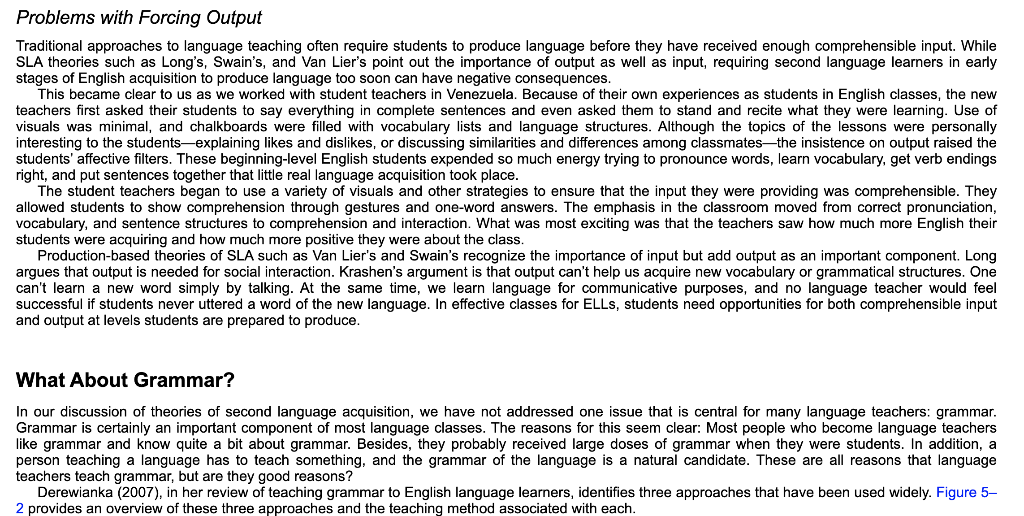

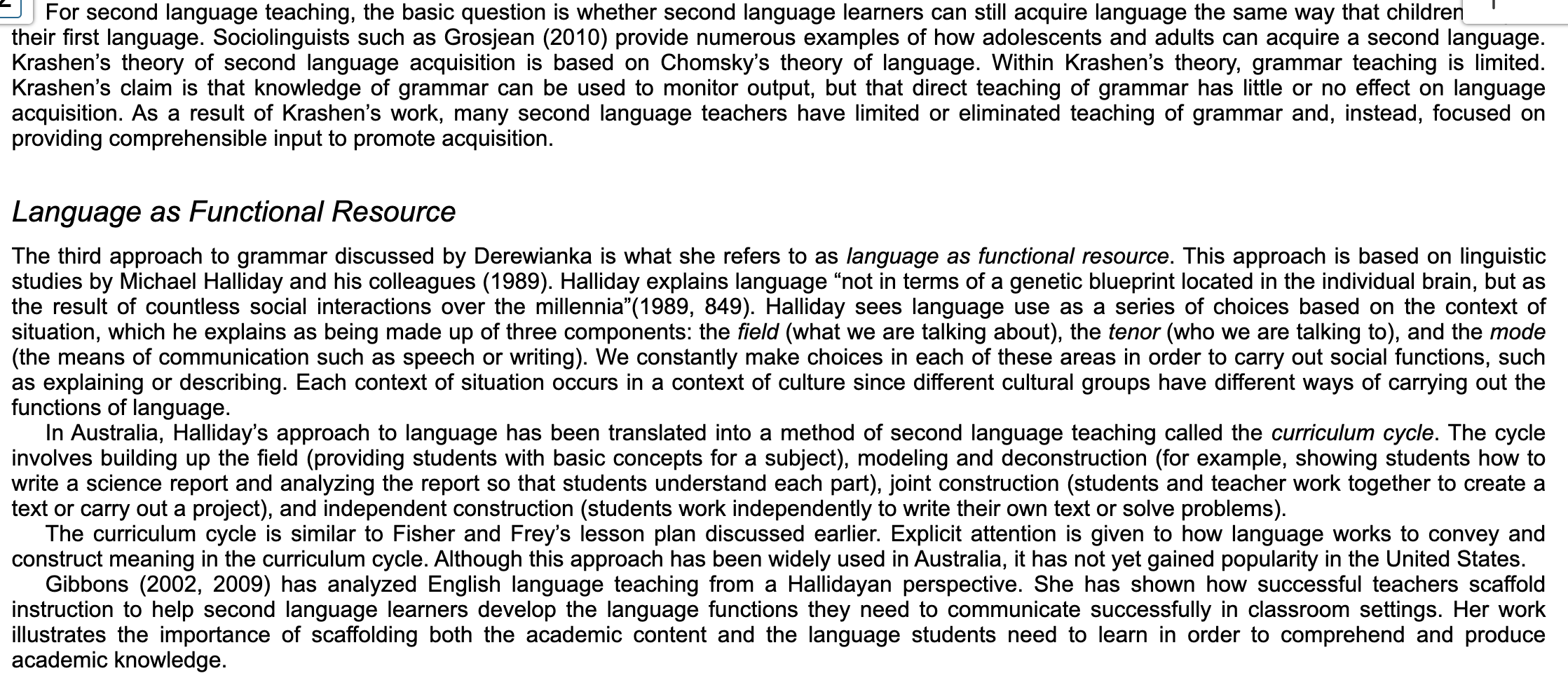
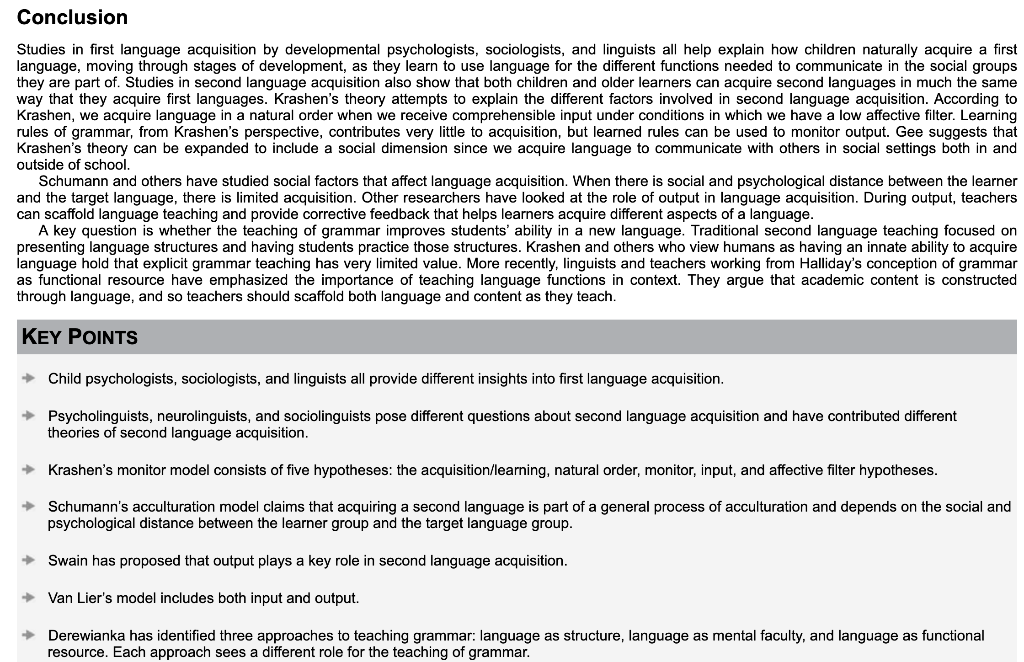
Problems with Forcing Output Traditional approaches to language teaching often require students to produce language before they have received enough comprehensible input. While SLA theories such as Long's, Swain's, and Van Lier's point out the importance of output as well as input, requiring second language learners in early stages of English acquisition to produce language too soon can have negative consequences. This became clear to us as we worked with student teachers in Venezuela. Because of their own experiences as students in English classes, the new teachers first asked their students to say everything in complete sentences and even asked them to stand and recite what they were learning. Use of visuals was minimal, and chalkboards were filled with vocabulary lists and language structures. Although the topics of the lessons were personally interesting to the studentsexplaining likes and dislikes, or discussing similarities and differences among classmatesthe insistence on output raised the students' affective filters. These beginning-level right, and put sentences together that little reali glish students expended so much energy trying to pronounce words, learn vocabulary, get verb endings little real language acquisition The student teachers began to use a variety of visuals and other strategies to ensure that the input they were providing was comprehensible. They allowed students to show comprehension through gestures and one-word answers. The emphasis in the classroom moved from correct pronunciation, vocabulary, and sentence structures to comprehension and interaction. What was most exciting was that the teachers saw how much more English their students were acquiring and how much more positive they were about the class. Production-based theories of SLA such as Van Lier's and Swain's recognize the importance of input but add output as an important component. Long argues that output is needed for social interaction. Krashen's argument is that output can't help us acquire new vocabulary or grammatical structures. One can't learn a new word simply by talking. At the same time, we learn language for communicative purposes, and no language teacher would feel successful if students never uttered a word of the new language. In effective classes for ELLs, students need opportunities for both comprehensible input and output at levels students are prepared to produce. place. a What About Grammar? In our discussion of theories of second language acquisition, we have not addressed one issue that is central for many language teachers: grammar. Grammar is certainly an important component of most language classes. The reasons for this seem clear: Most people who become language teachers like grammar and know quite a bit about grammar. Besides, they probably received large doses of grammar when they were students. In addition, a person teaching a language has to teach something, and the grammar of the language is a natural candidate. These are all reasons that language teachers teach grammar, but are they good reasons? Derewianka (2007), in her review of teaching grammar to English language learners, identifies three approaches that have been used widely. Figure 5 2 provides an overview of these three approaches and the teaching method associated with each. 9 Approach Teaching Method + - Language as Structure Teach grammar rules explicitly and have students practice with decontextualized exercises. Language as Mental Faculty Teach only a few grammar rules that students can use to monitor output. Language as Functional Resource Following a curriculum cycle, teach grammar forms and functions through modeling, joint con- struction, and individual practice. FIGURE 5-2. Three approaches to grammar teaching for ELLs (based on Derewianka 2007) Language as Structure The first approach, language as structure, involves identifying different parts of speech, such as nouns and verbs, and the rules for combining them into sentences. As Derewianka writes, Traditionally grammar in the ELT [English language teaching) field has been conceived of in terms of identifying the parts of speech and the rules for combining them into structures" (2007, 844). Structures refers to subjects, predicates, and other parts of a sentence. Traditional approaches to second language teaching, such as the grammar translation method, use this approach. This method consists of explicit teaching of rules followed by decontextualized exercises designed to give students practice with the rule. For example, students might learn the proper forms for the present perfect tense in English and then be given an exercise in which they convert past-tense sentences, such as "He studied English" to present perfect, "He has studied English." ish Derewianka comments that a traditional approach to teaching grammar is still the most widely used model of English language teaching. However, this applies primarily to teaching English in countries where English is not the native language. Traditional approaches to grammar teaching result in students learning about the language (they can tell you how to form the present perfect tense), but this approach has not been shown to help students develop the ability to communicate in the language. For that reason, in English as a second language (as opposed to English as a foreign language) and bilingual classes, traditional grammar is not the basis for the language teaching method. Although traditional grammar-based approaches to teaching a second language are outdated and are not supported by research, within more current second language teaching methods, some aspects of aram grammar The question is whether the rules should be taught explicitly. Continue to be taught. That is, there is still what Long (2001) refers to as a "focus on form." incidentally for ample , looked at four ways of presenting form-focused instruction. One way is to structure the input. "This option asks learners to , process input that has been specially contrived to induce comprehension of the target structure"(44). Learners are not required to produce the structure, but they are exposed to large amounts of the structure and asked to attend to it. For example, students often say things like "I am boring" when they mean "I am bored," so structured input might focus on the difference between these two grammatical forms. For example, the teacher might give a series of sentences such as "The book is boring, so I am bored." A second possibility is explicit instruction. Such instruction can be direct (the teacher teaches the rule and the students must practice it) or indirect. In indirect explicit instruction, students look at some sample of language and try to figure out the rule. That is, explicit instruction can be deductive or inductive. Explicit instruction is designed to raise students' consciousness of the grammatical form. A third approach to incorporate grammar into second language teaching is what Ellis calls production practice. This approach involves students in practicing certain grammatical forms. For example, a student might do a worksheet in which the task is to put the words in, on, or at into the appropriate Ellis (1998) For second language teaching, the basic question is whether second language learners can still acquire language the same way that children their first language. Sociolinguists such as Grosjean (2010) provide numerous examples of how adolescents and adults can acquire a second language. Krashen's theory of second language acquisition is based on Chomsky's theory of language. Within Krashen's theory, grammar teaching is limited. Krashen's claim is that knowledge of grammar can be used to monitor output, but that direct teaching of grammar has little or no effect on language acquisition. As a result of Krashen's work, many second language teachers have limited or eliminated teaching of grammar and, instead, focused on providing comprehensible input to promote acquisition. Language as Functional Resource The third approach to grammar discussed by Derewianka is what she refers to as language as functional resource. This approach is based on linguistic studies by Michael Halliday and his colleagues (1989). Halliday explains language "not in terms of a genetic blueprint located in the individual brain, but as the result of countless social interactions over the millennia" (1989, 849). Halliday sees language use as a series of choices based on the context of situation, which he explains as being made up of three components: the field (what we are talking about), the tenor (who we are talking to), and the mode (the means of communication such as speech or writing). We constantly make choices in each of these areas in order to carry out social functions, such as explaining or describing. Each context of situation occurs in a context of culture since different cultural groups have different ways of carrying out the functions of language. In Australia, Halliday's approach to language has been translated into a method of second language teaching called the curriculum cycle. The cycle involves building up the field (providing students with basic concepts for a subject), modeling and deconstruction (for example, showing students how to write a science report and analyzing the report so that students understand each part), joint construction (students and teacher work together to create a text or carry out a project), and independent construction (students work independently to write their own text or solve problems). The curriculum cycle is similar to Fisher and Frey's lesson plan discussed earlier. Explicit attention is given to how language works to convey and construct meaning in the curriculum cycle. Although this approach has been widely used in Australia, it has not yet gained popularity in the United States. Gibbons (2002, 2009) has analyzed English language teaching from a Hallidayan perspective. She has shown how successful teachers scaffold instruction to help second language learners develop the language functions they need to communicate successfully in classroom settings. Her work illustrates the importance of scaffolding both the academic content and the language students need to learn in order to comprehend and produce academic knowledge. Conclusion Studies in first language acquisition by developmental psychologists, sociologists, and linguists all help explain how children naturally acquire a first language, moving through stages of development, as they learn to use language for the different functions needed to communicate in the social groups they are part of. Studies in second language acquisition also show that both children and older learners can acquire second languages in much the same way that they acquire first languages. Krashen's theory attempts to explain the different factors involved in second language acquisition. According to Krashen, we acquire language in a natural order when we receive comprehensible input under conditions in which we have a low affective filter. Learning rules of grammar, from Krashen's perspective, contributes very little to acquisition, but learned rules can be used to monitor output. Gee suggests that Krashen's theory can be expanded to include a social dimension since we acquire language to communicate with others in social settings both in and outside of school. Schumann and others have studied social factors that affect language acquisition. When there is social and psychological distance between the learner and the target language, there is limited acquisition. Other researchers have looked at the role of output in language acquisition. During output, teachers can scaffold language teaching and provide corrective feedback that helps learners acquire different aspects of a language. A key question is whether the teaching of grammar improves students' ability in a new language. Traditional second language teaching focused on presenting language structures and having students practice those structures. Krashen and others who view humans as having an innate ability to acquire language hold that explicit grammar teaching has very limited value. More recently, linguists and teachers working from Halliday's conception of grammar as functional resource have emphasized the importance of teaching language functions in context. They argue that academic content is constructed through language, and so teachers should scaffold both language and content as they teach. KEY POINTS Child psychologists, sociologists, and linguists all provide different insights into first language acquisition. Psycholinguists, neurolinguists, and sociolinguists pose different questions about second language acquisition and have contributed different theories of second language acquisition. Krashen's monitor model consists of five hypotheses: the acquisition/learning, natural order, monitor, input, and affective filter hypotheses. Schumann's acculturation model claims that acquiring a second language is part of a general process of acculturation and depends on the social and psychological distance between the learner group and the target language group. Swain has proposed that output plays a key role in second language acquisition. Van Lier's model includes both input and output. Derewianka has identified three approaches to teaching grammar: language as structure, language as mental faculty, and language as functional resource. Each approach sees a different role for the teaching of grammar









 Study Help