



Question: Please read these paragraphs to answer the questions I'll up vote your answer but it must be appropriate. Thank You... No Time to Be Nice
Please read these paragraphs to answer the questions
I'll up vote your answer but it must be appropriate. Thank You...
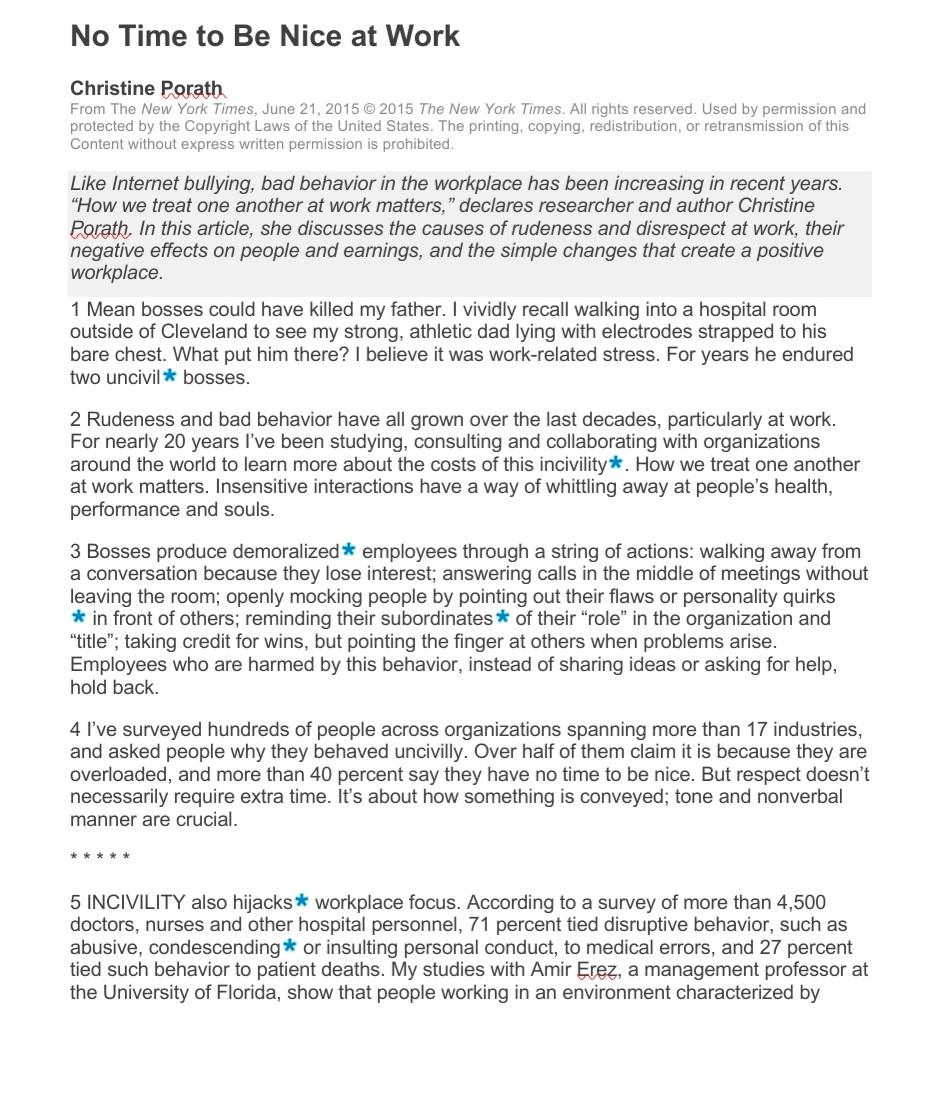
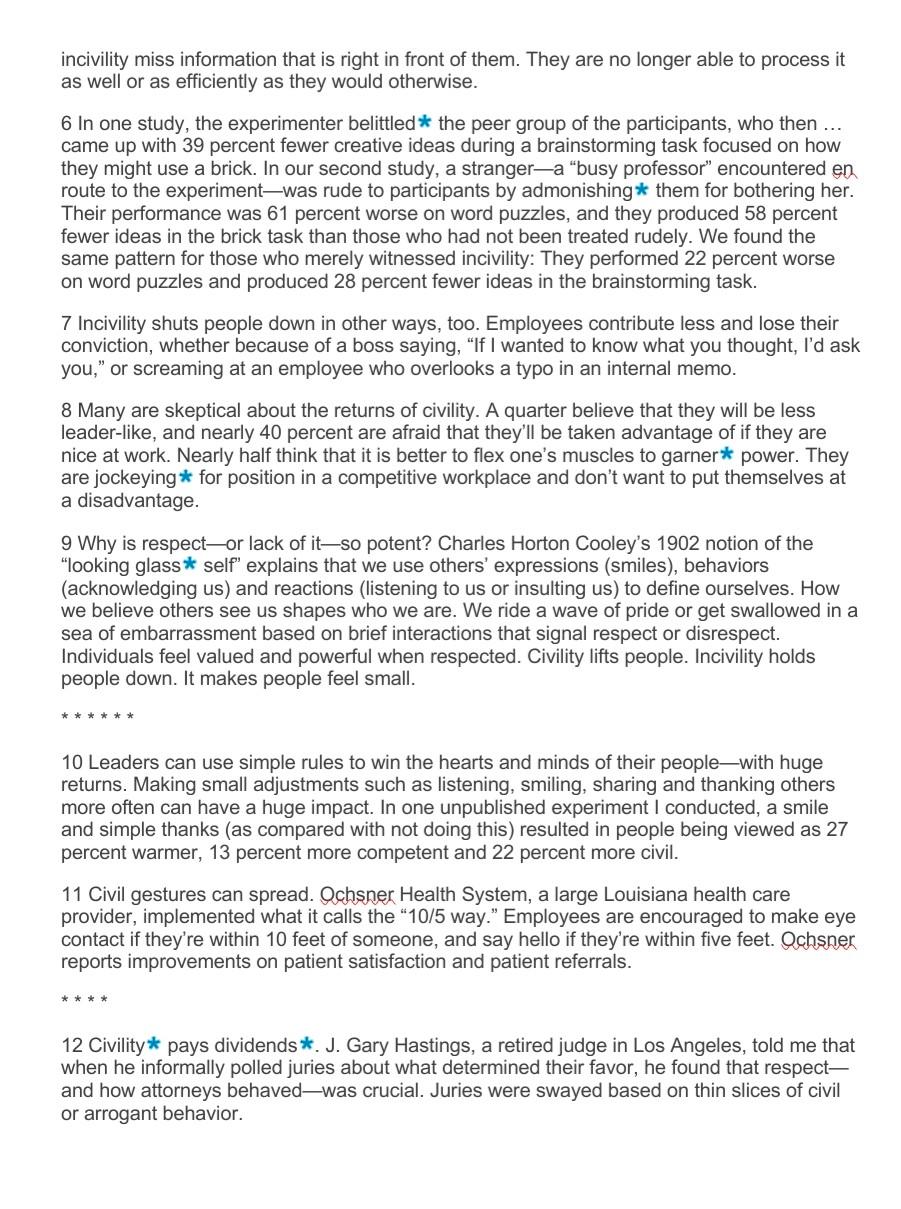
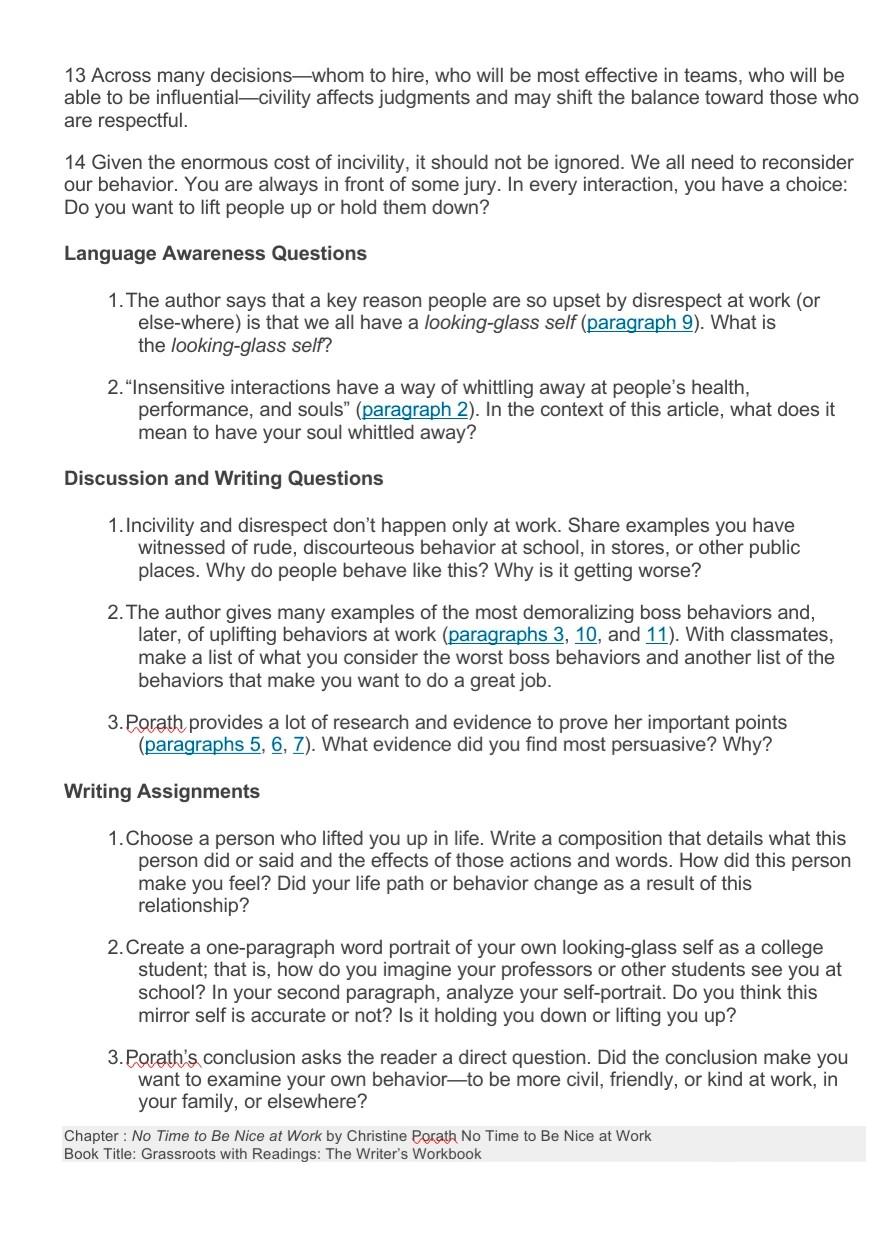
No Time to Be Nice at Work Christine Porath From The New York Times, June 21, 2015 2015 The New York Times. All rights reserved. Used by permission and protected by the Copyright Laws of the United States. The printing, copying, redistribution, or retransmission of this Content without express written permission is prohibited. Like Internet bullying, bad behavior in the workplace has been increasing in recent years. "How we treat one another at work matters," declares researcher and author Christine Porath. In this article, she discusses the causes of rudeness and disrespect at work, their negative effects on people and earnings, and the simple changes that create a positive workplace. 1 Mean bosses could have killed my father. I vividly recall walking into a hospital room outside of Cleveland to see my strong, athletic dad lying with electrodes strapped to his bare chest. What put him there? I believe it was work-related stress. For years he endured two uncivil* bosses. 2 Rudeness and bad behavior have all grown over the last decades, particularly at work. For nearly 20 years I've been studying, consulting and collaborating with organizations around the world to learn more about the costs of this incivility*. How we treat one another at work matters. Insensitive interactions have a way of whittling away at people's health, performance and souls. 3 Bosses produce demoralized* employees through a string of actions: walking away from a conversation because they lose interest; answering calls in the middle of meetings without leaving the room; openly mocking people by pointing out their flaws or personality quirks * in front of others; reminding their subordinates of their role" in the organization and "title"; taking credit for wins, but pointing the finger at others when problems arise. Employees who are harmed by this behavior, instead of sharing ideas or asking for help, hold back. 4 I've surveyed hundreds of people across organizations spanning more than 17 industries, and asked people why they behaved uncivilly. Over half of them claim it is because they are overloaded, and more than 40 percent say they have no time to be nice. But respect doesn't necessarily require extra time. It's about how something is conveyed; tone and nonverbal manner are crucial. ***** 5 INCIVILITY also hijacks* workplace focus. According to a survey of more than 4,500 doctors, nurses and other hospital personnel, 71 percent tied disruptive behavior, such as abusive, condescending* or insulting personal conduct, to medical errors, and 27 percent tied such behavior to patient deaths. My studies with Amir Erez, a management professor at the University of Florida, show that people working in an environment characterized by incivility miss information that is right in front of them. They are no longer able to process it as well or as efficiently as they would otherwise. 6 In one study, the experimenter belittled* the peer group of the participants, who then ... came up with 39 percent fewer creative ideas during a brainstorming task focused on how they might use a brick. In our second study, a strangera "busy professor" encountered en route to the experimentwas rude to participants by admonishing them for bothering her. Their performance was 61 percent worse on word puzzles, and they produced 58 percent fewer ideas in the brick task than those who had not been treated rudely. We found the same pattern for those who merely witnessed incivility: They performed 22 percent worse on word puzzles and produced 28 percent fewer ideas in the brainstorming task. 7 Incivility shuts people down in other ways, too. Employees contribute less and lose their conviction, whether because of a boss saying, "If I wanted to know what you thought, I'd ask you," or screaming at an employee who overlooks a typo in an internal memo. 8 Many are skeptical about the returns of civility. A quarter believe that they will be less leader-like, and nearly 40 percent are afraid that they'll be taken advantage of if they are nice at work. Nearly half think that it is better to flex one's muscles to garner* power. They are jockeying* for position in a competitive workplace and don't want to put themselves at a disadvantage. 9 Why is respect-or lack of itso potent? Charles Horton Cooley's 1902 notion of the "looking glass* self" explains that we use others' expressions (smiles), behaviors (acknowledging us) and reactions (listening to us or insulting us) to define ourselves. How we believe others see us shapes who we are. We ride a wave of pride or get swallowed in a sea of embarrassment based on brief interactions that signal respect or disrespect. Individuals feel valued and powerful when respected. Civility lifts people. Incivility holds people down. It makes people feel small. 10 Leaders can use simple rules to win the hearts and minds of their peoplewith huge returns. Making small adjustments such as listening, smiling, sharing and thanking others more often can have a huge impact. In one unpublished experiment I conducted, a smile and simple thanks (as compared with not doing this) resulted in people being viewed as 27 percent warmer, 13 percent more competent and 22 percent more civil. 11 Civil gestures can spread. Ochsner Health System, a large Louisiana health care provider, implemented what it calls the 10/5 way." Employees are encouraged to make eye contact if they're within 10 feet of someone, and say hello if they're within five feet. Ochsner reports improvements on patient satisfaction and patient referrals. 12 Civility * pays dividends*. J. Gary Hastings, a retired judge in Los Angeles, told me that when he informally polled juries about what determined their favor, he found that respect- and how attorneys behavedwas crucial. Juries were swayed based on thin slices of civil or arrogant behavior. 13 Across many decisionswhom to hire, who will be most effective in teams, who will be able to be influential-civility affects judgments and may shift the balance toward those who are respectful. 14 Given the enormous cost of incivility, it should not be ignored. We all need to reconsider our behavior. You are always in front of some jury. In every interaction, you have a choice: Do you want to lift people up or hold them down? Language Awareness Questions 1. The author says that a key reason people are so upset by disrespect at work (or else-where) is that we all have a looking-glass self (paragraph 9). What is the looking-glass self? 2. "Insensitive interactions have a way of whittling away at people's health, performance, and souls" (paragraph 2). In the context of this article, what does it mean to have your soul whittled away? Discussion and Writing Questions 1. Incivility and disrespect don't happen only at work. Share examples you have witnessed of rude, discourteous behavior at school, in stores, or other public places. Why do people behave like this? Why is it getting worse? 2. The author gives many examples of the most demoralizing boss behaviors and, later, of uplifting behaviors at work (paragraphs 3, 10, and 11). With classmates, make a list of what you consider the worst boss behaviors and another list of the behaviors that make you want to do a great job. 3. Porath provides a lot of research and evidence to prove her important points (paragraphs 5, 6, 7). What evidence did you find most persuasive? Why? Writing Assignments 1. Choose a person who lifted you up in life. Write a composition that details what this person did or said and the effects of those actions and words. How did this person make you feel? Did your life path or behavior change as a result of this relationship? 2. Create a one-paragraph word portrait of your own looking-glass self as a college student; that is, how do you imagine your professors or other students see you at school? In your second paragraph, analyze your self-portrait. Do you think this mirror self is accurate or not? Is it holding you down or lifting you up? 3.Porath's conclusion asks the reader a direct question. Did the conclusion make you want to examine your own behaviorto be more civil, friendly, or kind at work, in your family, or elsewhere? Chapter : No Time to Be Nice at Work by Christine Porath No Time to Be Nice at Work Book Title: Grassroots with Readings: The Writer's WorkbookStep by Step Solution
There are 3 Steps involved in it
1 Expert Approved Answer
Step: 1 Unlock

Question Has Been Solved by an Expert!
Get step-by-step solutions from verified subject matter experts
Step: 2 Unlock
Step: 3 Unlock