







Question: Please show all work! This problem considers instruction set architectures for three architecture styl accumulator architecture, a stack architecture, and a two-address load-store architecture. (You
 Please show all work!
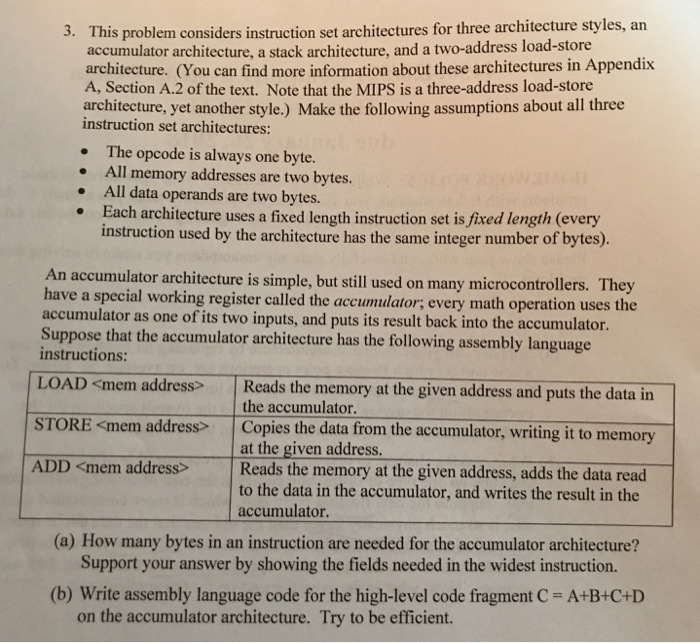
 This problem considers instruction set architectures for three architecture styl accumulator architecture, a stack architecture, and a two-address load-store architecture. (You can find more information about these architectures in Appendix A, Section A.2 of the text. Note that the MIPS is a three-address load-store architecture, yet another style.) Make the following assumptions about all three instruction set architectures: 3. es, an . The opcode is always one byte. . All memory addresses are two bytes All data operands are two bytes. Each architecture uses a fixed length instruction set is fixed length (every instruction used by the architecture has the same integer number of bytes). . An accumulator architecture is simple, but still used on many microcontrollers. They accumulator as one of its two inputs, and puts its result back into the accumulator. have a special working register called the accumulator; every math operation uses the Suppose that the accumulator architecture has the following assembly language instructions: LOAD
Step by Step Solution
There are 3 Steps involved in it

Get step-by-step solutions from verified subject matter experts
 Study Help