







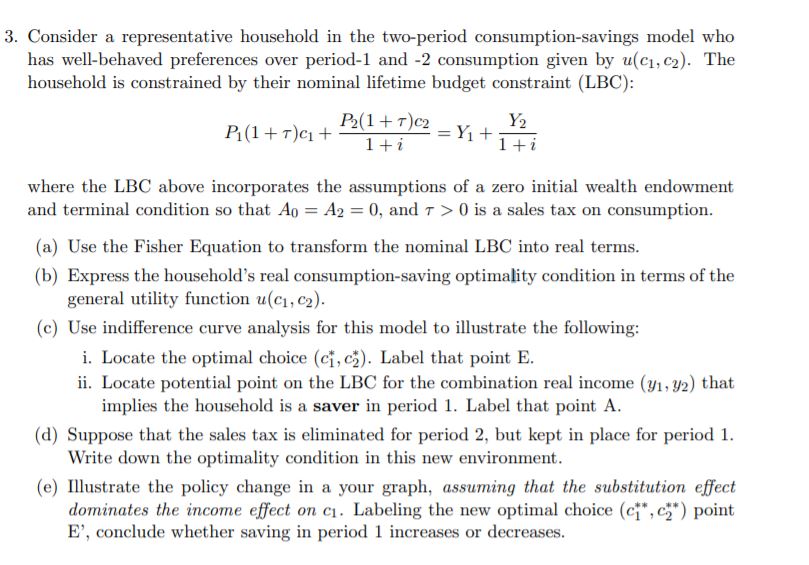
Question: Please solve 3. Consider a representative household in the two-period consumption-savings model who has well-behaved preferences over period-1 and -2 consumption given by n(c1,c2]. The
Please solve
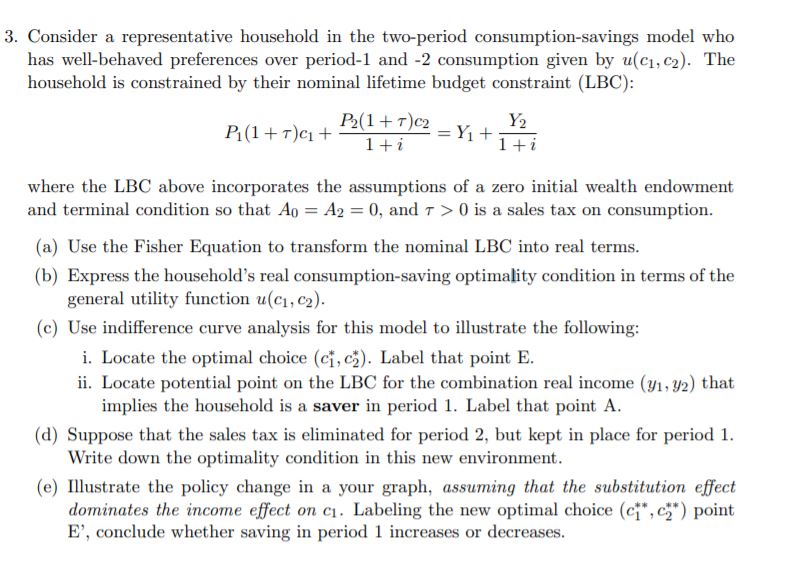
3. Consider a representative household in the two-period consumption-savings model who has well-behaved preferences over period-1 and -2 consumption given by n(c1,c2]. The household is constrained by their nominal lifetime budget constraint (LEG): P2{1 +T}t32 Y2 : Y 1+i 1+1+t P1(1 + lm + where the LED above incorporates the assumptions of a zero initial wealth endowment and terminal condition so that A0 = A2 = D, and 1' 3} {l is a sales tax on consumption. {a} Use the Fisher Equation to transform the nominal LBC into real terms. {h} Express the household's real consumption-saving optimality condition in terms of the general utility function Mn. (:2). [c] Use indifference curve analysis for this model to illustrate the following: 1. Locate the optimal choice {cic}. Label that point E. ii. Locate potential point on the LBC for the combination real income (yl, yg] that implies the household is a sewer in period 1. Label that point A. [d] Suppose that the sales tax is eliminated for period 2, but kept in place for period 1. Write down the optimality condition in this new environment. (e) illustrate the policy change in a your graph. assuming that the substitution effect dominates the income effect on c1. Labeling the new optimal choice (or, c?) point E', conclude whether saving in period 1 increases or decreases
Step by Step Solution
There are 3 Steps involved in it

Get step-by-step solutions from verified subject matter experts
 Study Help