







Question: please someone help me to answer part b The effect of temperature on two different reactions rate constants were graphed in the Arrhenius plots shown
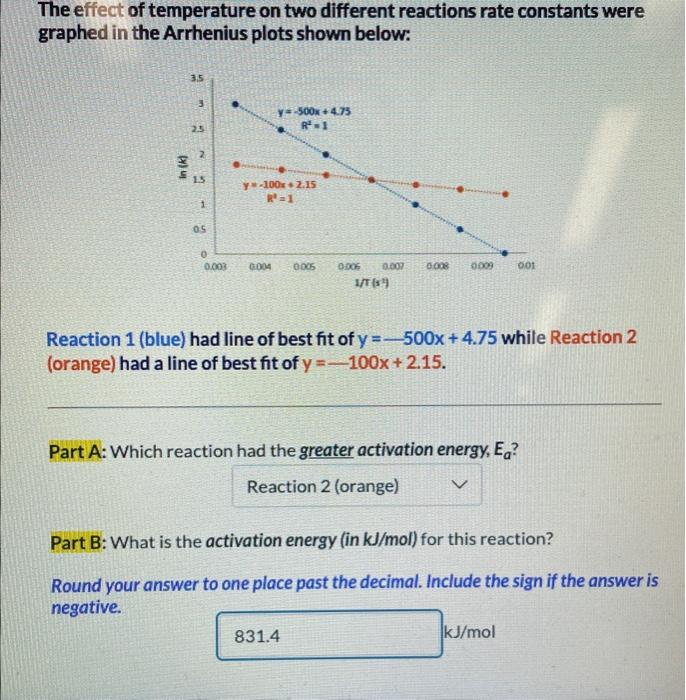
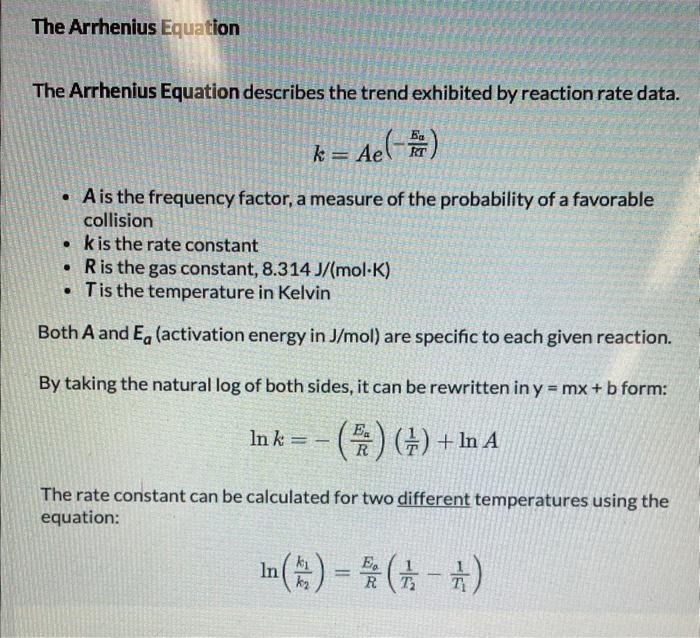
The effect of temperature on two different reactions rate constants were graphed in the Arrhenius plots shown below: Reaction 1 (blue) had line of best fit of y=500x+4.75 while Reaction 2 (orange) had a line of best fit of y=100x+2.15. Part A: Which reaction had the greater activation energy, Ea ? Part B: What is the activation energy (in kJ/mol ) for this reaction? Round your answer to one place past the decimal. Include the sign if the answer is negative. The Arrhenius Equation The Arrhenius Equation describes the trend exhibited by reaction rate data. k=Ae(RTEa) - A is the frequency factor, a measure of the probability of a favorable collision - k is the rate constant - R is the gas constant, 8.314J/(molK) - T is the temperature in Kelvin Both A and Ea (activation energy in J/mol ) are specific to each given reaction. By taking the natural log of both sides, it can be rewritten in y=mx+b form: lnk=(REa)(T1)+lnA The rate constant can be calculated for two different temperatures using the equation: ln(k2k1)=REa(T21T11)
Step by Step Solution
There are 3 Steps involved in it

Get step-by-step solutions from verified subject matter experts
 Study Help