



Question: Please thoroughly explain how you got the answers for these problems! (3-5) A parallel plate capacitor with plates of area A and plate separation dis
Please thoroughly explain how you got the answers for these problems!
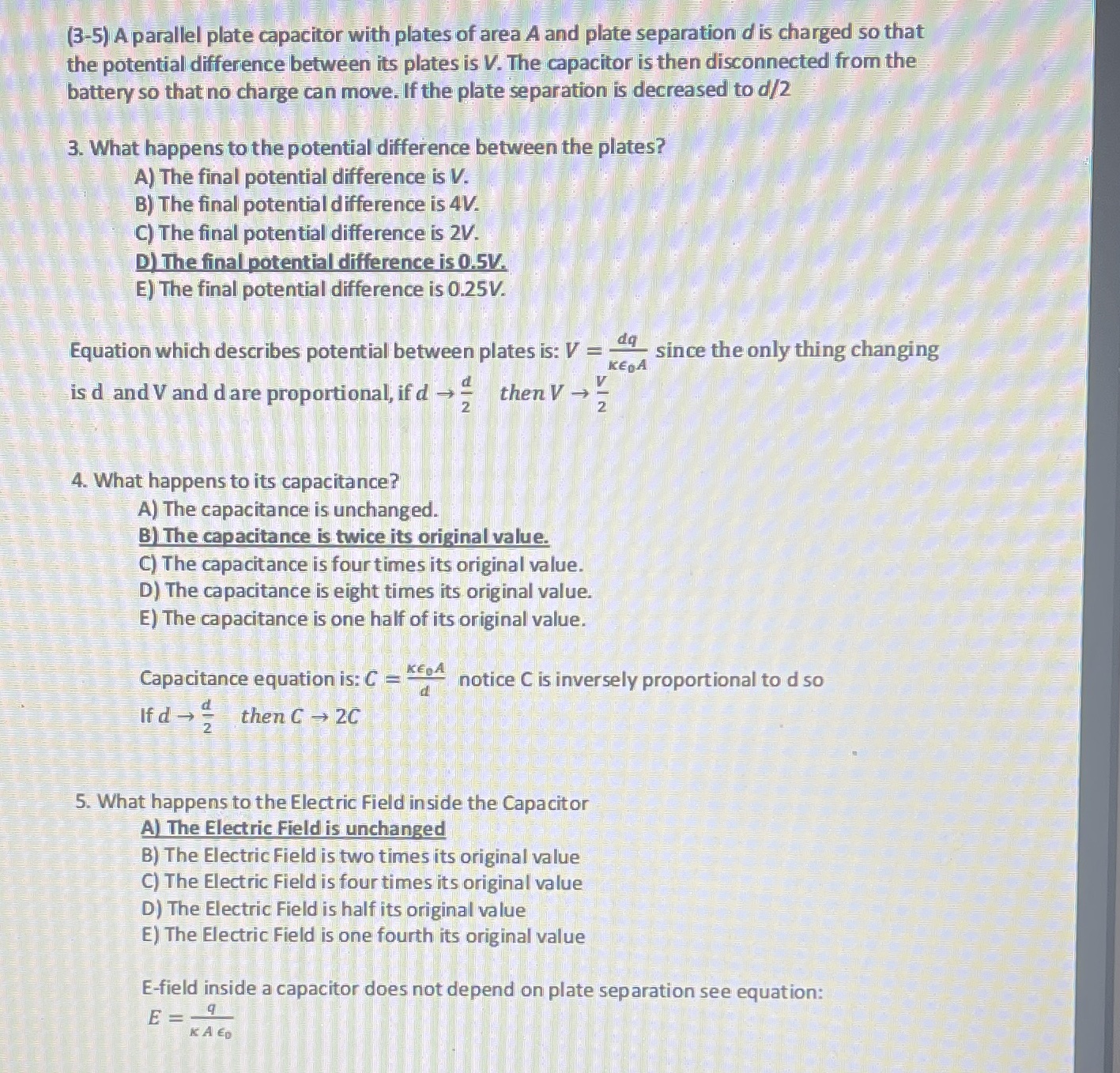
(3-5) A parallel plate capacitor with plates of area A and plate separation dis charged so that the potential difference between its plates is V. The capacitor is then disconnected from the battery so that no charge can move. If the plate separation is decreased to d/2 3. What happens to the potential difference between the plates? A) The final potential difference is V. B) The final potential difference is 4V. C) The final potential difference is 2V. D) The final potential difference is 0.5V. E) The final potential difference is 0.25V. Equation which describes potential between plates is: V = - KESA "" since the only thing changing is d and V and dare proportional, ifd - - then V _ 4. What happens to its capacitance? A) The capacitance is unchanged. B) The capacitance is twice its original value. C) The capacitance is four times its original value. D) The capacitance is eight times its original value. E) The capacitance is one half of its original value. Capacitance equation is: C = $5.4 many notice C is inversely proportional to d so Ifd - then C - 20 5. What happens to the Electric Field inside the Capacitor A) The Electric Field is unchanged B) The Electric Field is two times its original value C) The Electric Field is four times its original value D) The Electric Field is half its original value E) The Electric Field is one fourth its original value E-field inside a capacitor does not depend on plate separation see equation: E= = KAED
Step by Step Solution
There are 3 Steps involved in it

Get step-by-step solutions from verified subject matter experts