Question: PLEASE TYPE!! PLEASE TYPE!! PLEASE ANSWER THIS IF YOURE A REAL EXPERT IF U CANT ANSWER IT ATLEAST SAY IT IN THE COMMENT SO I
PLEASE TYPE!! PLEASE TYPE!! PLEASE ANSWER THIS IF YOURE A REAL EXPERT IF U CANT ANSWER IT ATLEAST SAY IT IN THE COMMENT SO I DONT WAIT FOR NOTHING
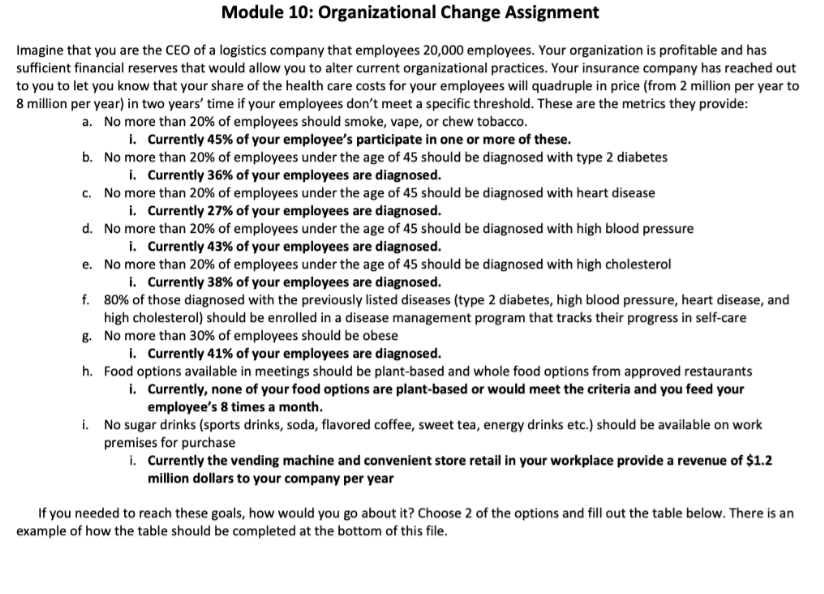
QUESTIONS:
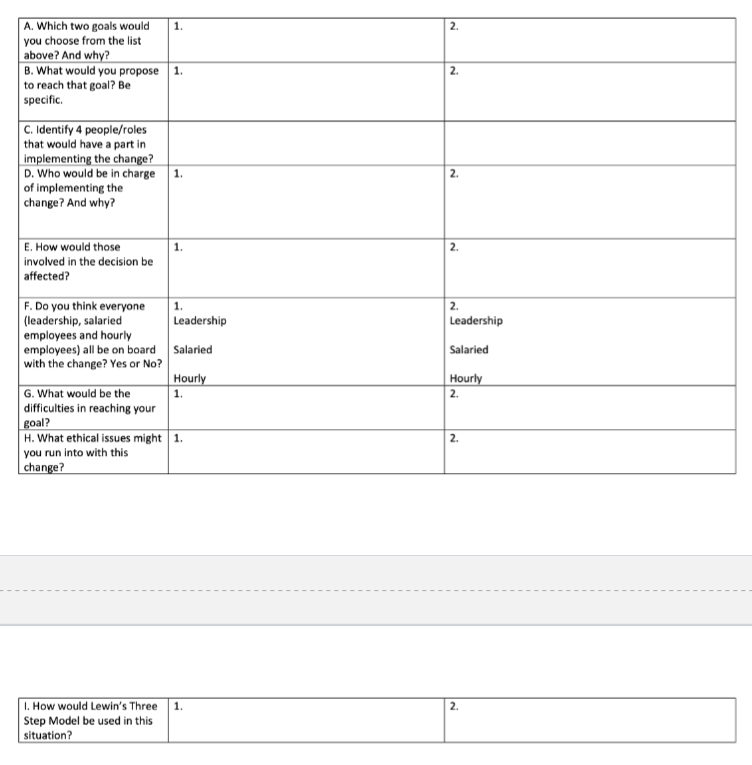
example of what the answer should look like:
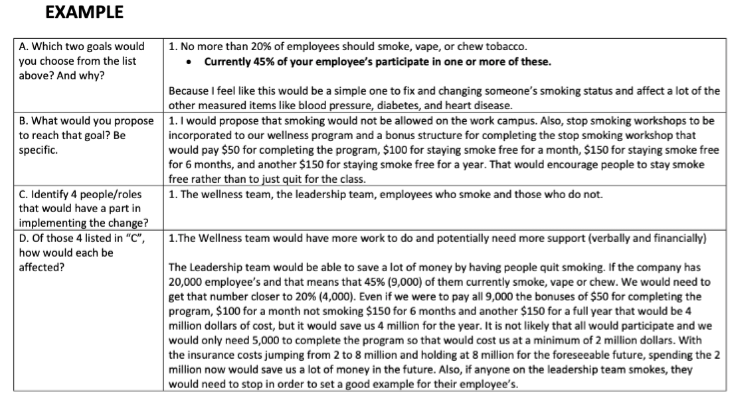
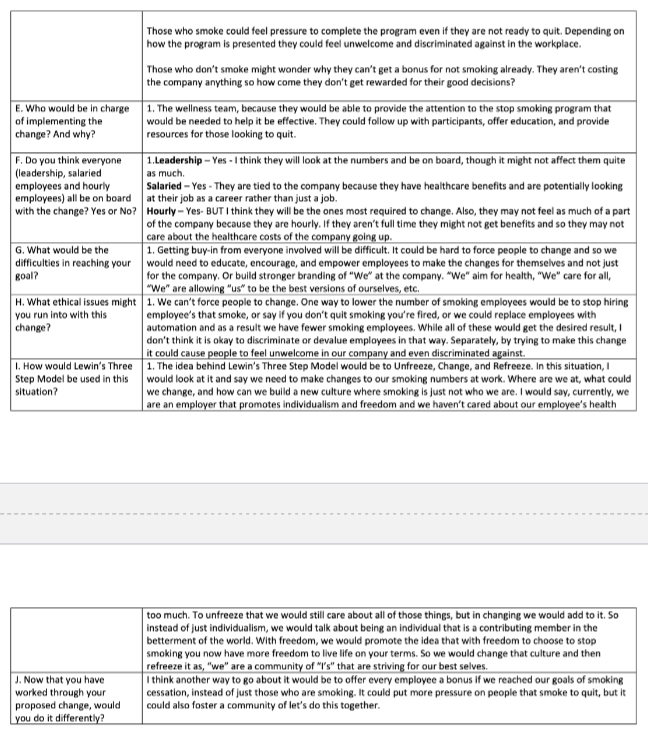
Module 10: Organizational Change Assignment Imagine that you are the CEO of a logistics company that employees 20,000 employees. Your organization is profitable and has sufficient financial reserves that would allow you to alter current organizational practices. Your insurance company has reached out to you to let you know that your share of the health care costs for your employees will quadruple in price (from 2 million per year to 8 million per year) in two years' time if your employees don't meet a specific threshold. These are the metrics they provide: a. No more than 20% of employees should smoke, vape, or chew tobacco. i. Currently 45% of your employee's participate in one or more of these. b. No more than 20% of employees under the age of 45 should be diagnosed with type 2 diabetes i. Currently 36% of your employees are diagnosed. C. No more than 20% of employees under the age of 45 should be diagnosed with heart disease i. Currently 27% of your employees are diagnosed. d. No more than 20% of employees under the age of 45 should be diagnosed with high blood pressure i. Currently 43% of your employees are diagnosed. e. No more than 20% of employees under the age of 45 should be diagnosed with high cholesterol i. Currently 38% of your employees are diagnosed. f. 80% of those diagnosed with the previously listed diseases (type 2 diabetes, high blood pressure, heart disease, and high cholesterol) should be enrolled in a disease management program that tracks their progress in self-care g. No more than 30% of employees should be obese i. Currently 41% of your employees are diagnosed. h. Food options available in meetings should be plant-based and whole food options from approved restaurants i. Currently, none of your food options are plant-based or would meet the criteria and you feed your employee's 8 times a month. i. No sugar drinks (sports drinks, soda, flavored coffee, sweet tea, energy drinks etc.) should be available on work premises for purchase i. Currently the vending machine and convenient store retail in your workplace provide a revenue of $1.2 million dollars to your company per year If you needed to reach these goals, how would you go about it? Choose 2 of the options and fill out the table below. There is an example of how the table should be completed at the bottom of this file. 2. A. Which two goals would 1. you choose from the list above? And why? B. What would you propose 1. to reach that goal? Be specific 2. . C. Identify 4 people/roles that would have a part in implementing the change? D. Who would be in charge 1. of implementing the change? And why? 2. 1. 2. E. How would those involved in the decision be affected? 2 Leadership Salaried F. Do you think everyone 1. (leadership, salaried Leadership employees and hourly employees) all be on board Salaried with the change? Yes or No? Hourly G. What would be the 1. difficulties in reaching your goal? H. What ethical issues might 1. you run into with this change? Hourly 2. 2. . 1. 2. 1. How would Lewin's Three Step Model be used in this situation? EXAMPLE A. Which two goals would 1. No more than 20% of employees should smoke, vape, or chew tobacco. you choose from the list Currently 45% of your employee's participate in one or more of these. above? And why? Because I feel like this would be a simple one to fix and changing someone's smoking status and affect a lot of the other measured items like blood pressure, diabetes, and heart disease. B. What would you propose 1. I would propose that smoking would not be allowed on the work campus. Also, stop smoking workshops to be to reach that goal? Be incorporated to our wellness program and a bonus structure for completing the stop smoking workshop that specific would pay $50 for completing the program, $100 for staying smoke free for a month, $150 for staying smoke free for 6 months, and another $150 for staying smoke free for a year. That would encourage people to stay smoke free rather than to just quit for the class. C. Identify 4 people/roles 1. The wellness team, the leadership team, employees who smoke and those who do not. that would have a part in implementing the change? D. Of those 4 listed in "C", 1. The Wellness team would have more work to do and potentially need more support (verbally and financially) how would each be affected? The Leadership team would be able to save a lot of money by having people quit smoking. If the company has 20,000 employee's and that means that 45% (9,000) of them currently smoke, vape or chew. We would need to get that number closer to 20% (4,000). Even if we were to pay all 9,000 the bonuses of $50 for completing the program, $100 for a month not smoking $150 for 6 months and another $150 for a full year that would be 4 million dollars of cost, but it would save us 4 million for the year. It is not likely that all would participate and we would only need 5,000 to complete the program so that would cost us at a minimum of 2 million dollars. With the insurance costs jumping from 2 to 8 million and holding at 8 million for the foreseeable future, spending the 2 million now would save us a lot of money in the future. Also, if anyone on the leadership team smokes, they would need to stop in order to set a good example for their employee's Those who smoke could feel pressure to complete the program even if they are not ready to quit. Depending on how the program is presented they could feel unwelcome and discriminated against in the workplace. Those who don't smoke might wonder why they can't get a bonus for not smoking already. They aren't costing the company anything so how come they don't get rewarded for their good decisions? E. Who would be in charge 1. The wellness team, because they would be able to provide the attention to the stop smoking program that of implementing the would be needed to help it be effective. They could follow up with participants, offer education, and provide change? And why? resources for those looking to quit. F. Do you think everyone 1. Leadership - Yes - I think they will look at the numbers and be on board, though it might not affect them quite (leadership, salaried as much employees and hourly Salaried - Yes - They are tied to the company because they have healthcare benefits and are potentially looking employees) all be on board at their job as a career rather than just a job. with the change? Yes or No? Hourly - Yes-BUT I think they will be the ones most required to change. Also, they may not feel as much of a part of the company because they are hourly. If they aren't full time they might not get benefits and so they may not care about the healthcare costs of the company going up. G. What would be the 1. Getting buy-in from everyone involved will be difficult. It could be hard to force people to change and so we difficulties in reaching your would need to educate, encourage, and empower employees to make the changes for themselves and not just goal? for the company, or build stronger branding of "We" at the company. "We" aim for health, "We" care for all, "We are allowing "us" to be the best versions of ourselves, etc. H. What ethical issues might 1. We can't force people to change. One way to lower the number of smoking employees would be to stop hiring you run into with this employee's that smoke, or say if you don't quit smoking you're fired, or we could replace employees with change? automation and as a result we have fewer smoking employees. While all of these would get the desired result, i don't think it is okay to discriminate or devalue employees in that way. Separately, by trying to make this change it could cause people to feel unwelcome in our company and even discriminated against 1. How would Lewin's Three 1. The idea behind Lewin's Three Step Model would be to Unfreeze. Change, and Refreeze. In this situation, Step Model be used in this would look at it and say we need to make changes to our smoking numbers at work. Where are we at, what could situation? we change, and how can we build a new culture where smoking is just not who we are. I would say, currently, we are an employer that promotes individualism and freedom and we haven't cared about our employee's health too much. To unfreeze that we would still care about all of those things, but in changing we would add to it. So instead of just individualism, we would talk about being an individual that is a contributing member in the betterment of the world. With freedom, we would promote the idea that with freedom to choose to stop smoking you now have more freedom to live life on your terms. So we would change that culture and then refreeze it as, "we" are a community of "I's" that are striving for our best selves. I think another way to go about it would be to offer every employee a bonus if we reached our goals of smoking cessation, instead of just those who are smoking. It could put more pressure on people that smoke to quit, but it could also foster a community of let's do this together. J. Now that you have worked through your proposed change, would you do it differently? Module 10: Organizational Change Assignment Imagine that you are the CEO of a logistics company that employees 20,000 employees. Your organization is profitable and has sufficient financial reserves that would allow you to alter current organizational practices. Your insurance company has reached out to you to let you know that your share of the health care costs for your employees will quadruple in price (from 2 million per year to 8 million per year) in two years' time if your employees don't meet a specific threshold. These are the metrics they provide: a. No more than 20% of employees should smoke, vape, or chew tobacco. i. Currently 45% of your employee's participate in one or more of these. b. No more than 20% of employees under the age of 45 should be diagnosed with type 2 diabetes i. Currently 36% of your employees are diagnosed. C. No more than 20% of employees under the age of 45 should be diagnosed with heart disease i. Currently 27% of your employees are diagnosed. d. No more than 20% of employees under the age of 45 should be diagnosed with high blood pressure i. Currently 43% of your employees are diagnosed. e. No more than 20% of employees under the age of 45 should be diagnosed with high cholesterol i. Currently 38% of your employees are diagnosed. f. 80% of those diagnosed with the previously listed diseases (type 2 diabetes, high blood pressure, heart disease, and high cholesterol) should be enrolled in a disease management program that tracks their progress in self-care g. No more than 30% of employees should be obese i. Currently 41% of your employees are diagnosed. h. Food options available in meetings should be plant-based and whole food options from approved restaurants i. Currently, none of your food options are plant-based or would meet the criteria and you feed your employee's 8 times a month. i. No sugar drinks (sports drinks, soda, flavored coffee, sweet tea, energy drinks etc.) should be available on work premises for purchase i. Currently the vending machine and convenient store retail in your workplace provide a revenue of $1.2 million dollars to your company per year If you needed to reach these goals, how would you go about it? Choose 2 of the options and fill out the table below. There is an example of how the table should be completed at the bottom of this file. 2. A. Which two goals would 1. you choose from the list above? And why? B. What would you propose 1. to reach that goal? Be specific 2. . C. Identify 4 people/roles that would have a part in implementing the change? D. Who would be in charge 1. of implementing the change? And why? 2. 1. 2. E. How would those involved in the decision be affected? 2 Leadership Salaried F. Do you think everyone 1. (leadership, salaried Leadership employees and hourly employees) all be on board Salaried with the change? Yes or No? Hourly G. What would be the 1. difficulties in reaching your goal? H. What ethical issues might 1. you run into with this change? Hourly 2. 2. . 1. 2. 1. How would Lewin's Three Step Model be used in this situation? EXAMPLE A. Which two goals would 1. No more than 20% of employees should smoke, vape, or chew tobacco. you choose from the list Currently 45% of your employee's participate in one or more of these. above? And why? Because I feel like this would be a simple one to fix and changing someone's smoking status and affect a lot of the other measured items like blood pressure, diabetes, and heart disease. B. What would you propose 1. I would propose that smoking would not be allowed on the work campus. Also, stop smoking workshops to be to reach that goal? Be incorporated to our wellness program and a bonus structure for completing the stop smoking workshop that specific would pay $50 for completing the program, $100 for staying smoke free for a month, $150 for staying smoke free for 6 months, and another $150 for staying smoke free for a year. That would encourage people to stay smoke free rather than to just quit for the class. C. Identify 4 people/roles 1. The wellness team, the leadership team, employees who smoke and those who do not. that would have a part in implementing the change? D. Of those 4 listed in "C", 1. The Wellness team would have more work to do and potentially need more support (verbally and financially) how would each be affected? The Leadership team would be able to save a lot of money by having people quit smoking. If the company has 20,000 employee's and that means that 45% (9,000) of them currently smoke, vape or chew. We would need to get that number closer to 20% (4,000). Even if we were to pay all 9,000 the bonuses of $50 for completing the program, $100 for a month not smoking $150 for 6 months and another $150 for a full year that would be 4 million dollars of cost, but it would save us 4 million for the year. It is not likely that all would participate and we would only need 5,000 to complete the program so that would cost us at a minimum of 2 million dollars. With the insurance costs jumping from 2 to 8 million and holding at 8 million for the foreseeable future, spending the 2 million now would save us a lot of money in the future. Also, if anyone on the leadership team smokes, they would need to stop in order to set a good example for their employee's Those who smoke could feel pressure to complete the program even if they are not ready to quit. Depending on how the program is presented they could feel unwelcome and discriminated against in the workplace. Those who don't smoke might wonder why they can't get a bonus for not smoking already. They aren't costing the company anything so how come they don't get rewarded for their good decisions? E. Who would be in charge 1. The wellness team, because they would be able to provide the attention to the stop smoking program that of implementing the would be needed to help it be effective. They could follow up with participants, offer education, and provide change? And why? resources for those looking to quit. F. Do you think everyone 1. Leadership - Yes - I think they will look at the numbers and be on board, though it might not affect them quite (leadership, salaried as much employees and hourly Salaried - Yes - They are tied to the company because they have healthcare benefits and are potentially looking employees) all be on board at their job as a career rather than just a job. with the change? Yes or No? Hourly - Yes-BUT I think they will be the ones most required to change. Also, they may not feel as much of a part of the company because they are hourly. If they aren't full time they might not get benefits and so they may not care about the healthcare costs of the company going up. G. What would be the 1. Getting buy-in from everyone involved will be difficult. It could be hard to force people to change and so we difficulties in reaching your would need to educate, encourage, and empower employees to make the changes for themselves and not just goal? for the company, or build stronger branding of "We" at the company. "We" aim for health, "We" care for all, "We are allowing "us" to be the best versions of ourselves, etc. H. What ethical issues might 1. We can't force people to change. One way to lower the number of smoking employees would be to stop hiring you run into with this employee's that smoke, or say if you don't quit smoking you're fired, or we could replace employees with change? automation and as a result we have fewer smoking employees. While all of these would get the desired result, i don't think it is okay to discriminate or devalue employees in that way. Separately, by trying to make this change it could cause people to feel unwelcome in our company and even discriminated against 1. How would Lewin's Three 1. The idea behind Lewin's Three Step Model would be to Unfreeze. Change, and Refreeze. In this situation, Step Model be used in this would look at it and say we need to make changes to our smoking numbers at work. Where are we at, what could situation? we change, and how can we build a new culture where smoking is just not who we are. I would say, currently, we are an employer that promotes individualism and freedom and we haven't cared about our employee's health too much. To unfreeze that we would still care about all of those things, but in changing we would add to it. So instead of just individualism, we would talk about being an individual that is a contributing member in the betterment of the world. With freedom, we would promote the idea that with freedom to choose to stop smoking you now have more freedom to live life on your terms. So we would change that culture and then refreeze it as, "we" are a community of "I's" that are striving for our best selves. I think another way to go about it would be to offer every employee a bonus if we reached our goals of smoking cessation, instead of just those who are smoking. It could put more pressure on people that smoke to quit, but it could also foster a community of let's do this together. J. Now that you have worked through your proposed change, would you do it differently









 Study Help