







Question: PLEASE USE Kotters 8- step process for change management. Case Study Ultimate School Products (USP) is an old, established company that supplied school supplies to
PLEASE USE Kotters 8- step process for change management.
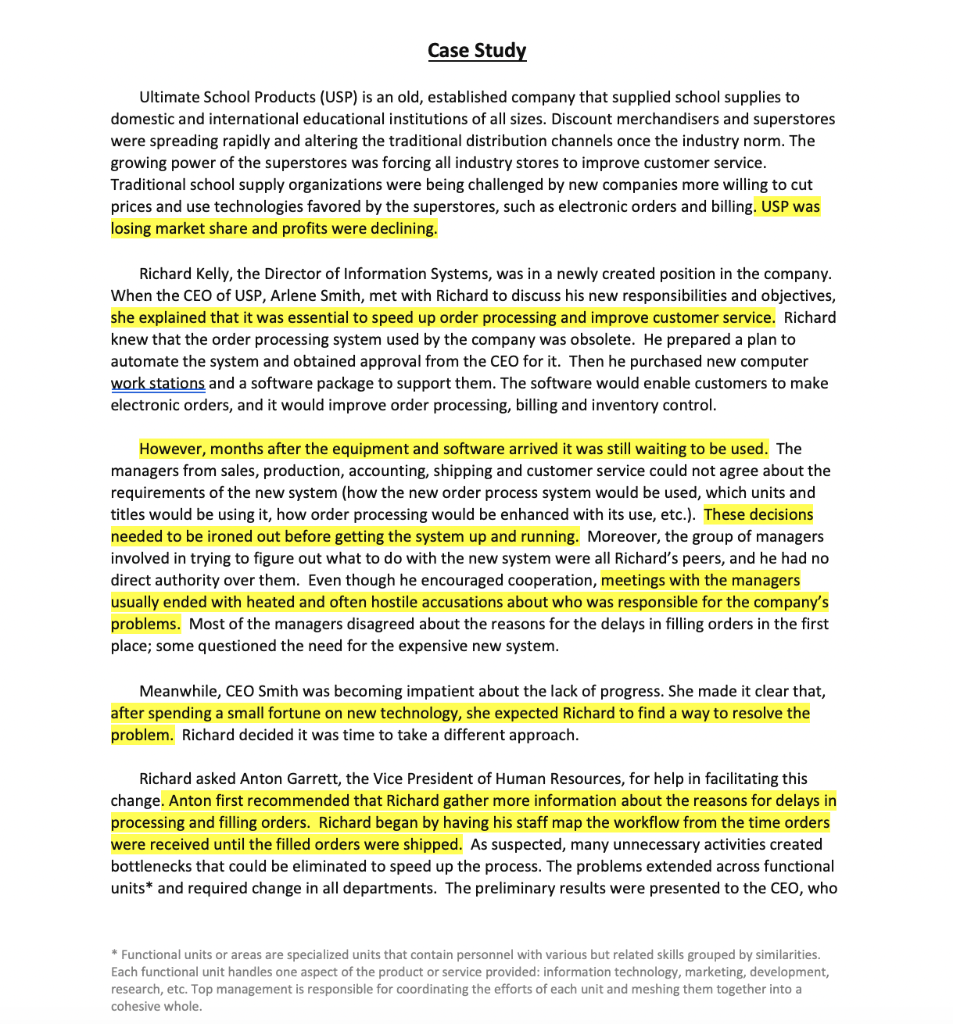
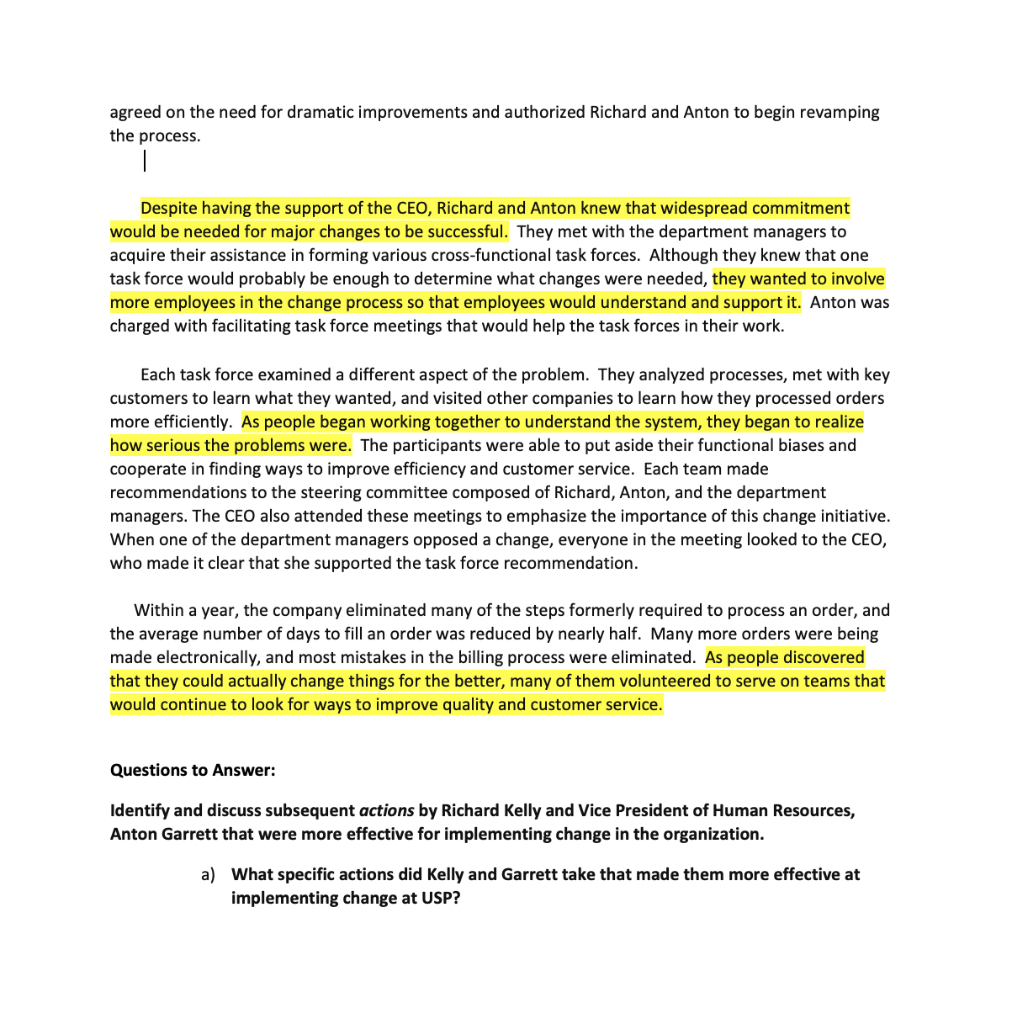
Case Study Ultimate School Products (USP) is an old, established company that supplied school supplies to domestic and international educational institutions of all sizes. Discount merchandisers and superstores were spreading rapidly and altering the traditional distribution channels once the industry norm. The growing power of the superstores was forcing all industry stores to improve customer service. Traditional school supply organizations were being challenged by new companies more willing to cut prices and use technologies favored by the superstores, such as electronic orders and billing. USP was losing market share and profits were declining. Richard Kelly, the Director of Information Systems, was in a newly created position in the company. When the CEO of USP, Arlene Smith, met with Richard to discuss his new responsibilities and objectives, she explained that it was essential to speed up order processing and improve customer service. Richard knew that the order processing system used by the company was obsolete. He prepared a plan to automate the system and obtained approval from the CEO for it. Then he purchased new computer work stations and a software package to support them. The software would enable customers to make electronic orders, and it would improve order processing, billing and inventory control. However, months after the equipment and software arrived it was still waiting to be used. The managers from sales, production, accounting, shipping and customer service could not agree about the requirements of the new system (how the new order process system would be used, which units and titles would be using it, how order processing would be enhanced with its use, etc.). These decisions needed to be ironed out before getting the system up and running. Moreover, the group of managers involved in trying to figure out what to do with the new system were all Richard's peers, and he had no direct authority over them. Even though he encouraged cooperation, meetings with the managers usually ended with heated and often hostile accusations about who was responsible for the company's problems. Most of the managers disagreed about the reasons for the delays in filling orders in the first place; some questioned the need for the expensive new system. Meanwhile, CEO Smith was becoming impatient about the lack of progress. She made it clear that, after spending a small fortune on new technology, she expected Richard to find a way to resolve the problem. Richard decided it was time to take a different approach. Richard asked Anton Garrett, the Vice President of Human Resources, for help in facilitating this change. Anton first recommended that Richard gather more information about the reasons for delays in processing and filling orders. Richard began by having his staff map the workflow from the time orders were received until the filled orders were shipped. As suspected, many unnecessary activities created bottlenecks that could be eliminated to speed up the process. The problems extended across functional units* and required change in all departments. The preliminary results were presented to the CEO, who * Functional units or areas are specialized units that contain personnel with various but related skills grouped by similarities. Each functional unit handles one aspect of the product or service provided: information technology, marketing, development, research, etc. Top management is responsible for coordinating the efforts of each unit and meshing them together into a cohesive whole. agreed on the need for dramatic improvements and authorized Richard and Anton to begin revamping the process. Despite having the support of the CEO, Richard and Anton knew that widespread commitment would be needed for major changes to be successful. They met with the department managers to acquire their assistance in forming various cross-functional task forces. Although they knew that one task force would probably be enough to determine what changes were needed, they wanted to involve more employees in the change process so that employees would understand and support it. Anton was charged with facilitating task force meetings that would help the task forces in their work. Each task force examined a different aspect of the problem. They analyzed processes, met with key customers to learn what they wanted, and visited other companies to learn how they processed orders more efficiently. As people began working together to understand the system, they began to realize how serious the problems were. The participants were able to put aside their functional biases and cooperate in finding ways to improve efficiency and customer service. Each team made recommendations to the steering committee composed of Richard, Anton, and the department managers. The CEO also attended these meetings to emphasize the importance of this change initiative. When one of the department managers opposed a change, everyone in the meeting looked to the CEO, who made it clear that she supported the task force recommendation. Within a year, the company eliminated many of the steps formerly required to process an order, and the average number of days to fill an order was reduced by nearly half. Many more orders were being made electronically, and most mistakes in the billing process were eliminated. As people discovered that they could actually change things for the better, many of them volunteered to serve on teams that would continue to look for ways to improve quality and customer service. Questions to Answer: Identify and discuss subsequent actions by Richard Kelly and Vice President of Human Resources, Anton Garrett that were more effective for implementing change in the organization. a) What specific actions did Kelly and Garrett take that made them more effective at implementing change at USPStep by Step Solution
There are 3 Steps involved in it
1 Expert Approved Answer
Step: 1 Unlock

Question Has Been Solved by an Expert!
Get step-by-step solutions from verified subject matter experts
Step: 2 Unlock
Step: 3 Unlock
 Study Help