







Question: please wite a full code that satisifies all the needed information and show that the code works with a screenshot of the output. Objective: Design
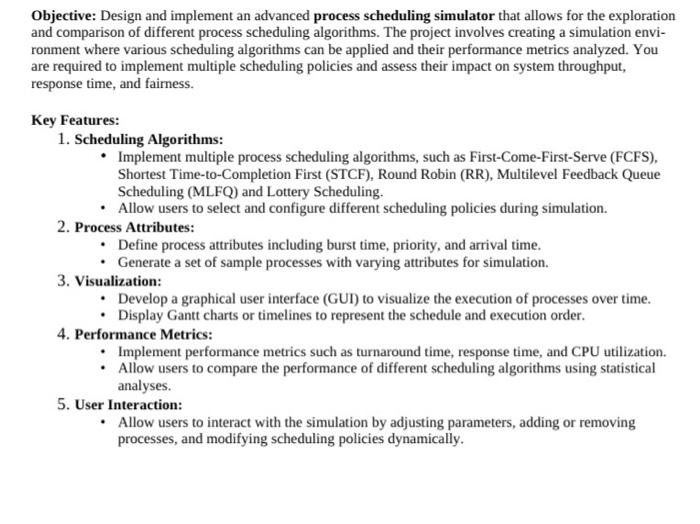
Objective: Design and implement an advanced process scheduling simulator that allows for the exploration and comparison of different process scheduling algorithms. The project involves creating a simulation environment where various scheduling algorithms can be applied and their performance metrics analyzed. You are required to implement multiple scheduling policies and assess their impact on system throughput, response time, and fairness. Key Features: 1. Scheduling Algorithms: - Implement multiple process scheduling algorithms, such as First-Come-First-Serve (FCFS), Shortest Time-to-Completion First (STCF), Round Robin (RR), Multilevel Feedback Queue Scheduling (MLFQ) and Lottery Scheduling. - Allow users to select and configure different scheduling policies during simulation. 2. Process Attributes: - Define process attributes including burst time, priority, and arrival time. - Generate a set of sample processes with varying attributes for simulation. 3. Visualization: - Develop a graphical user interface (GUI) to visualize the execution of processes over time. - Display Gantt charts or timelines to represent the schedule and execution order. 4. Performance Metrics: - Implement performance metrics such as turnaround time, response time, and CPU utilization. - Allow users to compare the performance of different scheduling algorithms using statistical analyses. 5. User Interaction: - Allow users to interact with the simulation by adjusting parameters, adding or removing processes, and modifying scheduling policies dynamically. Objective: Design and implement an advanced process scheduling simulator that allows for the exploration and comparison of different process scheduling algorithms. The project involves creating a simulation environment where various scheduling algorithms can be applied and their performance metrics analyzed. You are required to implement multiple scheduling policies and assess their impact on system throughput, response time, and fairness. Key Features: 1. Scheduling Algorithms: - Implement multiple process scheduling algorithms, such as First-Come-First-Serve (FCFS), Shortest Time-to-Completion First (STCF), Round Robin (RR), Multilevel Feedback Queue Scheduling (MLFQ) and Lottery Scheduling. - Allow users to select and configure different scheduling policies during simulation. 2. Process Attributes: - Define process attributes including burst time, priority, and arrival time. - Generate a set of sample processes with varying attributes for simulation. 3. Visualization: - Develop a graphical user interface (GUI) to visualize the execution of processes over time. - Display Gantt charts or timelines to represent the schedule and execution order. 4. Performance Metrics: - Implement performance metrics such as turnaround time, response time, and CPU utilization. - Allow users to compare the performance of different scheduling algorithms using statistical analyses. 5. User Interaction: - Allow users to interact with the simulation by adjusting parameters, adding or removing processes, and modifying scheduling policies dynamically
Step by Step Solution
There are 3 Steps involved in it

Get step-by-step solutions from verified subject matter experts
 Study Help