







Question: Please write 1-2 page answer to Exercise1, Chapter 2. You dont have to include the table in your answer. Just give an evaluation (on the
Please write 1-2 page answer to Exercise1, Chapter 2. You dont have to include the table in your answer. Just give an evaluation (on the scale of 1 to 10) for each of the five forces, based on your analysis of relevant factors for each force. One short paragraph of analysis is sufficient for each force.
Please note that the exercise asks you to rate how favorable each of the five forces are to the auto industry. So if a force is favorable to the auto industry then you rate it high toward 10, and if a force is unfavorable you rate it low toward 1. For example, if consumers have high bargaining power against auto makers, then it's unfavorable to auto industry, so the rating is toward 1, not toward 10.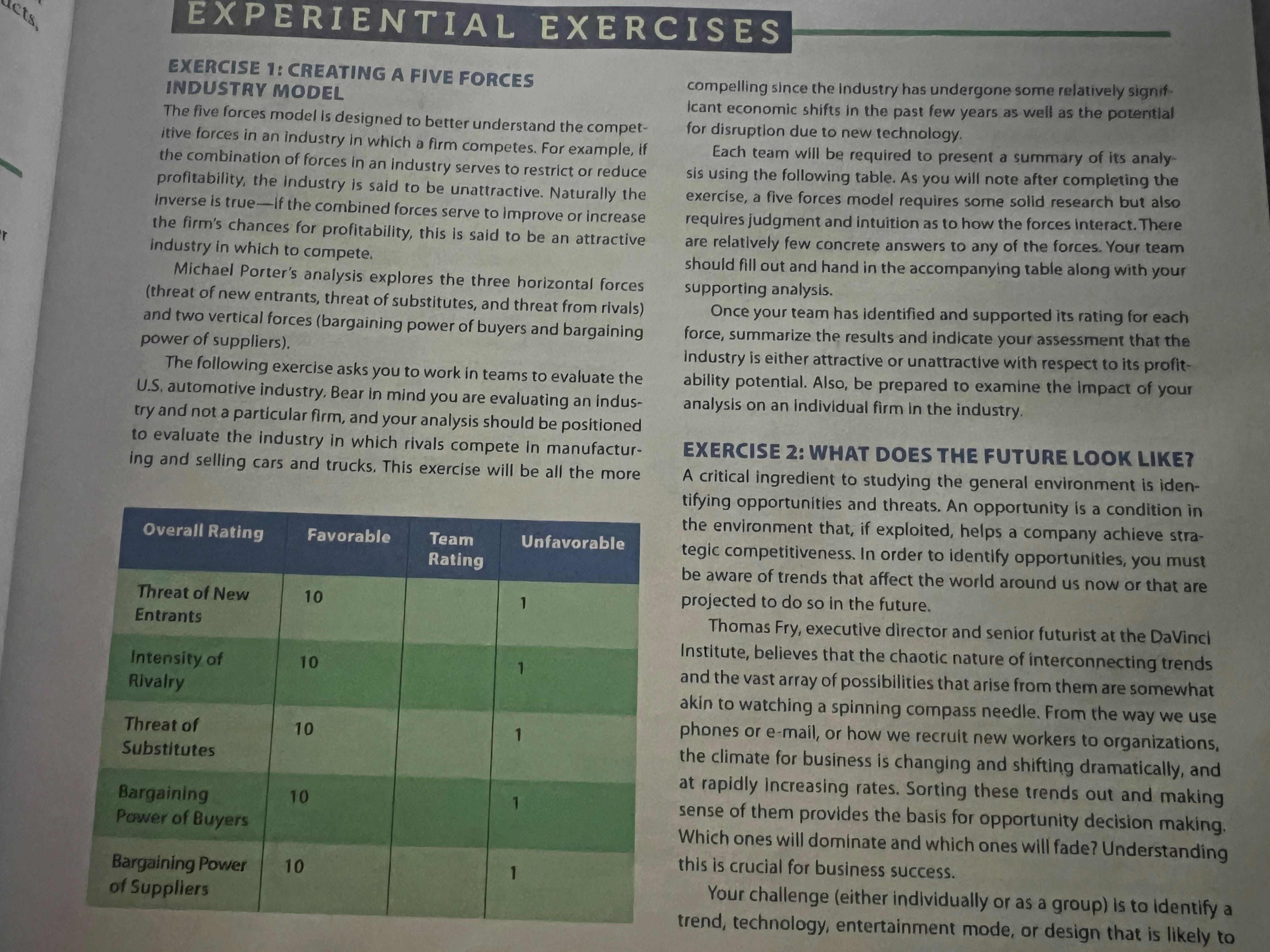
EXERCISE 1: CREATING A FIVE FORCES INDUSTRY MODEL The five forces model is designed to better understand the competitive forces in an industry in which a firm competes. For example, if the combination of forces in an industry serves to restrict or reduce profitability, the industry is said to be unattractive. Naturally the inverse is true-if the combined forces serve to improve or increase the firm's chances for profitability, this is said to be an attractive industry in which to compete. Michael Porter's analysis explores the three horizontal forces (threat of new entrants, threat of substitutes, and threat from rivals) and two vertical forces (bargaining power of buyers and bargaining power of suppliers). The following exercise asks you to work in teams to evaluate the U.S, automotive industry. Bear in mind you are evaluating an industry and not a particular firm, and your analysis should be positioned to evaluate the industry in which rivals compete in manufactur. ing and selling cars and trucks. This exercise will be all the more compelling since the industry has undergone some relatively signif icant economic shifts in the past few years as well as the potentlal for disruption due to new technology. Each team will be required to present a summary of its analy sis using the following table. As you will note after completing the exercise, a five forces model requires some solid research but also requires judgment and intuition as to how the forces interact. There are relatively few concrete answers to any of the forces. Your team should fill out and hand in the accompanying table along with your supporting analysis. Once your team has identified and supported its rating for each force, summarize the results and indicate your assessment that the industry is either attractive or unattractive with respect to its profitability potential. Also, be prepared to examine the impact of your analysis on an individual firm in the industry. EXERCISE 2: WHAT DOES THE FUTURE LOOK LIKE? A critical ingredient to studying the general environment is identifying opportunities and threats. An opportunity is a condition in the environment that, if exploited, helps a company achieve strategic competitiveness. In order to identify opportunities, you must be aware of trends that affect the world around us now or that are projected to do so in the future. Thomas Fry, executive director and senior futurist at the DaVincl Institute, believes that the chaotic nature of interconnecting trends and the vast array of possibilities that arise from them are somewhat akin to watching a spinning compass needle. From the way we use phones or e-mail, or how we recruit new workers to organizations, the climate for business is changing and shifting dramatically, and at rapidly increasing rates. Sorting these trends out and making sense of them provides the basis for opportunity decision making. Which ones will dominate and which ones will fade? Understanding this is crucial for business success. Your challenge (either indlvidually or as a group) is to identify trend, technology, entertainment mode, or design that is likelv to
Step by Step Solution
There are 3 Steps involved in it

Get step-by-step solutions from verified subject matter experts
 Study Help