


Question: Pls help and pls graph it correctly in demos and pls help with the written part as well, thank you. FUNGUS GG BEoUU UI uu,

Pls help and pls graph it correctly in demos and pls help with the written part as well, thank you.
Pls help and pls graph it correctly in demos and
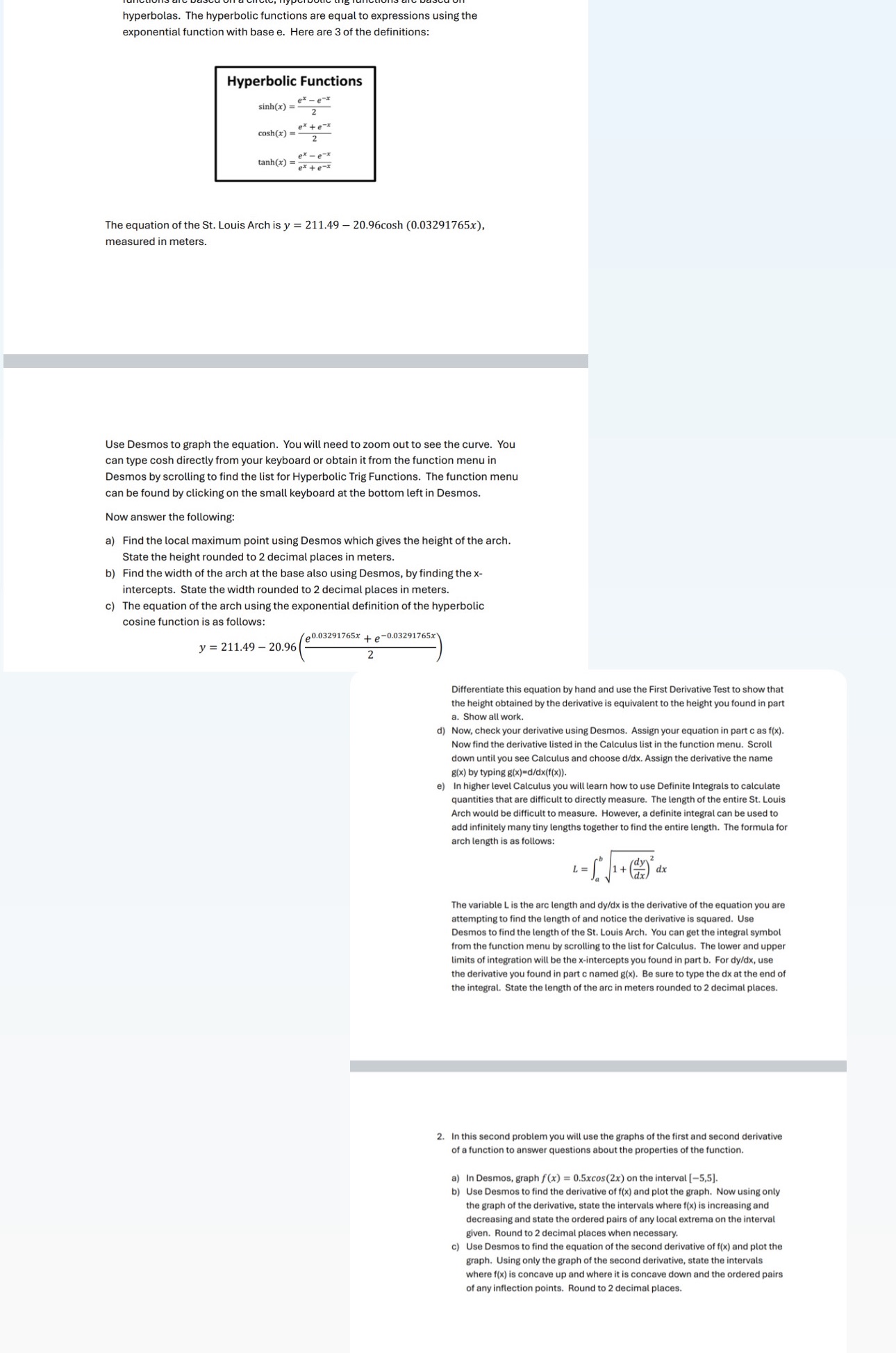
FUNGUS GG BEoUU UI uu, ypu UU Ung Huu anu waouU Ure hyperbolas. The hyperbolic functions are equal to expressions using the exponential function with base e. Here are 3 of the definitions: Hyperbolic Functions ete 2 te 2 sinh(x) = cosh(x) = : e tanh(x) = Fiet The equation of the St. Louis Arch is y = 211.49 20.96cosh (0.03291765x), measured in meters. Use Desmos to graph the equation. You will need to zoom out to see the curve. You can type cosh directly from your keyboard or obtain it from the function menu in Desmos by scrolling to find the list for Hyperbolic Trig Functions. The function menu can be found by clicking on the small keyboard at the bottom left in Desmos. Now answer the following: a) b) c) Find the local maximum point using Desmos which gives the height of the arch. State the height rounded to 2 decimal places in meters. Find the width of the arch at the base also using Desmos, by finding the x- intercepts. State the width rounded to 2 decimal places in meters. The equation of the arch using the exponential definition of the hyperbolic cosine function is as follows: y = 211.49 - 20.96( e 0.03291765x + e~0-03291765x ) d e) Differentiate this equation by hand and use the First Derivative Test to show that the height obtained by the derivative is equivalent to the height you found in part a. Show all work. Now, check your derivative using Desmos. Assign your equation in part c as f(x). Now find the derivative listed in the Calculus list in the function menu. Scroll down until you see Calculus and choose d/dx. Assign the derivative the name g(x) by typing glx)=d/dx(t(x)). In higher level Calculus you will learn how to use Definite Integrals to calculate quantities that are difficult to directly measure. The length of the entire St. Louis Arch would be difficult to measure. However, a definite integral can be used to add infinitely many tiny lengths together to find the entire length. The formula for arch length is as follows: t= 14 (2) ax The variable L is the arc length and dy/dx is the derivative of the equation you are attempting to find the length of and notice the derivative is squared. Use Desmos to find the length of the St. Louis Arch. You can get the integral symbol from the function menu by scrolling to the list for Calculus. The lower and upper limits of integration will be the x-intercepts you found in part b. For dy/dx, use the derivative you found in part c named g(x). Be sure to type the dx at the end of the integral. State the length of the arc in meters rounded to 2 decimal places. In this second problem you will use the graphs of the first and second derivative of a function to answer questions about the properties of the function. a) In Desmos, graph f(x) = 0.5xcos(2x) on the interval [5,5]. b) Use Desmos to find the derivative of f(x) and plot the graph. Now using only the graph of the derivative, state the intervals where {(x) is increasing and decreasing and state the ordered pairs of any local extrema on the interval given. Round to 2 decimal places when necessary. c) Use Desmos to find the equation of the second derivative of f(x) and plot the graph. Using only the graph of the second derivative, state the intervals where f(x) is concave up and where it is concave down and the ordered pairs. of any inflection points. Round to 2 decimal places

Step by Step Solution

There are 3 Steps involved in it

1 Expert Approved Answer
Step: 1 Unlock blur-text-image

Question Has Been Solved by an Expert!

Get step-by-step solutions from verified subject matter experts

Step: 2 Unlock
Step: 3 Unlock

Students Have Also Explored These Related Mathematics Questions!