







Question: Problem 1 (20 pts) For a direct-mapped cache design with a 32-bit address, the following bits of the address are used to access the cache.
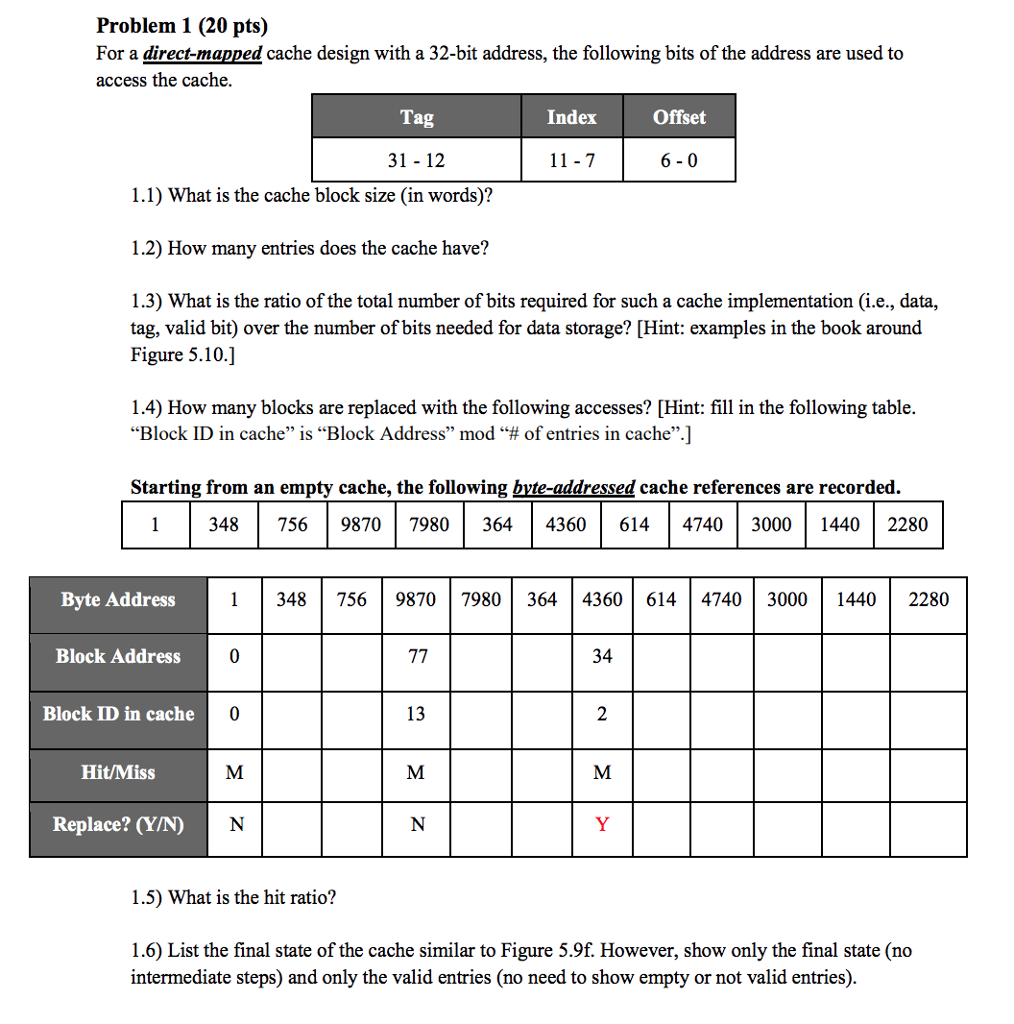
Problem 1 (20 pts) For a direct-mapped cache design with a 32-bit address, the following bits of the address are used to access the cache. Index Offset 31 - 12 11-7 6-0 1.1) What is the cache block size (in words)? 1.2) How many entries does the cache have? 1.3) What is the ratio of the total number of bits required for such a cache implementation (i.e., data, tag, valid bit) over the number of bits needed for data storage? [Hint: examples in the book around Figure 5.10.] 1.4) How many blocks are replaced with the following accesses? [Hint: fill in the following table. "Block ID in cache" is "Block Address" mod # of entries in cache".] Starting from an empty cache, the following byte-addressed cache references are recorded. 348 756 98707980 364 4360 61447403000 1440 2280 Byte Address 1348 75698707980 364 4360 61447403000 1440 2280 Block Address 34 Block ID in cache 13 2 Hit/Miss Replace? (YN) 1.5) What is the hit ratio? 1.6) List the final state of the cache similar to Figure 5.9f. However, show only the final state (no intermediate steps) and only the valid entries (no need to show empty or not valid entries)
Step by Step Solution
There are 3 Steps involved in it

Get step-by-step solutions from verified subject matter experts
 Study Help