







Question: Problem 1 : Consider the implementation of a ( 2 ^ { text { nd } } ) order filter shown in
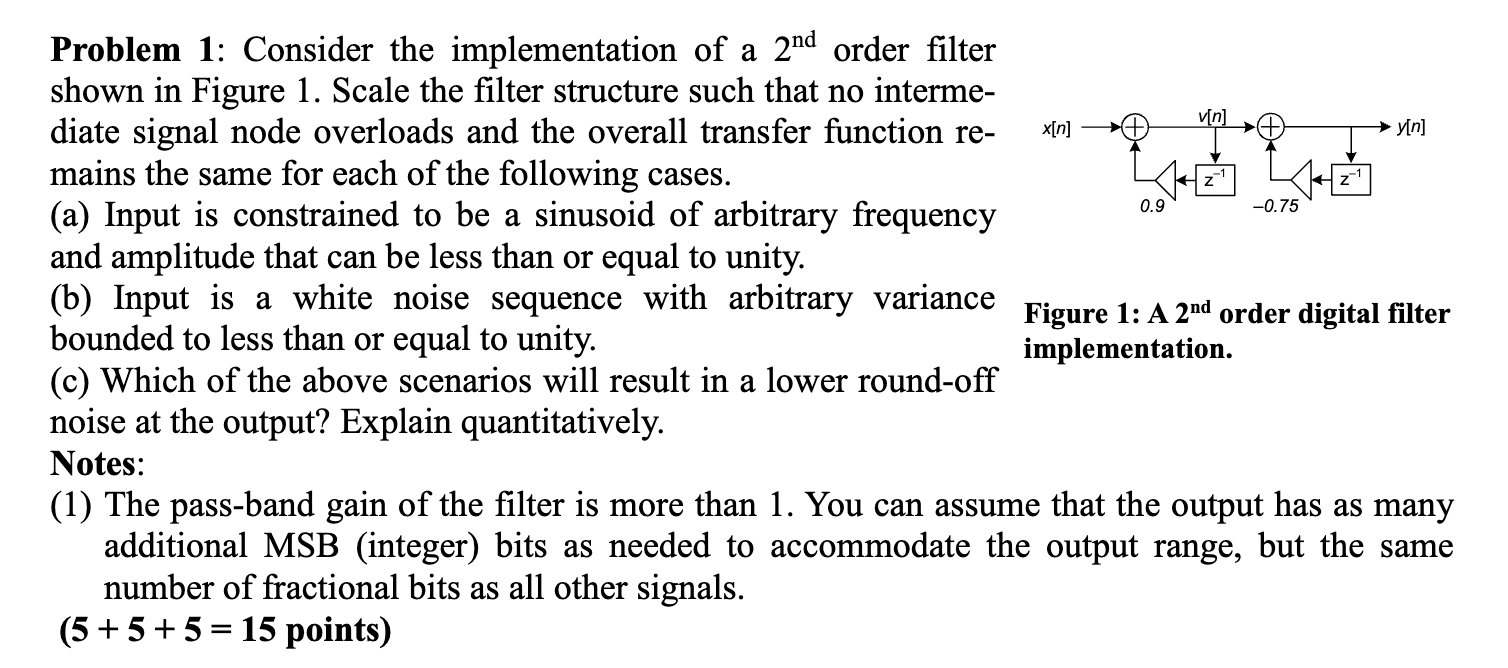
Problem : Consider the implementation of a text nd order filter shown in Figure Scale the filter structure such that no intermediate signal node overloads and the overall transfer function remains the same for each of the following cases.
a Input is constrained to be a sinusoid of arbitrary frequency and amplitude that can be less than or equal to unity.
b Input is a white noise sequence with arbitrary variance bounded to less than or equal to unity.
c Which of the above scenarios will result in a lower roundoff
Figure : A text nd order digital filter implementation.
noise at the output? Explain quantitatively.
Notes:
The passband gain of the filter is more than You can assume that the output has as many additional MSB integer bits as needed to accommodate the output range, but the same number of fractional bits as all other signals.
text points
Step by Step Solution
There are 3 Steps involved in it
1 Expert Approved Answer
Step: 1 Unlock

Question Has Been Solved by an Expert!
Get step-by-step solutions from verified subject matter experts
Step: 2 Unlock
Step: 3 Unlock
 Study Help