







Question: Problem 1: idealised Lenoir heat engine cycle [15 marks] (a) Please explain what adiabatic process, isochoric process and isobaric process are. (b) In an
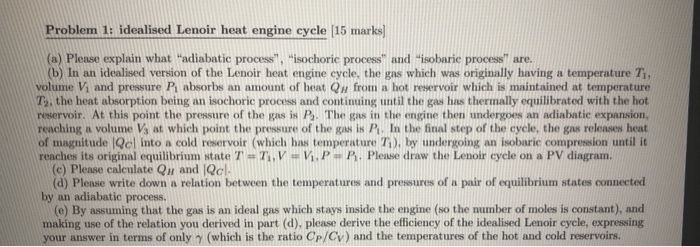
Problem 1: idealised Lenoir heat engine cycle [15 marks] (a) Please explain what "adiabatic process", "isochoric process" and "isobaric process" are. (b) In an idealised version of the Lenoir heat engine cycle, the gas which was originally having a temperature T, volume V and pressure P absorbs an amount of heat Qu from a hot reservoir which is maintained at temperature T, the heat absorption being an isochoric process and continuing until the gas has thermally equilibrated with the hot reservoir. At this point the pressure of the gas is P. The gas in the engine then undergoes an adiabatic expansion, reaching a volume V3 at which point the pressure of the gas is P. In the final step of the cycle, the gas releases heat of magnitude Qcl into a cold reservoir (which has temperature T), by undergoing an isobaric compression until it reaches its original equilibrium state T = T, V = V.P= P. Please draw the Lenoir cycle on a PV diagram. (c) Please calculate Qu and Qcl. (d) Please write down a relation between the temperatures and pressures of a pair of equilibrium states connected by an adiabatic process. (e) By assuming that the gas is an ideal gas which stays inside the engine (so the number of moles is constant), and making use of the relation you derived in part (d), please derive the efficiency of the idealised Lenoir cycle, expressing your answer in terms of only y (which is the ratio Cp/Cv) and the temperatures of the hot and cold reservoirs.
Step by Step Solution
3.43 Rating (166 Votes )
There are 3 Steps involved in it
Lets go through each part of the problem related to the idealized Lenoir heat engine cycle a Explana... View full answer

Get step-by-step solutions from verified subject matter experts
 Study Help