







Question: Problem 2 (5 pts). A liquid A is evaporating into a pure carrier gas B, which is flowing with a certain velocity across a
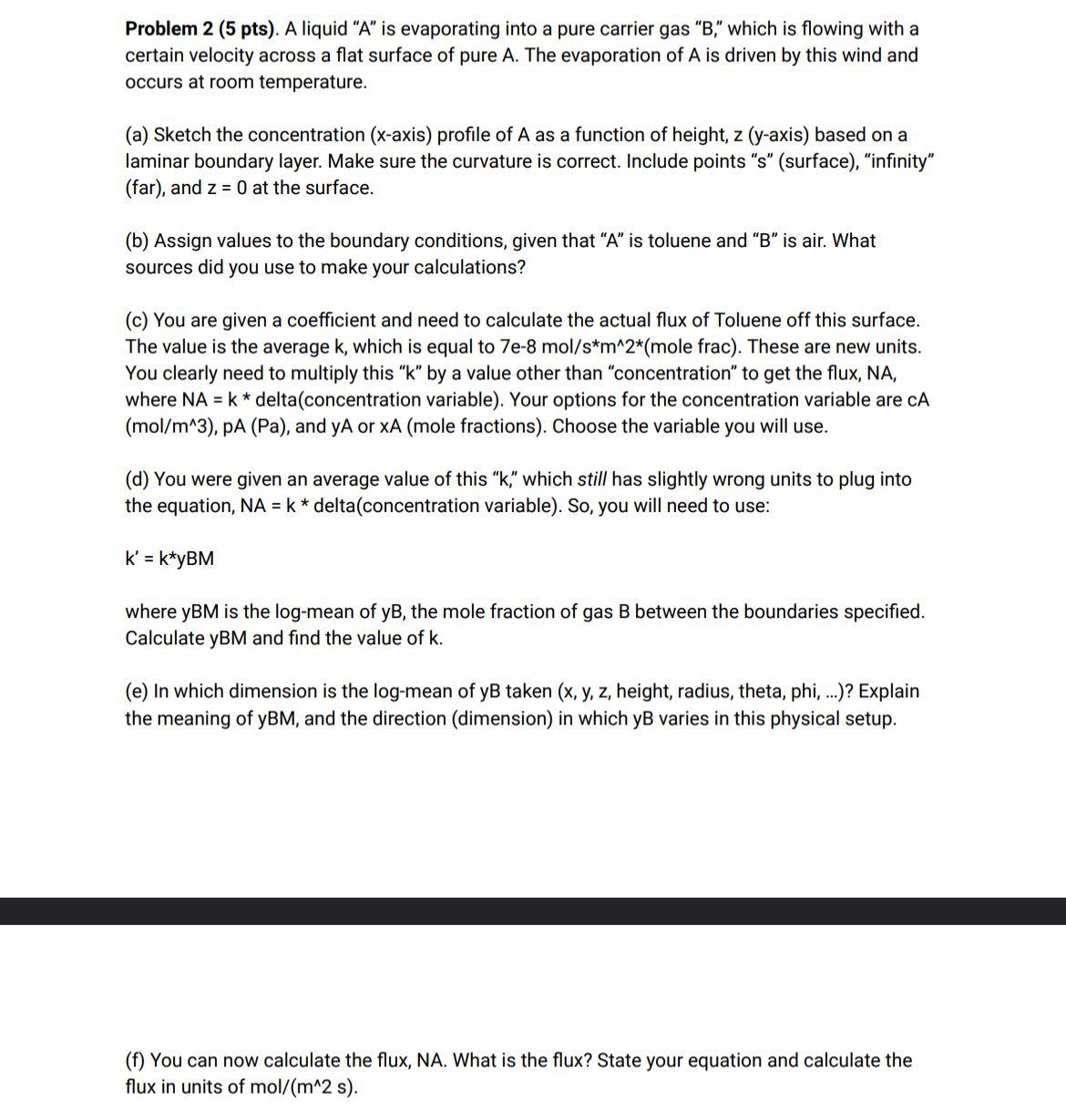
Problem 2 (5 pts). A liquid "A" is evaporating into a pure carrier gas "B," which is flowing with a certain velocity across a flat surface of pure A. The evaporation of A is driven by this wind and occurs at room temperature. (a) Sketch the concentration (x-axis) profile of A as a function of height, z (y-axis) based on a laminar boundary layer. Make sure the curvature is correct. Include points "s" (surface), "infinity" (far), and z = 0 at the surface. (b) Assign values to the boundary conditions, given that "A" is toluene and "B" is air. What sources did you use to make your calculations? (c) You are given a coefficient and need to calculate the actual flux of Toluene off this surface. The value is the average k, which is equal to 7e-8 mol/s*m^2*(mole frac). These are new units. You clearly need to multiply this "k" by a value other than "concentration" to get the flux, NA, where NA = k* delta(concentration variable). Your options for the concentration variable are cA (mol/m^3), pA (Pa), and yA or xA (mole fractions). Choose the variable you will use. (d) You were given an average value of this "k," which still has slightly wrong units to plug into the equation, NA = k* delta(concentration variable). So, you will need to use: k' = k*yBM where yBM is the log-mean of yB, the mole fraction of gas B between the boundaries specified. Calculate yBM and find the value of k. (e) In which dimension is the log-mean of yB taken (x, y, z, height, radius, theta, phi, ...)? Explain the meaning of yBM, and the direction (dimension) in which yB varies in this physical setup. (f) You can now calculate the flux, NA. What is the flux? State your equation and calculate the flux in units of mol/(m^2 s).
Step by Step Solution
3.38 Rating (164 Votes )
There are 3 Steps involved in it
a Concentration Profile In a laminar boundary layer the concentration profile of A toluene as a function of height z above the flat surface can be described as follows At the surface z 0 The concentra... View full answer

Get step-by-step solutions from verified subject matter experts
 Study Help