







Question: Problem 3. In this problem, we consider the determinant function from linear algebra. Let Mn denote the set of all n x n matrices
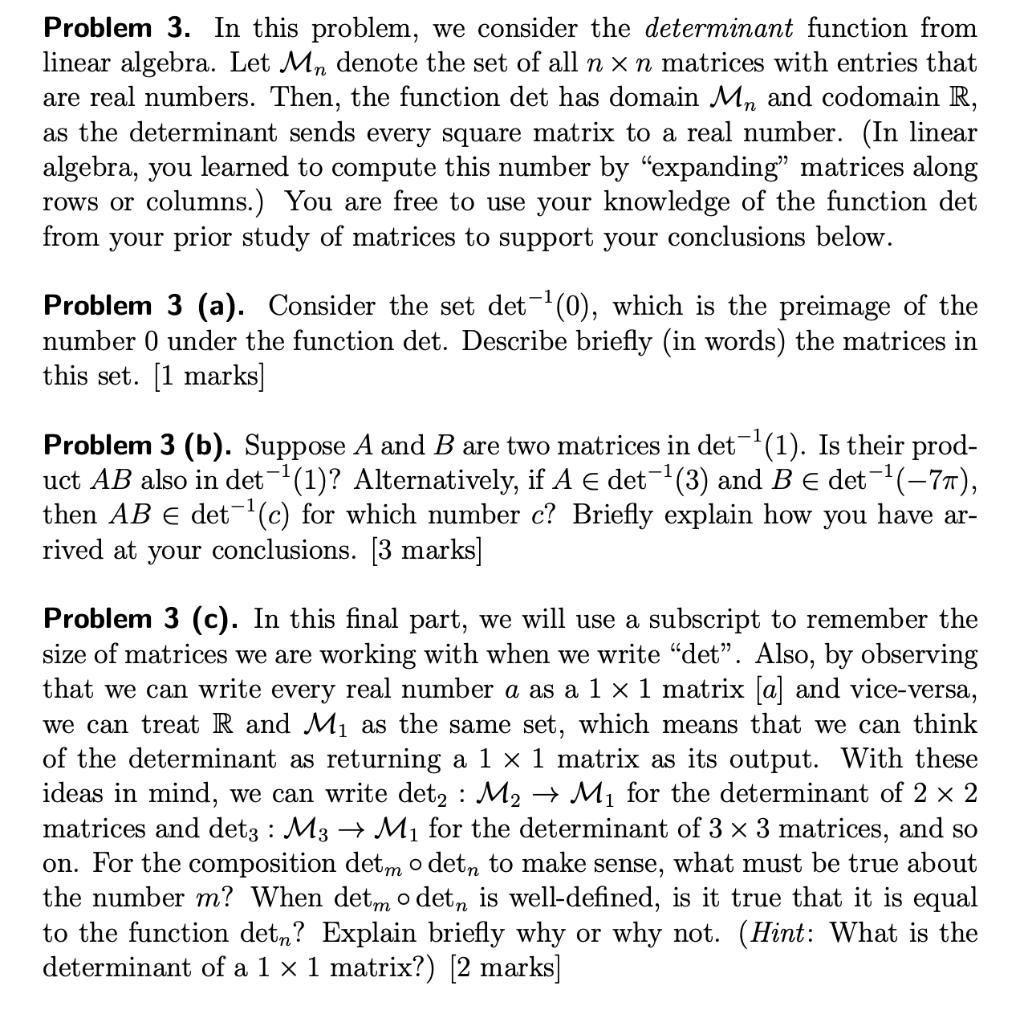
Problem 3. In this problem, we consider the determinant function from linear algebra. Let Mn denote the set of all n x n matrices with entries that are real numbers. Then, the function det has domain Mn and codomain R, as the determinant sends every square matrix to a real number. (In linear algebra, you learned to compute this number by "expanding" matrices along rows or columns.) You are free to use your knowledge of the function det from your prior study of matrices to support your conclusions below. Problem 3 (a). Consider the set det(0), which is the preimage of the number 0 under the function det. Describe briefly (in words) the matrices in this set. [1 marks] Problem 3 (b). Suppose A and B are two matrices in det(1). Is their prod- uct AB also in det (1)? Alternatively, if A det-(3) and B E det-(7), then AB E det(c) for which number c? Briefly explain how you have ar- rived at your conclusions. [3 marks] Problem 3 (c). In this final part, we will use a subscript to remember the size of matrices we are working with when we write "det". Also, by observing that we can write every real number a as a 1 1 matrix [a] and vice-versa, we can treat R and M as the same set, which means that we can think of the determinant as returning a 1 x 1 matrix as its output. With these ideas in mind, we can write det2 M M for the determinant of 2 2 matrices and det3 : M3 M for the determinant of 3 3 matrices, and so on. For the composition det odetn to make sense, what must be true about the number m? When detmo det, is well-defined, is it true that it is equal to the function detn? Explain briefly why or why not. (Hint: What is the determinant of a 1 x 1 matrix?) [2 marks]
Step by Step Solution
3.49 Rating (156 Votes )
There are 3 Steps involved in it
Problem 3 ... View full answer

Get step-by-step solutions from verified subject matter experts
 Study Help