







Question: Problem 3: Socially Optimal Forest Rotations with Non-timber values [2 points] Now suppose that the forest that you are considering to plant provides a non-timber
![Problem 3: Socially Optimal Forest Rotations with Non-timber values [2 points]](https://s3.amazonaws.com/si.experts.images/answers/2024/07/6685d910e2ec2_8886685d910b697f.jpg)
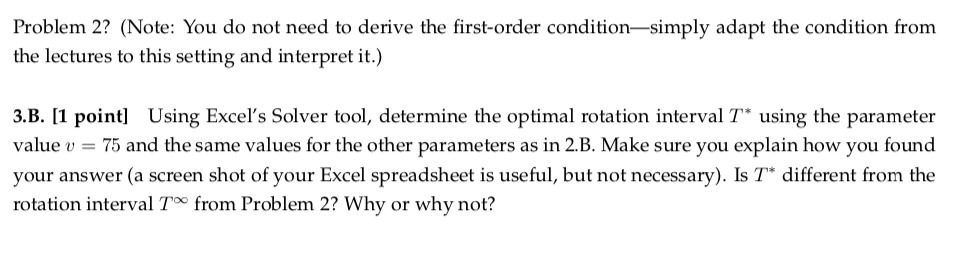
Problem 3: Socially Optimal Forest Rotations with Non-timber values [2 points] Now suppose that the forest that you are considering to plant provides a non-timber value of sequestering carbon. Assume that the per-period value of carbon sequestration depends linearly on the volume of the forest and is equal to a(t) = vt. The stream of discounted non-timber values from t = 0 to t = T is thus A(T) = Jo e rta(t)dt = (v/r?) [1 - e"(1 + rT)]. This means that the net-present-value to society of all forest rotations is: NPV* = -D + A(T) + er(iT) [pQ(T) - D + A(T)] i= 1 = -D+ A(T) + PQ(T) - D + A(T) erT - 1 3.A. [1 point] Suppose you want to know what the optimal rotation interval is that maximizes NPV*. Denote this as 7"*. Write down the first-order condition associated with 7"* and interpret the condition, in terms of marginal benefits and opportunity costs. How does this condition differ from the condition inProblem 2? (Note: You do not need to derive the first-order conditionsimply adapt the condition from the lectures to this setting and interpret it.) 3.3. [1 point] Using Excel's Solver tool, determine the optimal rotation interval '1\" using the parameter value v = 75 and the same values for the other parameters as in 2.3. Make sure you explain how you found your answer (a screen shot of your Excel spreadsheet is useful, but not necessary). Is '1\" different from the rotation interval TOO from Problem 2? Why or why not
Step by Step Solution
There are 3 Steps involved in it

Get step-by-step solutions from verified subject matter experts
 Study Help