







Question: Problem #4 and #5 use the following features to learn the concept Good Movie, which predicts whether a movie is good or not based on
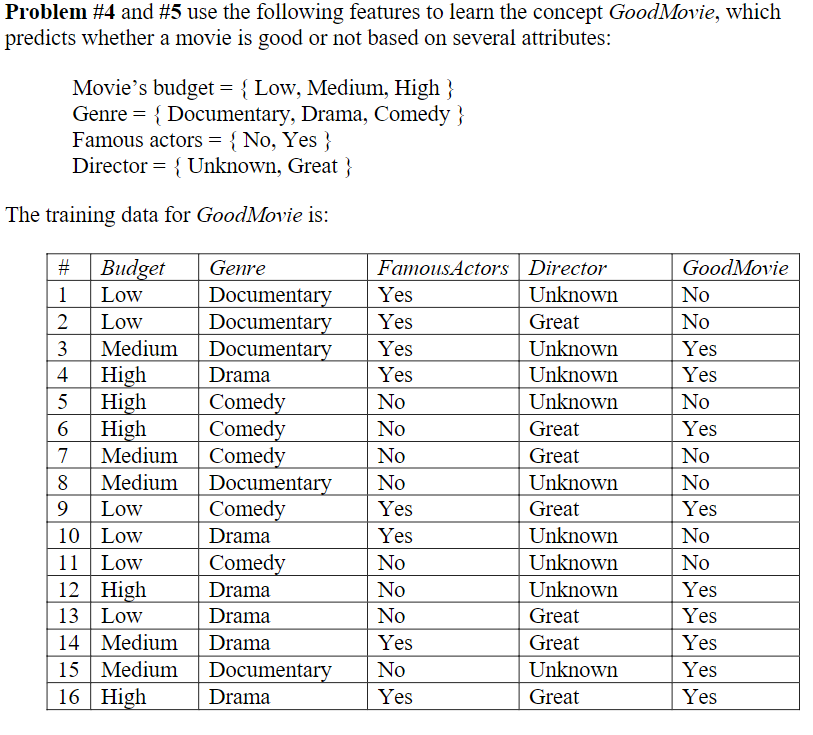
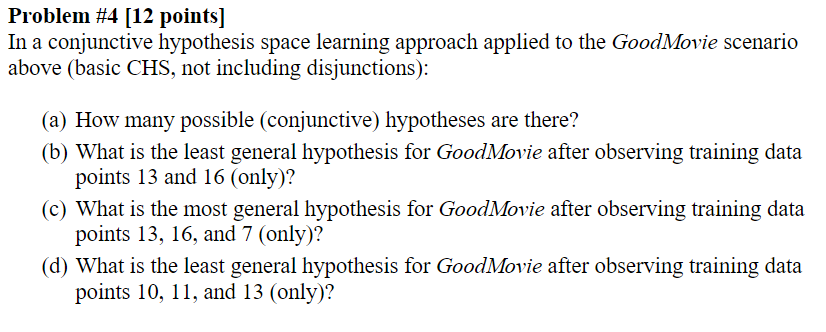
Problem #4 and #5 use the following features to learn the concept Good Movie, which predicts whether a movie is good or not based on several attributes: Movie's budget = { Low, Medium, High } Genre = {Documentary, Drama, Comedy } Famous actors = {No, Yes } Director = {Unknown, Great } The training data for Good Movie is: # Budget 1 Low 2 Low 3 Medium 4 High 5 High 6 High 7 Medium 8 Medium 9 Low 10 Low 11 Low 12 High 13 Low 14 Medium 15 Medium 16 High Genre Documentary Documentary Documentary Drama Comedy Comedy Comedy Documentary Comedy Drama Comedy Drama Drama Drama Documentary Drama Famous Actors Director Yes Unknown Yes Great Yes Unknown Yes Unknown No Unknown No Great No Great No Unknown Yes Great Yes Unknown No Unknown No Unknown No Great Yes Great No Unknown Yes Great Good Movie No No Yes Yes No Yes No No Yes No No Yes Yes Yes Yes Yes Problem #4 [12 points] In a conjunctive hypothesis space learning approach applied to the Good Movie scenario above (basic CHS, not including disjunctions): (a) How many possible (conjunctive) hypotheses are there? (b) What is the least general hypothesis for Good Movie after observing training data points 13 and 16 (only)? (c) What is the most general hypothesis for Good Movie after observing training data points 13, 16, and 7 (only)? (d) What is the least general hypothesis for Good Movie after observing training data points 10, 11, and 13 (only)
Step by Step Solution
There are 3 Steps involved in it

Get step-by-step solutions from verified subject matter experts
 Study Help