







Question: procedure for known solution below 3. Using the procedure provided for the known solution, construct a flow chart for separation and identification of the ions

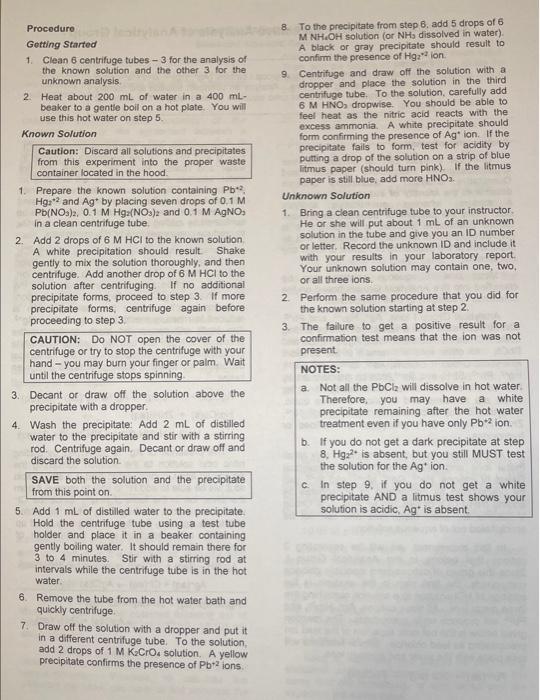
3. Using the procedure provided for the known solution, construct a flow chart for separation and identification of the ions in analytical group I. You may want to take a good look at the flow chart presented in the "Qualitative Analysis of Metal Ions" section of your textbook. Copy this page without the expected observation on the result section to aid your experiment. Procedure 8. To the precipitate from step 6, add 5 drops of 6 Getting Started M NHiOH soluton (or NHs dissolved in water). 1. Clean 6 centrifuge tubes 3 for the analysis of A black or gray precipitate should result to the known solution and the other 3 for the unknown analysis. confirm the presence of Hg22 ion. 2. Heat about 200mL of water in a 400mL - 9. Centrifuge and draw off the solution with a beaker to a gentle boil on a hot plate. You will dropper and place the solution in the third use this hot water on step 5 . centrifuge tube. To the solution, carefully add. 6MHNO3 dropwise. You should be able to feel heat as the nitric acid reacts with the Known Solution excess ammonia. A white precipitate should Caution: Discard all solutions and precipitates form confirming the presence of Ag ion. If the from this experiment into the proper waste precipitate fails to form, test for acidity by container located in the hood. putting a drop of the solution on a strip of blue itmus paper (should turn pink). If the litmus 1. Prepare the known solution containing Pb+2, paper is still blue, add more HNO3. Hg22 and Ag+by placing seven drops of 0.1M Unknown Solution Pb(NO3)2,0.1MHg2(NO3)2 and 0.1MAgNNO3 1. Bring a clean centrifuge tube to your instructor. in a clean centrifuge tube. He or she will put about 1mL of an unknown 2. Add 2 drops of 6MHCl to the known solution. solution in the tube and give you an ID number A white precipitation should result. Shake. or letter. Record the unknown ID and include it gently to mix the solution thoroughly, and then with your results in your laboratory report. centrifuge. Add another drop of 6MHCl to the Your uniknown solution may contain one, two, solution after centrifuging. If no additional or all three ions. precipitate forms, proceed to step 3 . If more 2. Perform the same procedure that you did for precipitate forms, centrifuge again before the known solution starting at step 2 . proceeding to step 3 . CAUTION: DO NOT open the cover of the 3. The fallure to get a positive result for a centrifuge or try to stop the centrifuge with your confirmation test means that the ion was not hand - you may burn your finger or palm. Wait until the centrifuge stops spinning present. 3. Decant or draw off the solution above the NOTES: precipitate with a dropper. 4. Wash the precipitate: Add 2mL of distilled water to the precipitate and stir with a stirring rod. Centrifuge again. Decant or draw off and discard the solution. a. Not all the PbCl2 will dissolve in hot water. Therefore, you may have a white precipitate remaining after the hot water treatment even if you have only Pb+2 ion: SAVE both the solution and the precipitate from this point on. c. In step 9. if you do not get a white precipitate AND a litmus test shows your 5. Add 1mL of distilled water to the precipitate. solution is acidic, Ag t is absent. Hold the centrifuge tube using a test tube holder and place it in a beaker containing. gently boiling water. It should remain there for 3 to 4 minutes. Stir with a stirring rod at intervals while the centrifuge tube is in the hot water. 6. Remove the tube from the hot water bath and quickly centrifuge. 7. Draw off the solution with a dropper and put it in a different centrifuge tube. To the solution, add 2 drops of 1MK2CrO4 solution. A yellow precipitate confirms the presence of Pb+2 ions
Step by Step Solution
There are 3 Steps involved in it

Get step-by-step solutions from verified subject matter experts
 Study Help