



Question: Process Controls how did my professor get 62.5 and then d? 1. A perfectly-mixed constant volume stirred tank is cooled by a cooling coil which
Process Controls
how did my professor get 62.5 and then d?
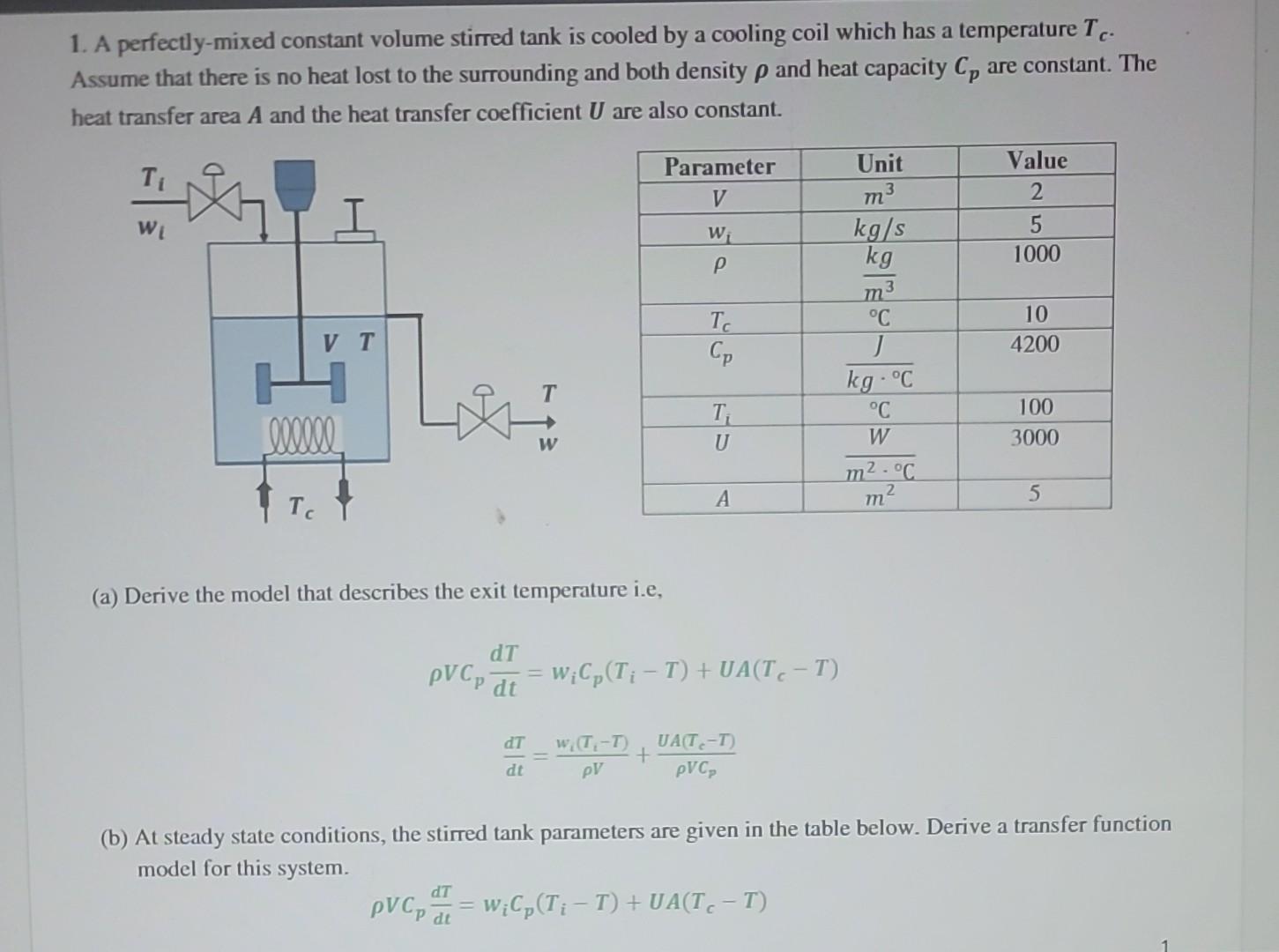
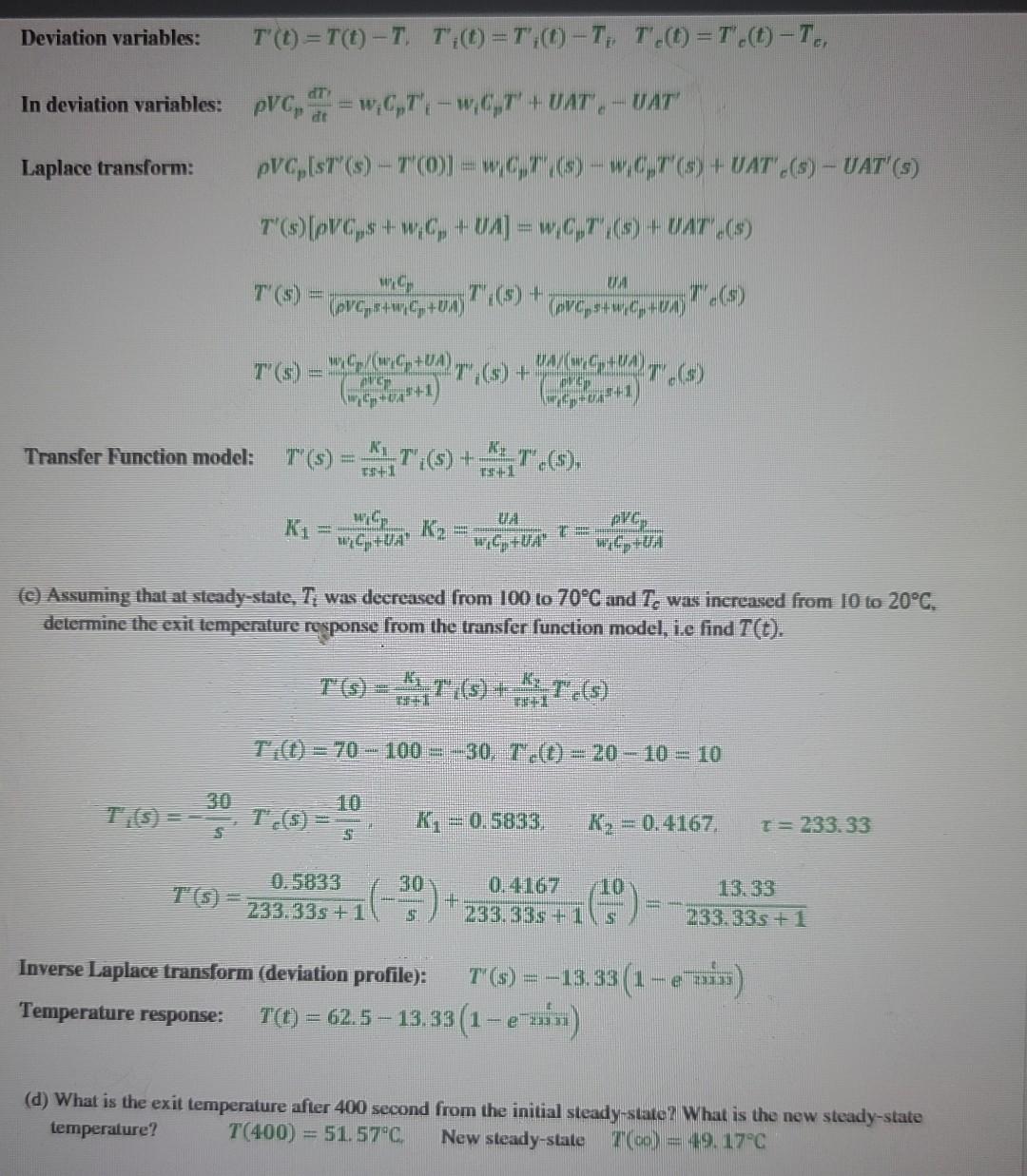
1. A perfectly-mixed constant volume stirred tank is cooled by a cooling coil which has a temperature Tc. Assume that there is no heat lost to the surrounding and both density and heat capacity Cp are constant. The heat transfer area A and the heat transfer coefficient U are also constant. (a) Derive the model that describes the exit temperature i.e, VCpdtdT=wiCp(TiT)+UA(TcT)dtdT=Vwi(TiT)+VCpUA(TcT) (b) At steady state conditions, the stirred tank parameters are given in the table below. Derive a transfer function model for this system. VCpdtdT=wiCp(TiT)+UA(TcT) Deviation variables: T(t)=T(t)T,Ti(t)=Ti(t)Ti,Tc(t)=Tc(t)Tc In deviation variables: VCpdtdT=wiCpTiwiCpT+UATcUAT Laplace transform: Transfer Function model: T(s)=rs+1K1Ti(s)+xs+1K7Tc(s) K1=wiCp+UAw1CpK2=w1Cp+UAv1r=wiCp+UApVCr (c) Assuining that at steady-state, Ti was decreased from 100 to 70C and Tc was increased from 10 to 20C. determine the exit temperature rosponse from the transfer function model, i.e find T(t). T(s)=m+T1N4TH(s)+m+T1KyTr(s)Ti(t)=70100=30Tc(t)=2010=10T(s)=s30,Tc(s)=s10,K1=0.5833.K2=0.4167,=233.33T(s)=233.33s+10.5833(s30)+233.33s+10.4167(s10)=233.33s+113.33 Inverse Laplace transform (deviation profile): T(s)=13.33(1e23i2)) Temperature response: T(t)=62.513.33(1e2.237i3) (d) What is the exit temperature after 400 second from the initial steady-state? What is the new steady-state temperature? T(400)=51.57C. New steady-state T(c0)=49.17C
Step by Step Solution
There are 3 Steps involved in it

Get step-by-step solutions from verified subject matter experts