Question: Produce complete as-is process models ONLY for the section Recruitment and selection Since all staff members at Talent Seek are very busy, you will not
- Produce complete as-is process models ONLY for the section Recruitment and selection
- Since all staff members at Talent Seek are very busy, you will not be able to gather further information (e.g., interviews) from the organisation. You will have to make appropriate assumptions. Describe assumptions that you make about the section Recruitment and selection particularly areas where the information provided in the case is not sufficient or not clear.
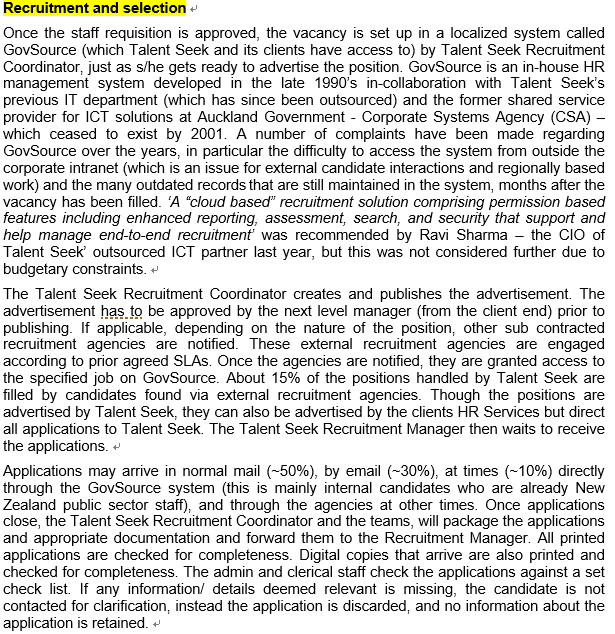
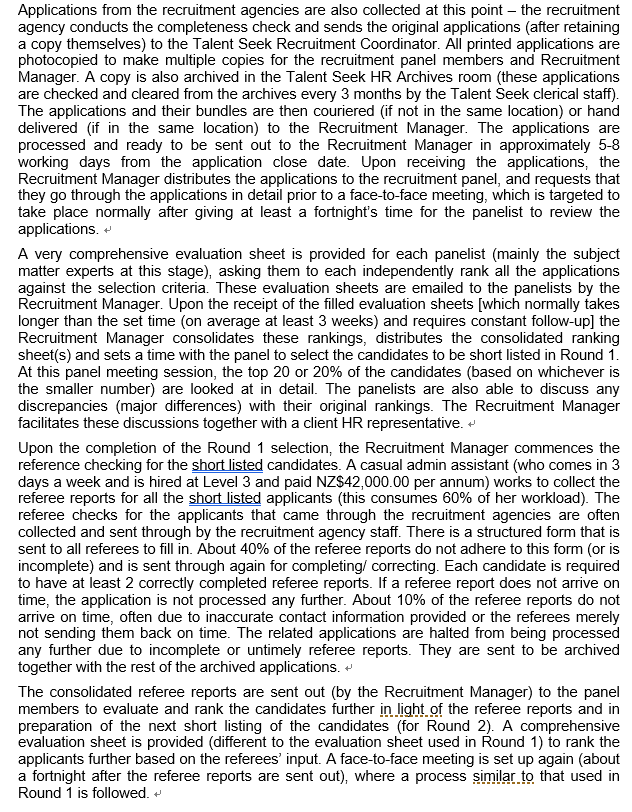
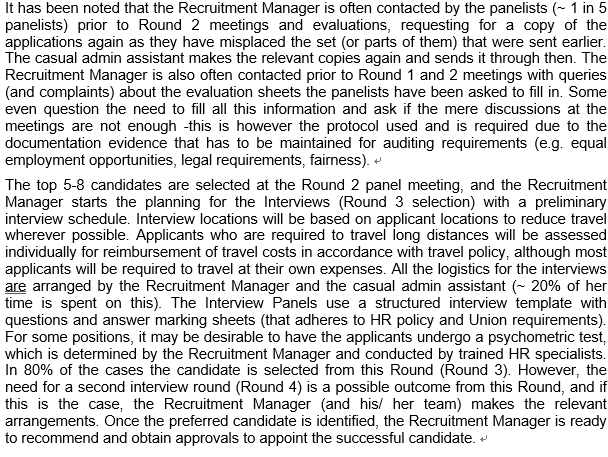
Recruitment and selection Once the staff requisition is approved, the vacancy is set up in a localized system called GovSource (which Talent Seek and its clients have access to) by Talent Seek Recruitment Coordinator, just as s/he gets ready to advertise the position. GovSource is an in-house HR management system developed in the late 1990's in-collaboration with Talent Seek's previous IT department (which has since been outsourced) and the former shared service provider for ICT solutions at Auckland Government - Corporate Systems Agency (CSA) - which ceased to exist by 2001. A number of complaints have been made regarding GovSource over the years, in particular the difficulty to access the system from outside the corporate intranet (which is an issue for external candidate interactions and regionally based work) and the many outdated records that are still maintained in the system, months after the vacancy has been filled. 'A "cloud based" recruitment solution comprising permission based features including enhanced reporting, assessment, search, and security that support and help manage end-to-end recruitment was recommended by Ravi Sharma the CIO of Talent Seek' outsourced ICT partner last year, but this was not considered further due to budgetary constraints. + The Talent Seek Recruitment Coordinator creates and publishes the advertisement. The advertisement has to be approved by the next level manager (from the client end) prior to publishing. If applicable, depending on the nature of the position, other sub contracted recruitment agencies are notified. These external recruitment agencies are engaged according to prior agreed SLAs. Once the agencies are notified, they are granted access to the specified job on GovSource. About 15% of the positions handled by Talent Seek are filled by candidates found via external recruitment agencies. Though the positions are advertised by Talent Seek, they can also be advertised by the clients HR Services but direct all applications to Talent Seek. The Talent Seek Recruitment Manager then waits to receive the applications. Applications may arrive in normal mail (-50%), by email (-30%), at times (-10%) directly through the GovSource system (this is mainly internal candidates who are already New Zealand public sector staff), and through the agencies at other times. Once applications close, the Talent Seek Recruitment Coordinator and the teams, will package the applications and appropriate documentation and forward them to the Recruitment Manager. All printed applications are checked for completeness. Digital copies that arrive are also printed and checked for completeness. The admin and clerical staff check the applications against a set check list. If any information/ details deemed relevant is missing, the candidate is not contacted for clarification, instead the application is discarded, and no information about the application is retained. + Applications from the recruitment agencies are also collected at this point the recruitment agency conducts the completeness check and sends the original applications (after retaining a copy themselves) to the Talent Seek Recruitment Coordinator. All printed applications are photocopied to make multiple copies for the recruitment panel members and Recruitment Manager. A copy is also archived in the Talent Seek HR Archives room (these applications are checked and cleared from the archives every 3 months by the Talent Seek clerical staff). The applications and their bundles are then couriered (if not in the same location) or hand delivered (if in the same location) to the Recruitment Manager. The applications are processed and ready to be sent out to the Recruitment Manager in approximately 5-8 working days from the application close date. Upon receiving the applications, the Recruitment Manager distributes the applications to the recruitment panel, and requests that they go through the applications in detail prior to a face-to-face meeting, which is targeted to take place normally after giving at least a fortnight's time for the panelist to review the applications. + A very comprehensive evaluation sheet is provided for each panelist (mainly the subject matter experts at this stage), asking them to each independently rank all the applications against the selection criteria. These evaluation sheets are emailed to the panelists by the Recruitment Manager. Upon the receipt of the filled evaluation sheets (which normally takes longer than the set time (on average at least 3 weeks) and requires constant follow-up] the Recruitment Manager consolidates these rankings, distributes the consolidated ranking sheet(s) and sets a time with the panel to select the candidates to be short listed in Round 1. At this panel meeting session, the top 20 or 20% of the candidates (based on whichever is the smaller number) are looked at in detail. The panelists are also able to discuss any discrepancies (major differences) with their original rankings. The Recruitment Manager facilitates these discussions together with a client HR representative. + Upon the completion of the Round 1 selection, the Recruitment Manager commences the reference checking for the short listed candidates. A casual admin assistant (who comes in 3 days a week and is hired at Level 3 and paid NZ$42,000.00 per annum) works to collect the referee reports for all the short listed applicants (this consumes 60% of her workload). The referee checks for the applicants that came through the recruitment agencies are often collected and sent through by the recruitment agency staff. There is a structured form that is sent to all referees to fill in. About 40% of the referee reports do not adhere to this form (or is incomplete) and is sent through again for completing/ correcting. Each candidate is required to have at least 2 correctly completed referee reports. If a referee report does not arrive on time, the application is not processed any further. About 10% of the referee reports do not arrive on time, often due to inaccurate contact information provided or the referees merely not sending them back on time. The related applications are halted from being processed any further due to incomplete or untimely referee reports. They are sent to be archived together with the rest of the archived applications. + The consolidated referee reports are sent out (by the Recruitment Manager) to the panel members to evaluate and rank the candidates further in light of the referee reports and in preparation of the next short listing of the candidates (for Round 2). A comprehensive evaluation sheet is provided (different to the evaluation sheet used in Round 1) to rank the applicants further based on the referees' input. A face-to-face meeting is set up again (about a fortnight after the referee reports are sent out), where a process similar to that used in Round 1 is followed. + It has been noted that the Recruitment Manager is often contacted by the panelists (-1 in 5 panelists) prior to Round 2 meetings and evaluations, requesting for a copy of the applications again as they have misplaced the set (or parts of them) that were sent earlier. The casual admin assistant makes the relevant copies again and sends it through then. The Recruitment Manager is also often contacted prior to Round 1 and 2 meetings with queries (and complaints) about the evaluation sheets the panelists have been asked to fill in. Some even question the need to fill all this information and ask if the mere discussions at the meetings are not enough - this is however the protocol used and is required due to the documentation evidence that has to be maintained for auditing requirements (e.g. equal employment opportunities, legal requirements, fairness). The top 5-8 candidates are selected at the Round 2 panel meeting, and the Recruitment Manager starts the planning for the Interviews (Round 3 selection) with a preliminary interview schedule. Interview locations will be based on applicant locations to reduce travel wherever possible. Applicants who are required to travel long distances will be assessed individually for reimbursement of travel costs in accordance with travel policy, although most applicants will be required to travel at their own expenses. All the logistics for the interviews are arranged by the Recruitment Manager and the casual admin assistant (- 20% of her time is spent on this). The Interview Panels use a structured interview template with questions and answer marking sheets (that adheres to HR policy and Union requirements). For some positions, it may be desirable to have the applicants undergo a psychometric test, which is determined by the Recruitment Manager and conducted by trained HR specialists. In 80% of the cases the candidate is selected from this Round (Round 3). However, the need for a second interview round (Round 4) is a possible outcome from this Round, and if this is the case, the Recruitment Manager (and his/ her team) makes the relevant arrangements. Once the preferred candidate is identified, the Recruitment Manager is ready to recommend and obtain approvals to appoint the successful candidate. Recruitment and selection Once the staff requisition is approved, the vacancy is set up in a localized system called GovSource (which Talent Seek and its clients have access to) by Talent Seek Recruitment Coordinator, just as s/he gets ready to advertise the position. GovSource is an in-house HR management system developed in the late 1990's in-collaboration with Talent Seek's previous IT department (which has since been outsourced) and the former shared service provider for ICT solutions at Auckland Government - Corporate Systems Agency (CSA) - which ceased to exist by 2001. A number of complaints have been made regarding GovSource over the years, in particular the difficulty to access the system from outside the corporate intranet (which is an issue for external candidate interactions and regionally based work) and the many outdated records that are still maintained in the system, months after the vacancy has been filled. 'A "cloud based" recruitment solution comprising permission based features including enhanced reporting, assessment, search, and security that support and help manage end-to-end recruitment was recommended by Ravi Sharma the CIO of Talent Seek' outsourced ICT partner last year, but this was not considered further due to budgetary constraints. + The Talent Seek Recruitment Coordinator creates and publishes the advertisement. The advertisement has to be approved by the next level manager (from the client end) prior to publishing. If applicable, depending on the nature of the position, other sub contracted recruitment agencies are notified. These external recruitment agencies are engaged according to prior agreed SLAs. Once the agencies are notified, they are granted access to the specified job on GovSource. About 15% of the positions handled by Talent Seek are filled by candidates found via external recruitment agencies. Though the positions are advertised by Talent Seek, they can also be advertised by the clients HR Services but direct all applications to Talent Seek. The Talent Seek Recruitment Manager then waits to receive the applications. Applications may arrive in normal mail (-50%), by email (-30%), at times (-10%) directly through the GovSource system (this is mainly internal candidates who are already New Zealand public sector staff), and through the agencies at other times. Once applications close, the Talent Seek Recruitment Coordinator and the teams, will package the applications and appropriate documentation and forward them to the Recruitment Manager. All printed applications are checked for completeness. Digital copies that arrive are also printed and checked for completeness. The admin and clerical staff check the applications against a set check list. If any information/ details deemed relevant is missing, the candidate is not contacted for clarification, instead the application is discarded, and no information about the application is retained. + Applications from the recruitment agencies are also collected at this point the recruitment agency conducts the completeness check and sends the original applications (after retaining a copy themselves) to the Talent Seek Recruitment Coordinator. All printed applications are photocopied to make multiple copies for the recruitment panel members and Recruitment Manager. A copy is also archived in the Talent Seek HR Archives room (these applications are checked and cleared from the archives every 3 months by the Talent Seek clerical staff). The applications and their bundles are then couriered (if not in the same location) or hand delivered (if in the same location) to the Recruitment Manager. The applications are processed and ready to be sent out to the Recruitment Manager in approximately 5-8 working days from the application close date. Upon receiving the applications, the Recruitment Manager distributes the applications to the recruitment panel, and requests that they go through the applications in detail prior to a face-to-face meeting, which is targeted to take place normally after giving at least a fortnight's time for the panelist to review the applications. + A very comprehensive evaluation sheet is provided for each panelist (mainly the subject matter experts at this stage), asking them to each independently rank all the applications against the selection criteria. These evaluation sheets are emailed to the panelists by the Recruitment Manager. Upon the receipt of the filled evaluation sheets (which normally takes longer than the set time (on average at least 3 weeks) and requires constant follow-up] the Recruitment Manager consolidates these rankings, distributes the consolidated ranking sheet(s) and sets a time with the panel to select the candidates to be short listed in Round 1. At this panel meeting session, the top 20 or 20% of the candidates (based on whichever is the smaller number) are looked at in detail. The panelists are also able to discuss any discrepancies (major differences) with their original rankings. The Recruitment Manager facilitates these discussions together with a client HR representative. + Upon the completion of the Round 1 selection, the Recruitment Manager commences the reference checking for the short listed candidates. A casual admin assistant (who comes in 3 days a week and is hired at Level 3 and paid NZ$42,000.00 per annum) works to collect the referee reports for all the short listed applicants (this consumes 60% of her workload). The referee checks for the applicants that came through the recruitment agencies are often collected and sent through by the recruitment agency staff. There is a structured form that is sent to all referees to fill in. About 40% of the referee reports do not adhere to this form (or is incomplete) and is sent through again for completing/ correcting. Each candidate is required to have at least 2 correctly completed referee reports. If a referee report does not arrive on time, the application is not processed any further. About 10% of the referee reports do not arrive on time, often due to inaccurate contact information provided or the referees merely not sending them back on time. The related applications are halted from being processed any further due to incomplete or untimely referee reports. They are sent to be archived together with the rest of the archived applications. + The consolidated referee reports are sent out (by the Recruitment Manager) to the panel members to evaluate and rank the candidates further in light of the referee reports and in preparation of the next short listing of the candidates (for Round 2). A comprehensive evaluation sheet is provided (different to the evaluation sheet used in Round 1) to rank the applicants further based on the referees' input. A face-to-face meeting is set up again (about a fortnight after the referee reports are sent out), where a process similar to that used in Round 1 is followed. + It has been noted that the Recruitment Manager is often contacted by the panelists (-1 in 5 panelists) prior to Round 2 meetings and evaluations, requesting for a copy of the applications again as they have misplaced the set (or parts of them) that were sent earlier. The casual admin assistant makes the relevant copies again and sends it through then. The Recruitment Manager is also often contacted prior to Round 1 and 2 meetings with queries (and complaints) about the evaluation sheets the panelists have been asked to fill in. Some even question the need to fill all this information and ask if the mere discussions at the meetings are not enough - this is however the protocol used and is required due to the documentation evidence that has to be maintained for auditing requirements (e.g. equal employment opportunities, legal requirements, fairness). The top 5-8 candidates are selected at the Round 2 panel meeting, and the Recruitment Manager starts the planning for the Interviews (Round 3 selection) with a preliminary interview schedule. Interview locations will be based on applicant locations to reduce travel wherever possible. Applicants who are required to travel long distances will be assessed individually for reimbursement of travel costs in accordance with travel policy, although most applicants will be required to travel at their own expenses. All the logistics for the interviews are arranged by the Recruitment Manager and the casual admin assistant (- 20% of her time is spent on this). The Interview Panels use a structured interview template with questions and answer marking sheets (that adheres to HR policy and Union requirements). For some positions, it may be desirable to have the applicants undergo a psychometric test, which is determined by the Recruitment Manager and conducted by trained HR specialists. In 80% of the cases the candidate is selected from this Round (Round 3). However, the need for a second interview round (Round 4) is a possible outcome from this Round, and if this is the case, the Recruitment Manager (and his/ her team) makes the relevant arrangements. Once the preferred candidate is identified, the Recruitment Manager is ready to recommend and obtain approvals to appoint the successful candidate









 Study Help