







Question: Python 3.x Please Anonymous, do not copy and paste the same incorrect answer, over and over again considering that I'm simply stuck with where to
Python 3.x Please Anonymous, do not copy and paste the same incorrect answer, over and over again considering that I'm simply stuck with where to go, I would like someone to please take a look at how to help me fix it.
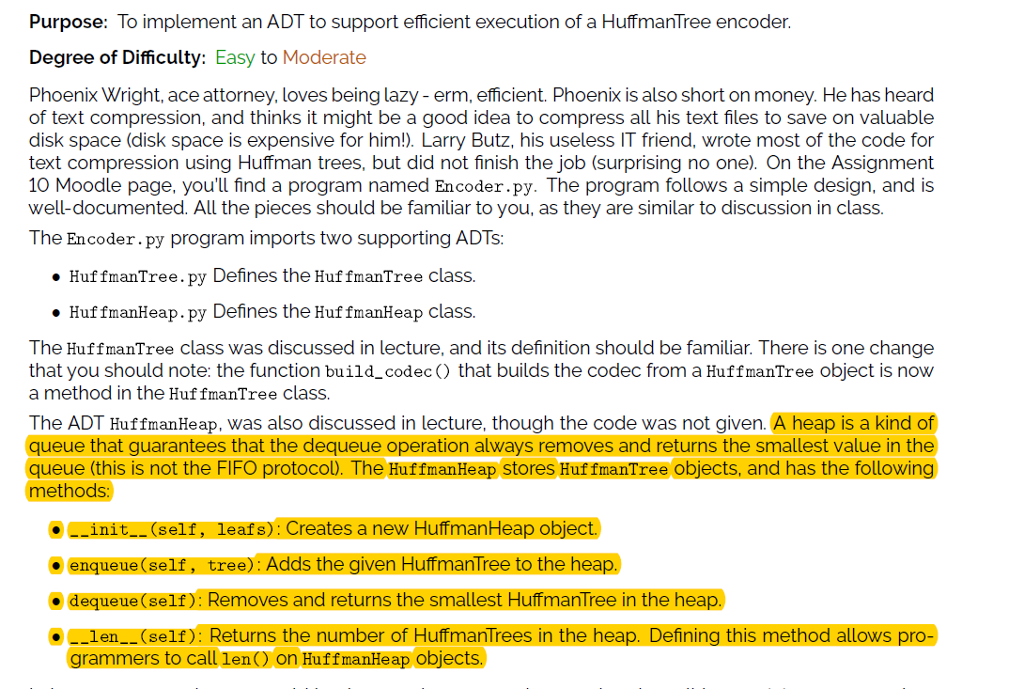
Filling out HuffmanHeap.py so it works with Encoder I've tried a million things but the code is wrong, and I don't know how to fix it, any help would be greatly appreciated :
class HuffmanHeap(object): def __init__(self, leafs): """ Purpose: Creates a new HuffmanHeap object. Pre-conditions: leafs: a list of HuffmanTree leaf nodes. Post-conditions: The heap is created and initialized. Return: None """ self.leafs = leafs leafs.sort(key = lambda x:x.__freq)
def enqueue(self, tree): """ Purpose: Adds the tree to the Heap. This is an O(1) operation. Pre-conditions: tree is a HuffmanTree object Post-conditions: the heap increases in size by 1 Return: None """ self.leafs.append(tree) leafs.sort(key = lambda x:x.__freq)
def dequeue(self): """ Purpose: Return the smallest value in the queue. This is an O(1) operation. Pre-conditions: None Post-conditions: The heap decreases in size by 1 Return: A HuffmanTree object, with the lowest frequency """ data = self.leafs[0] self.leafs.remove(data) return data
def __len__(self): """ Purpose: Return the number of data values stored in the heap. This method allows Python scripts to call len(hh) if hh is a HuffmanHeap object. Pre-conditions: None Post-conditions: None Return: The number of values stored in the heap """ return len(self.leafs)
def display(self): """ Purpose: Display the data for debugging. Pre-conditions: None Post-conditions: None Return: None """ for tree in self.leafs: tree.display()
HuffmanTree.py:
# Defines the Huffman Tree data structure # # A Huffman tree-node has a character and a frequency. # some strings to avoid long lines later _INIT_ASSERT_MESSAGE_NONLEAF = 'Invalid Huffman tree construction attempted.' _GETCH_ASSERT_MESSAGE_NONLEAF = 'Method get_char() called on non-leaf node' class HuffmanTree(object): def __init__(self, freq=0, char=None, left=None, right=None): """ Purpose: Initializes the HuffmanTree object. To create a leaf node aleaf = HuffmanTree(freq=10, char='A') bleaf = HuffmanTree(freq=15, char='E') To create an internal node: node = HuffmanTree(left=aleaf,right=bleaf) Pre-conditions: :param freq: a positive integer :param char: a character :param left: another Huffman Tree :param right: another HuffmanTree """ self.__char = char self.left = left self.right = right if left is None and right is None: # leaf node: assign the frequency as given self.__freq = freq else: assert left is not None and right is not None, _INIT_ASSERT_MESSAGE_NONLEAF # non-leaf node: calculate the frequency from the given subtrees self.__freq = left.__freq + right.__freq def is_leaf(self): """ Purpose: Check if the node is a leaf. Simplifies some of the other methods with an abstraction. Return: True if the node is a leaf node """ return self.left is None and self.right is None def get_freq(self): """ Purpose: Return the frequency data stored in the node. Return: :return: the frequency """ return self.__freq def get_char(self): """ Purpose: Return the character stored at a leaf node. Return: :return: the character at a leaf node """ assert self.is_leaf(), _GETCH_ASSERT_MESSAGE_NONLEAF return self.__char def display(self, level=0): """ Purpose: For debugging, display the tree. The structure of the tree is represented by indentation No other real purpose. Preconditions: :param level: indentation amount for subtrees. Return :return: None """ if self.is_leaf(): print(' '*level+'Leaf:', self.__char, self.__freq) else: print(' '*level+'Node:', self.__freq, 'Children:') self.left.display(level+1) self.right.display(level+1) def build_codec(self): """ Purpose: Build a dictionary of char-code pairs from the Huffman tree. Return: :return: a dictionary with character as key, code as value """ codes = {} def encoder(tree, code): if tree.is_leaf(): codes[tree.get_char()] = code else: encoder(tree.left, code+'0') encoder(tree.right, code+'1') if self.is_leaf(): codes[self.__char] = '0' else: encoder(self,'') return codes def __lt__(self, other): return self.__freq Encoder.py:import sys as sys import HuffmanTree as HT import HuffmanHeap as HH DEFAULT_OUTPUT_FILE = 'encoded.txt' def main(): """ Purpose: Application to read and encode a file using Huffman codes. Usage: python3 Encoder.py Sends output to DEFAULT_OUTPUT_FILE Return: :return: None """ if len(sys.argv) != 2: print('Usage: python3', sys.argv[0], '') print('-- sends output to', DEFAULT_OUTPUT_FILE, '-- ') return fname = sys.argv[1] lines = read_file(fname) freqs = count_characters(lines) codec = build_codec(freqs) coded = encode(lines, codec) write_file(DEFAULT_OUTPUT_FILE, coded) def read_file(fname): """ Purpose: Read a file and return contents in a list of strings. Preconditions: :param fname: the name of a text file Return: :return: a list of strings, one string for each line """ tfile = open(fname) lines = [l.rstrip() for l in tfile] tfile.close() return lines def write_file(fname, lines): """ Purpose: Write the data in lines to the named file. Warning: this will over-write any data in the named file! Preconditions: :param fname: the name of a text file :param lines: a list of strings Post-condition: The named file is created or over-written. Return: :return: None """ tfile = open(fname, 'w') for line in lines: tfile.write(line + ' ') tfile.close() def count_characters(contents): """ Purpose: Count the characters in the contents. Pre-conditions: :param contents: a list of strings. Return: :return: a list of (character,frequency) tuples """ freqs = dict() for line in contents: for char in line: if char in freqs: freqs[char] += 1 else: freqs[char] = 1 return list(freqs.items()) def build_codec(freq_list): """ Purpose: Build a codec from the frequency list. Pre-conditions: :param freq_list: A list of (char,frequency) tuples. Return: :return: a dictionary mapping characters to codes """ freq_list.sort(key=lambda p: p[1]) hq = HH.HuffmanHeap([HT.HuffmanTree(freq=f,char=c) \ for c,f in freq_list]) while len(hq) > 1: t1 = hq.dequeue() t2 = hq.dequeue() hq.enqueue(HT.HuffmanTree(left=t1, right=t2)) survivor = hq.dequeue() return survivor.build_codec() def encode(strings, codec): """ Purpose: Use the codec to create the data to be sent to the output file. Pre-conditions: :param strings: A list of strings to encode. :param codec: A dictionary containing character-code pairs Return: :return: a list of strings including: the number of codes the number of coded lines, the codes the coded lines """ output = [] output.append(str(len(codec)) + ' ' + str(len(strings))) for char in codec: output.append(codec[char] + ':' + "'" + char + "'") for s in strings: encoded = [] for char in s: encoded.append(codec[char]) output.append(''.join(encoded)) return output if __name__ == '__main__': main() text file that needs to be encoded belaire.txt :
Now this is a story all about how My life got flipped-turned upside down
Step by Step Solution
There are 3 Steps involved in it

Get step-by-step solutions from verified subject matter experts
 Study Help