







Question: python code for all commented parts Let's first import the digits data from scikit-learn datasets again. If you don't remember how to do so, please
python code for all commented parts
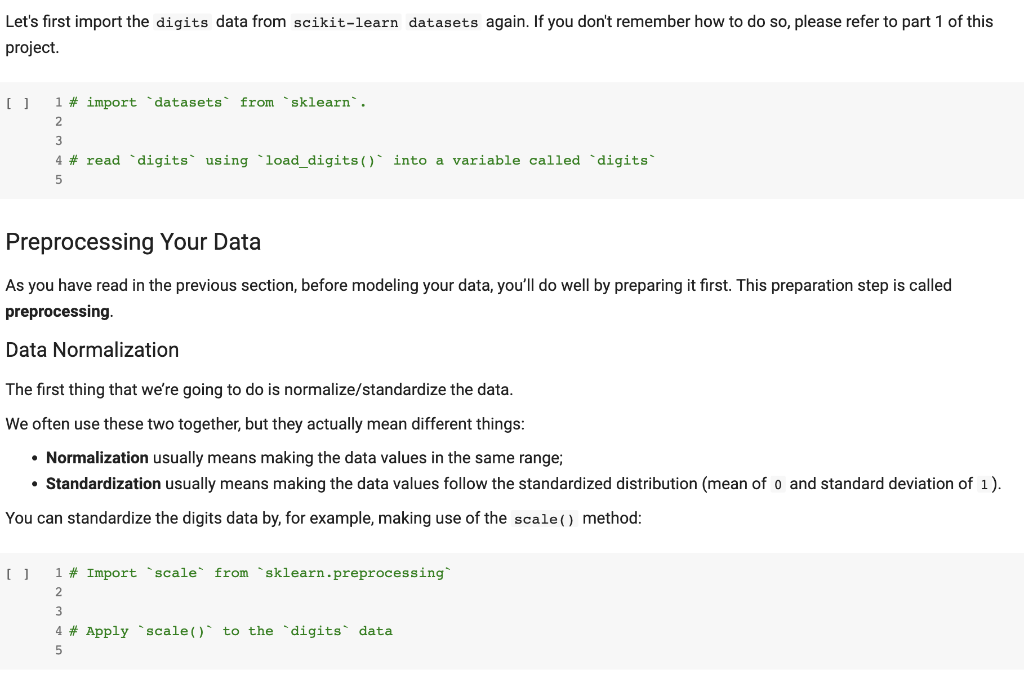
Let's first import the digits data from scikit-learn datasets again. If you don't remember how to do so, please refer to part 1 of this project. [ ] 1 \# import 'datasets' from 'sklearn'. 4 \# read 'digits' using 'load_digits()' into a variable called 'digits' Preprocessing Your Data As you have read in the previous section, before modeling your data, you'll do well by preparing it first. This preparation step is called preprocessing. Data Normalization The first thing that we're going to do is normalize/standardize the data. We often use these two together, but they actually mean different things: - Normalization usually means making the data values in the same range; - Standardization usually means making the data values follow the standardized distribution (mean of 0 and standard deviation of 1 ). You can standardize the digits data by, for example, making use of the scale() method: Let's first import the digits data from scikit-learn datasets again. If you don't remember how to do so, please refer to part 1 of this project. [ ] 1 \# import 'datasets' from 'sklearn'. 4 \# read 'digits' using 'load_digits()' into a variable called 'digits' Preprocessing Your Data As you have read in the previous section, before modeling your data, you'll do well by preparing it first. This preparation step is called preprocessing. Data Normalization The first thing that we're going to do is normalize/standardize the data. We often use these two together, but they actually mean different things: - Normalization usually means making the data values in the same range; - Standardization usually means making the data values follow the standardized distribution (mean of 0 and standard deviation of 1 ). You can standardize the digits data by, for example, making use of the scale() method
Step by Step Solution
There are 3 Steps involved in it

Get step-by-step solutions from verified subject matter experts
 Study Help