







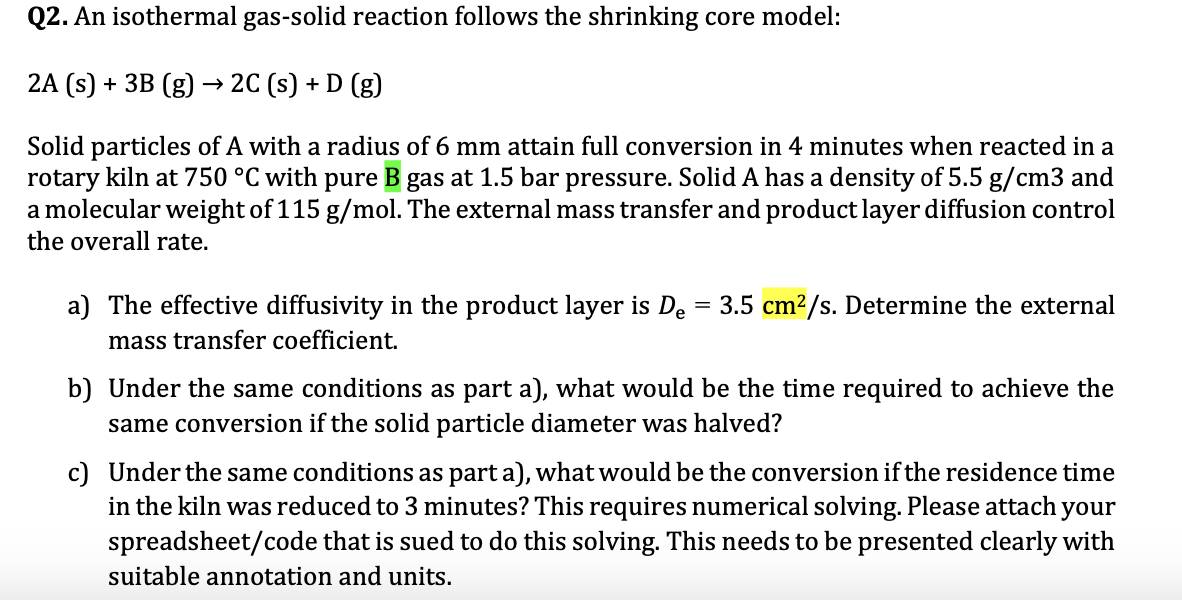
Question: Q 2 . An isothermal gas - solid reaction follows the shrinking core model: 2 A ( s ) + 3 B ( g )
Q An isothermal gassolid reaction follows the shrinking core model:
Solid particles of A with a radius of attain full conversion in minutes when reacted in a
rotary kiln at with pure gas at bar pressure. Solid A has a density of and
a molecular weight of The external mass transfer and product layer diffusion control
the overall rate.
a The effective diffusivity in the product layer is Determine the external
mass transfer coefficient.
b Under the same conditions as part a what would be the time required to achieve the
same conversion if the solid particle diameter was halved?
c Under the same conditions as part a what would be the conversion if the residence time
in the kiln was reduced to minutes? This requires numerical solving. Please attach your
spreadsheetcode that is sued to do this solving. This needs to be presented clearly with
suitable annotation and units.
Step by Step Solution
There are 3 Steps involved in it
1 Expert Approved Answer
Step: 1 Unlock

Question Has Been Solved by an Expert!
Get step-by-step solutions from verified subject matter experts
Step: 2 Unlock
Step: 3 Unlock
 Study Help