







Question: Q1 (a) (b) Use Hooke's law to derive an expression for the shear modulus G in terms of Young's modulus E and the Poisson's
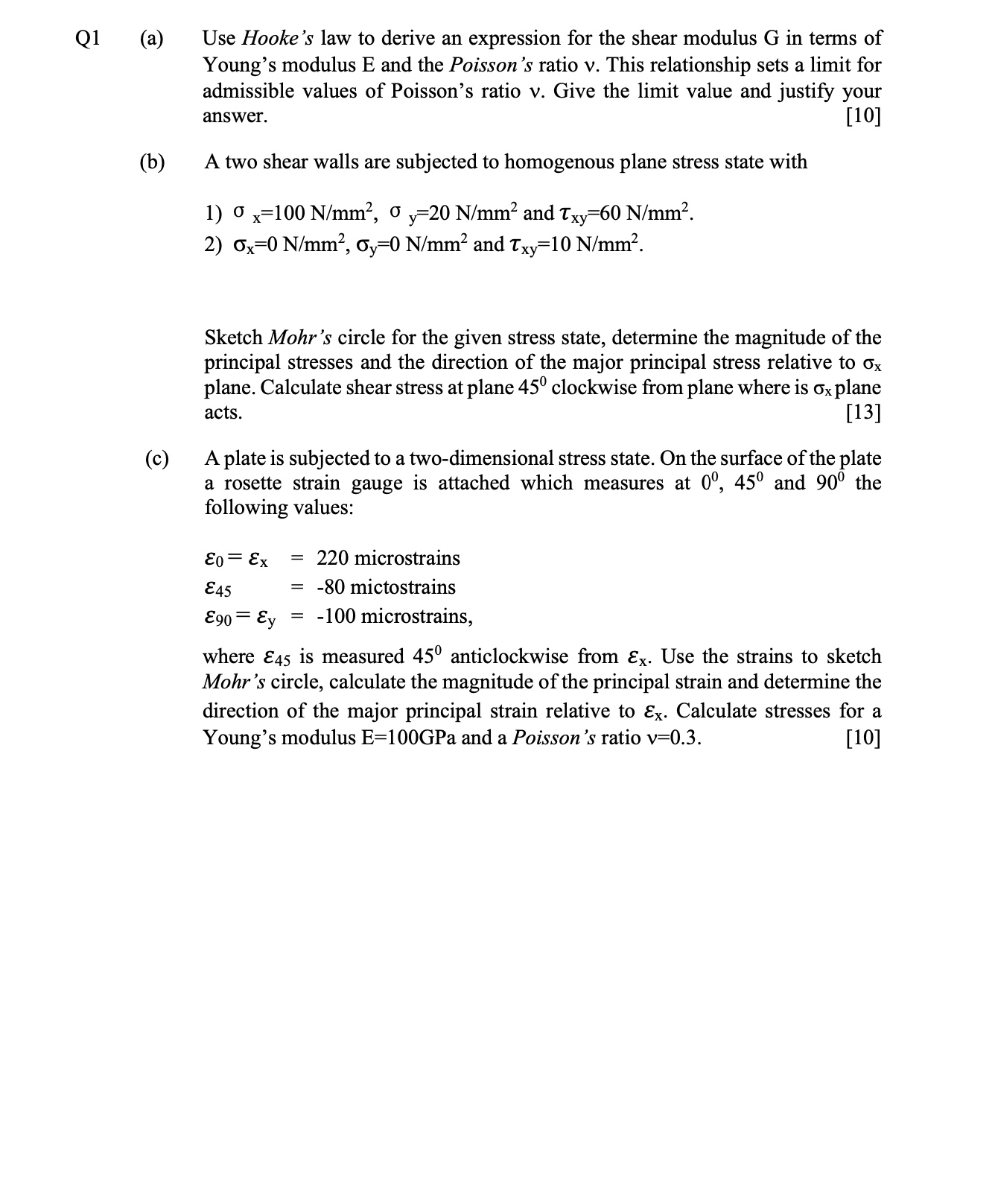
Q1 (a) (b) Use Hooke's law to derive an expression for the shear modulus G in terms of Young's modulus E and the Poisson's ratio v. This relationship sets a limit for admissible values of Poisson's ratio v. Give the limit value and justify your [10] answer. A two shear walls are subjected to homogenous plane stress state with 1) 0 x 100 N/mm, oy-20 N/mm and Txy=60 N/mm. 2) Ox=0 N/mm, oy=0 N/mm and Txy=10 N/mm. Sketch Mohr's circle for the given stress state, determine the magnitude of the principal stresses and the direction of the major principal stress relative to ox plane. Calculate shear stress at plane 45 clockwise from plane where is Ox plane [13] acts. (c) A plate is subjected to a two-dimensional stress state. On the surface of the plate a rosette strain gauge is attached which measures at 0, 45 and 90 the following values: 0 = Ex E45 E90 Ey = 220 microstrains -80 mictostrains = -100 microstrains, where 45 is measured 45 anticlockwise from Ex. Use the strains to sketch Mohr's circle, calculate the magnitude of the principal strain and determine the direction of the major principal strain relative to Ex. Calculate stresses for a Young's modulus E=100GPa and a Poisson's ratio v=0.3. [10]
Step by Step Solution
There are 3 Steps involved in it
a To derive the expression for the shear modulus G in terms of Youngs modulus E and Poissons ratio v we start with Hookes law for isotropic materials ... View full answer

Get step-by-step solutions from verified subject matter experts
 Study Help