







Question: Q4. Design a 3-bit Gray Code Counter with its initial value as 000. A Gray Code Counter is like a normal incremental counter, except that
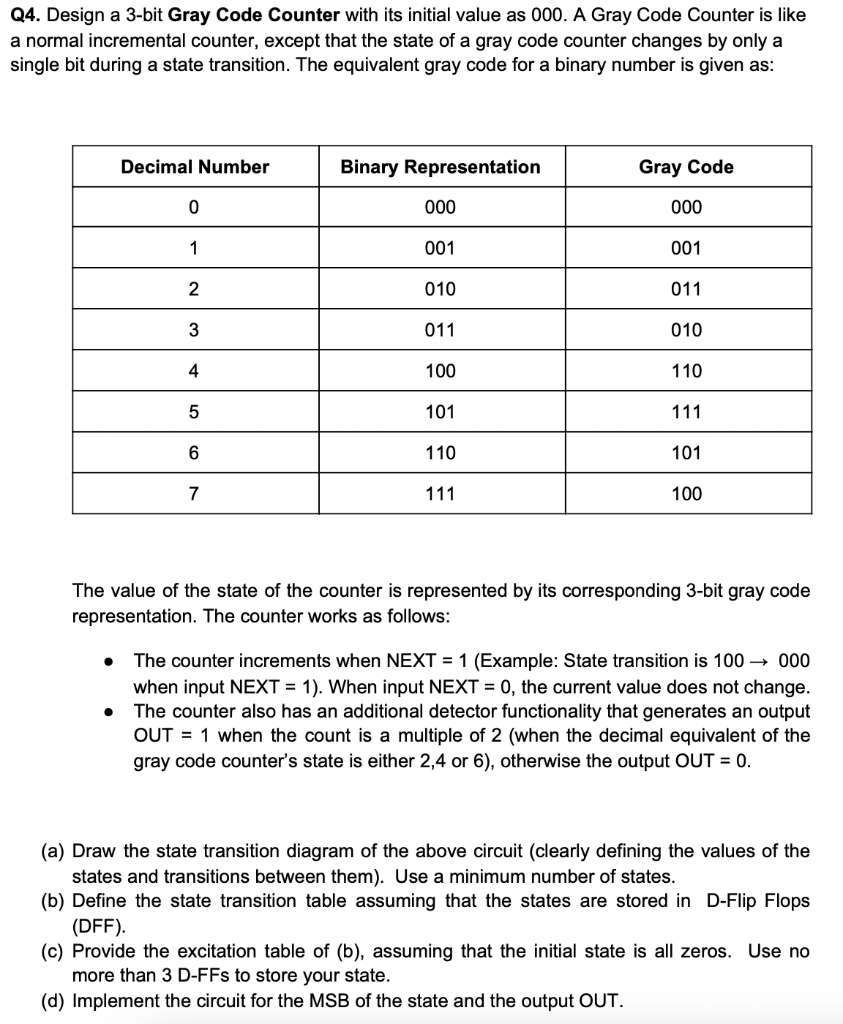
Q4. Design a 3-bit Gray Code Counter with its initial value as 000. A Gray Code Counter is like a normal incremental counter, except that the state of a gray code counter changes by only a single bit during a state transition. The equivalent gray code for a binary number is given as: Decimal Number Binary Representation Gray Code 0 000 000 1 001 001 2 010 011 3 011 010 4 100 110 5 101 111 6 110 101 7 111 100 The value of the state of the counter is represented by its corresponding 3-bit gray code representation. The counter works as follows: . . The counter increments when NEXT = 1 (Example: State transition is 100 000 when input NEXT = 1). When input NEXT = 0, the current value does not change. The counter also has an additional detector functionality that generates an output OUT = 1 when the count is a multiple of 2 (when the decimal equivalent of the gray code counter's state is either 2,4 or 6), otherwise the output OUT = 0. (a) Draw the state transition diagram of the above circuit (clearly defining the values of the states and transitions between them). Use a minimum number of states. (b) Define the state transition table assuming that the states are stored in D-Flip Flops (DFF). (C) Provide the excitation table of (b), assuming that the initial state is all zeros. Use no more than 3 D-FFs to store your state. (d) Implement the circuit for the MSB of the state and the output OUT
Step by Step Solution
There are 3 Steps involved in it

Get step-by-step solutions from verified subject matter experts
 Study Help