







Question: Qantas Case Study E CASE 1 QANTAS 319 QUESTIONS 1 Based on the above forecast financial performance and assumptions, calculate the value of Qantas' shares
Qantas Case Study E
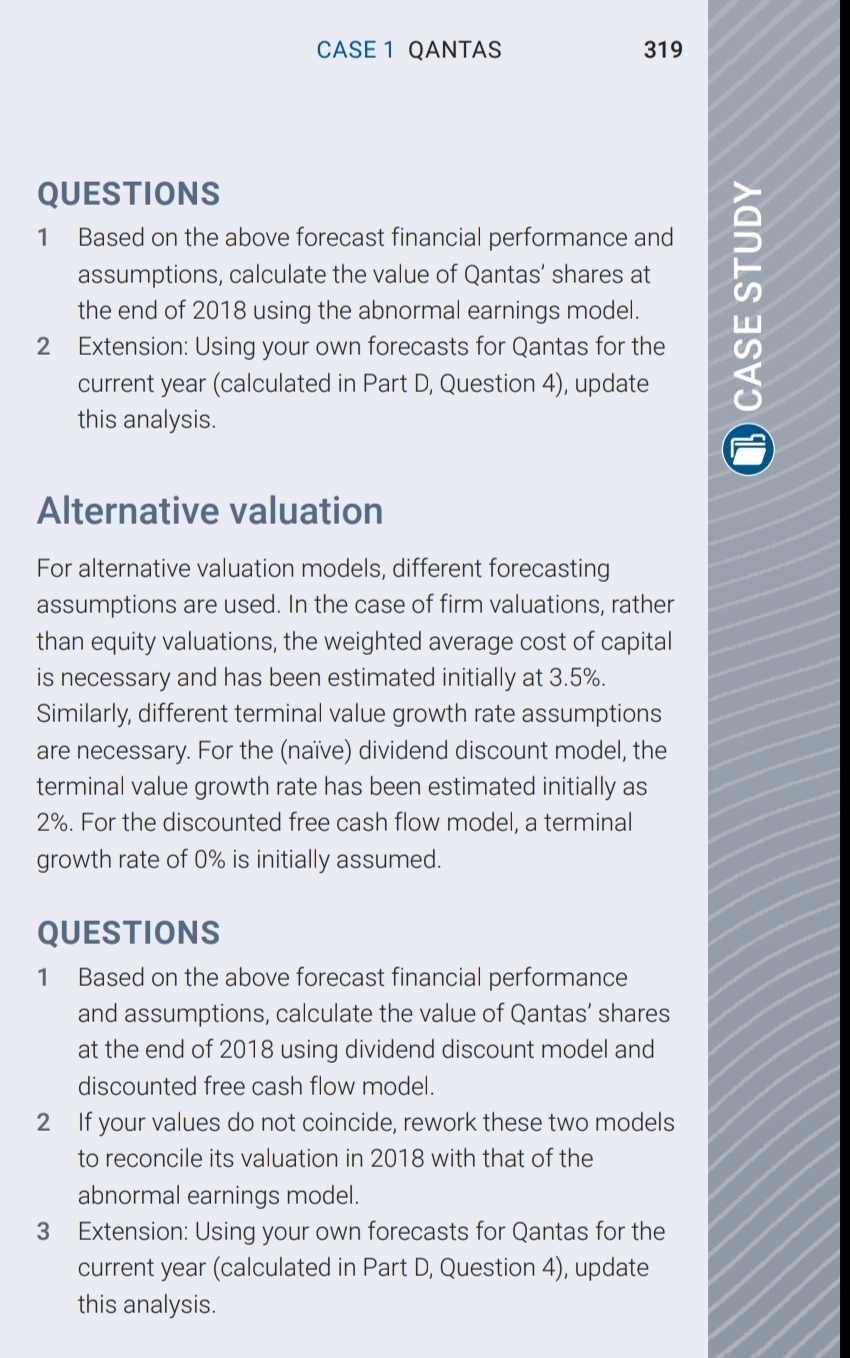
CASE 1 QANTAS 319 QUESTIONS 1 Based on the above forecast financial performance and assumptions, calculate the value of Qantas' shares at CASE STUDY the end of 2018 using the abnormal earnings model. 2 Extension: Using your own forecasts for Qantas for the current year (calculated in Part D, Question 4), update this analysis. Alternative valuation For alternative valuation models, different forecasting assumptions are used. In the case of firm valuations, rather than equity valuations, the weighted average cost of capital is necessary and has been estimated initially at 3.5%. Similarly, different terminal value growth rate assumptions are necessary. For the (naive) dividend discount model, the terminal value growth rate has been estimated initially as 2%. For the discounted free cash flow model, a terminal growth rate of 0% is initially assumed. QUESTIONS 1 Based on the above forecast financial performance and assumptions, calculate the value of Qantas' shares at the end of 2018 using dividend discount model and discounted free cash flow model. 2 If your values do not coincide, rework these two models to reconcile its valuation in 2018 with that of the abnormal earnings model. 3 Extension: Using your own forecasts for Qantas for the current year (calculated in Part D, Question 4), update this analysis
Step by Step Solution
There are 3 Steps involved in it

Get step-by-step solutions from verified subject matter experts
 Study Help