





Question: Question #1: (5 Marks) 1. Explain the different between typical and non- typical sequences. (2.5 Marks) 2. Mention a different between vector and scalar quantizers.
Question #1: (5 Marks) 1. Explain the different
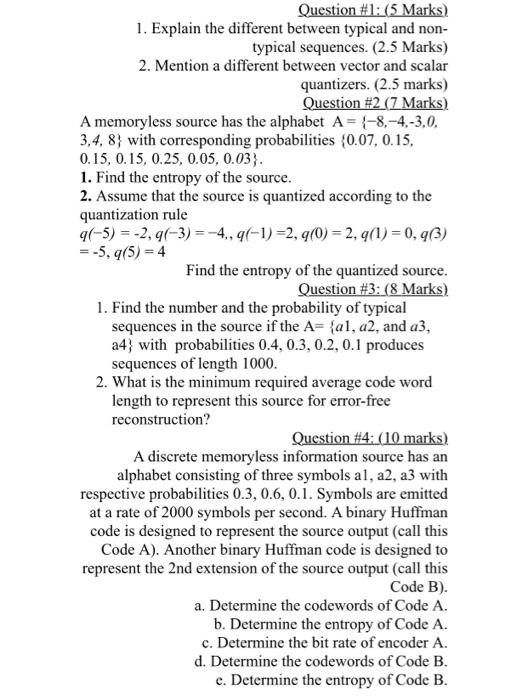
Question #1: (5 Marks) 1. Explain the different between typical and non- typical sequences. (2.5 Marks) 2. Mention a different between vector and scalar quantizers. (2.5 marks) Question #2 (7 Marks) A memoryless source has the alphabet A = {-8,-4,-3.0. 3,4,8} with corresponding probabilities (0.07, 0.15, 0.15, 0.15, 0.25, 0.05, 0.03). 1. Find the entropy of the source. 2. Assume that the source is quantized according to the quantization rule 9(-5) = -2, 9(-3)=-4., 9(-1)=2,0)= 2, 9(1) = 0,9(3) = -5,9/5) = 4 Find the entropy of the quantized source. Question #3: (8 Marks) 1. Find the number and the probability of typical sequences in the source if the A= {al, a2, and a3, a4} with probabilities 0.4, 0.3, 0.2, 0.1 produces sequences of length 1000. 2. What is the minimum required average code word length to represent this source for error-free reconstruction? Question #4: (10 marks) A discrete memoryless information source has an alphabet consisting of three symbols al, a2, a3 with respective probabilities 0.3, 0.6, 0.1. Symbols are emitted at a rate of 2000 symbols per second. A binary Huffman code is designed to represent the source output (call this Code A). Another binary Huffman code is designed to represent the 2nd extension of the source output (call this Code B). a. Determine the codewords of Code A. b. Determine the entropy of Code A. c. Determine the bit rate of encoder A. d. Determine the codewords of Code B. e. Determine the entropy of Code B

Step by Step Solution

There are 3 Steps involved in it

1 Expert Approved Answer
Step: 1 Unlock blur-text-image

Question Has Been Solved by an Expert!

Get step-by-step solutions from verified subject matter experts

Step: 2 Unlock
Step: 3 Unlock

Students Have Also Explored These Related General Management Questions!