Question: Question 1 Chapter 1: Read and watch the video case Using Operations to Create Value at Crayola on page 34 of the textbook and provide
Question 1
Chapter 1: Read and watch the video case Using Operations to Create Value at Crayola on page 34 of the textbook and provide your answers to the following questions. Your answers to parts b and c must be specific to the competitive priority you identified in part a.
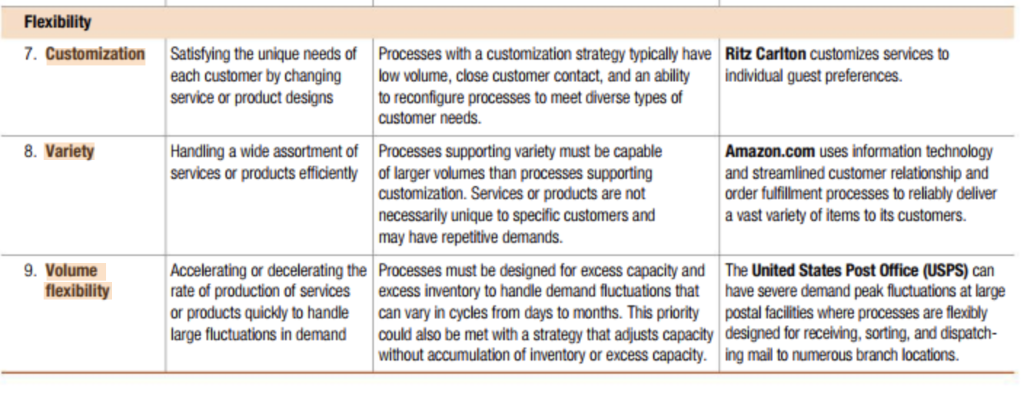
- Identify and state one of Crayolas competitive priorities from the list of nine competitive priorities presented in Table 1.3 on pages 12-13 of the textbook.
- Discuss Crayolas capabilities to achieve the identified competitive priority.
- Discuss possible opportunities and/or challenges related to the identified competitive priority as Crayola expands internationally.
You can access the video from Multimedia Library on MyOMLabs website.
Question 2
Chapter 2: Describe a process you are familiar with and draw a flowchart for the process. Make sure all the steps of the process and the arrows used to show the flow are clearly illustrated in your chart. Make sure to include a legend. See Figure 2.16 on page 86 of the textbook for an example.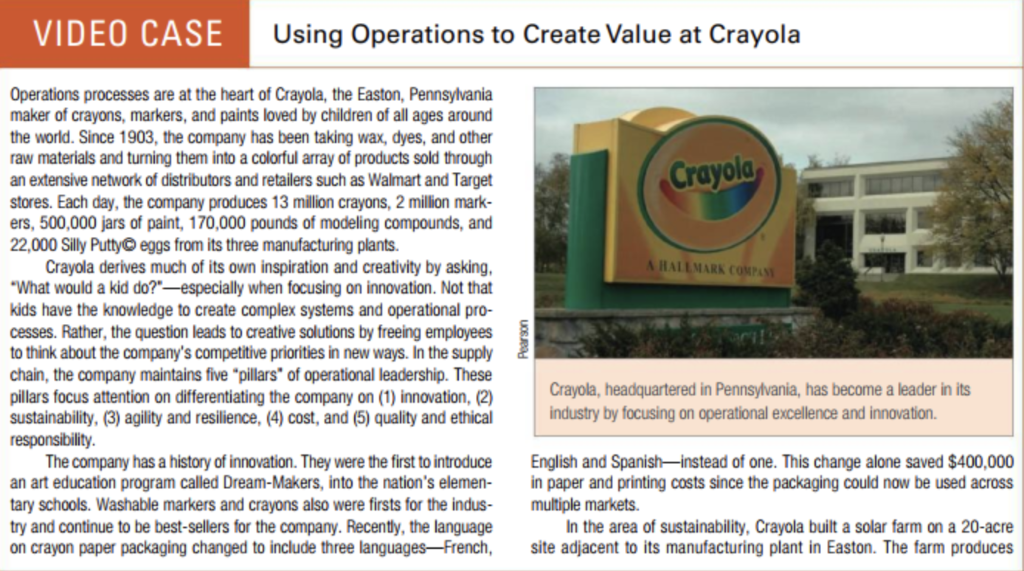
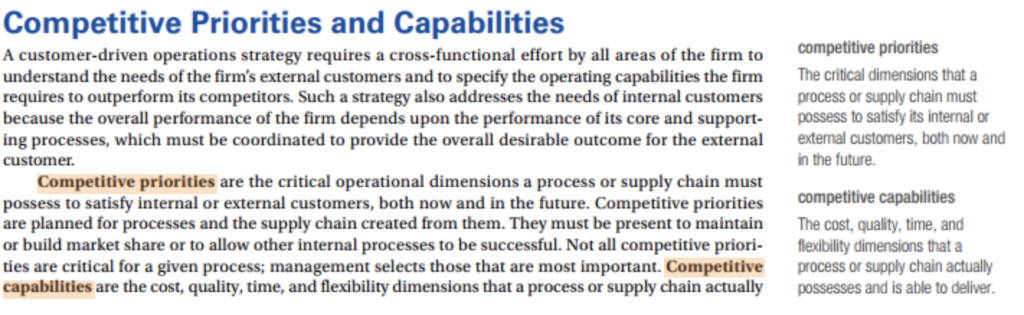
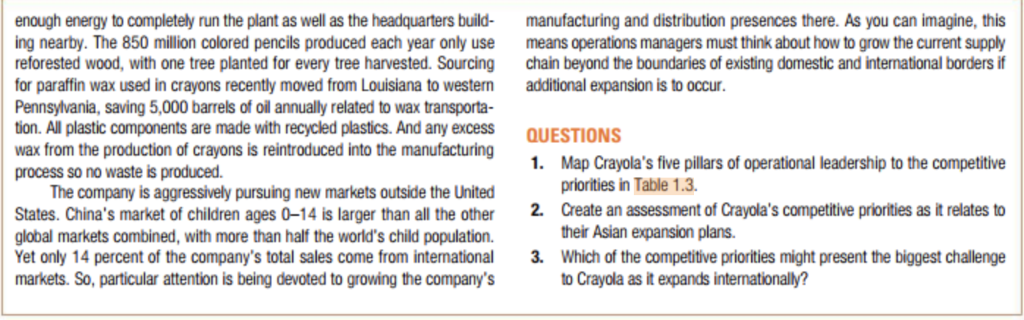
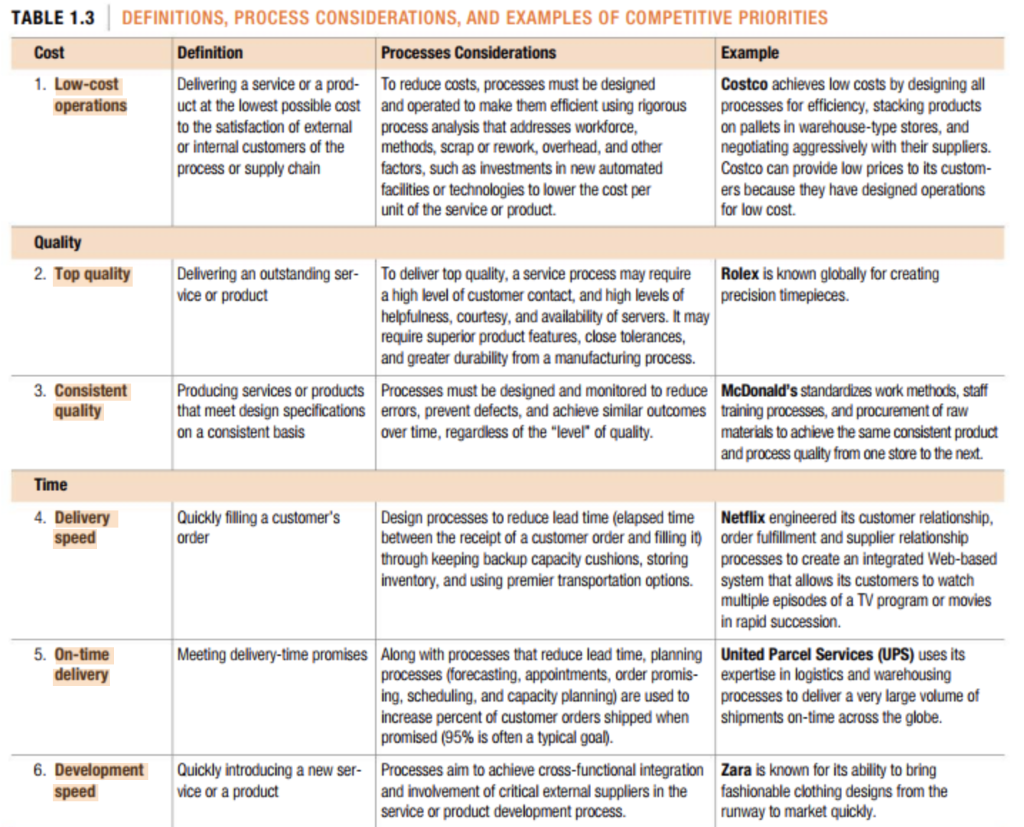
Using Operations to Create Value at Crayola Operations processes are at the heart of Crayola, the Easton, Pennsylvania maker of crayons, markers, and paints loved by children of all ages around the world. Since 1903, the company has been taking wax, dyes, and other raw materials and turning them into a colorful array of products sold through an extensive network of distributors and retailers such as Walmart and Target stores. Each day, the company produces 13 million crayons, 2 million markers, 500,000 jars of paint, 170,000 pounds of modeling compounds, and 22,000 Silly Putty egs from its three manufacturing plants. Crayola derives much of its own inspiration and creativity by asking, "What would a kid do?"-especially when focusing on innovation. Not that kids have the knowledge to create complex systems and operational processes. Rather, the question leads to creative solutions by freeing employees to think about the company's competitive priorities in new ways. In the supply chain, the company maintains five "pillars" of operational leadership. These pillars focus attention on differentiating the company on (1) innovation, (2) sustainability, (3) agility and resilience, (4) cost, and (5) quality and ethical responsibility. responsibility. The company has a history of innovation. They were the first to introduce English and Spanish-instead of one. This change alone saved $400,000 an art education program called Dream-Makers, into the nation's elemen- in paper and printing costs since the packaging could now be used across tary schools. Washable markers and crayons also were firsts for the indus- multiple markets. try and continue to be best-sellers for the company. Recently, the language In the area of sustainability, Crayola built a solar farm on a 20 -acre on crayon paper packaging changed to include three languages-French, site adjacent to its manufacturing plant in Easton. The farm produces Competitive Priorities and Capabilities enough energy to completely run the plant as well as the headquarters build- manufacturing and distribution presences there. As you can imagine, this ing nearby. The 850 million colored pencils produced each year only use means operations managers must think about how to grow the current supply reforested wood, with one tree planted for every tree harvested. Sourcing chain beyond the boundaries of existing domestic and international borders if for paraffin wax used in crayons recently moved from Louisiana to western additional expansion is to occur. Pennsylvania, saving 5,000 barrels of oil annually related to wax transportation. All plastic components are made with recycled plastics. And any excess wax from the production of crayons is reintroduced into the manufacturing QUESTIONS process so no waste is produced. 1. Map Crayola's five pillars of operational leadership to the competitive The company is aggressively pursuing new markets outside the United priorities in Table 1.3. States. China's market of children ages 014 is larger than all the other 2. Create an assessment of Crayola's competitive priorities as it relates to global markets combined, with more than half the world's child population. their Asian expansion plans. Yet only 14 percent of the company's total sales come from intemational 3. Which of the competitive priorities might present the biggest challenge markets. So, particular attention is being devoted to growing the company's \begin{tabular}{l|l} TABLE 1.3 & DEFINITIONS, PROCESS CONSIDERATIONS, AND EXAMPLES OF COMPETITIVE PRIORITIES \end{tabular}









 Study Help