







Question: Question 1: Consider two students working together on a group assignment for a Game Theory course. Student 1 is grade focussed and wants to do
Question 1:Consider two students working together on a group assignment for a Game Theory course. Student 1 is grade focussed and wants to do well in the course but considers e?ort costly and prefers less work to more. Student 2 might be either studious or lazy with equal probability. If student 2 is studious then they care both about grades and learning. If student 2 is lazy then they value grades but hates work. As long as someone does the work then they will do well in the project. Both students have the option of working (W) on the project this weekend or going to a party (P) and must make the decision independently without observing the other's choice. The payoffs for student 1 and each type of student 2 are as follows.
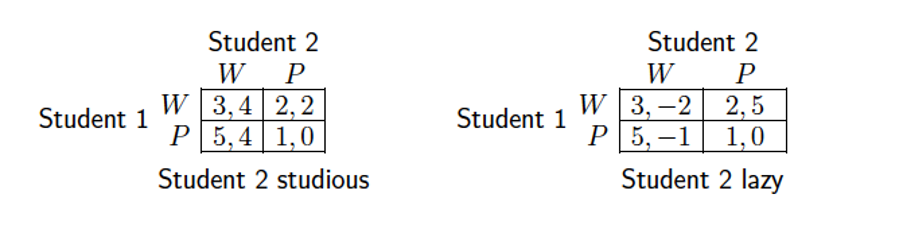
(a) Draw the extensive form of this game. (4 Marks)
(b) Draw the three player normal form game after the Bayesian transformation and define payoffs for each of the three players (student 1, student 2 studious and student 2 lazy). (5 Marks)
(c) Find the set of Bayesian Nash equilibrium of this game. (6 Marks)
Question 2: Apple and Samsung are the only two producers of smartphones in Australia. Every year they set the price of their phones for the rest of the year. Suppose they can either price their phones Low or High. If one company set the price Low and the other set it High, then the low-price company would receive a profit equal to 400 while the company with the high price only receives 100. If they both set the price low they both receive 200. Finally, if the both decide to set their prices high the each receive 300.
- What is the Nash equilibrium of this game if it is only played once? (5 marks)
- What is the subgame perfect equilibrium of this game if both firms play the same game for T periods? (5 marks)
- Suppose in 10 years AI would replace smart phones and both companies go bankrupt. However currently neither of the two firms know what will happen in 10 years from now and have no expectation about this possibility. Is it possible to support an equilibrium in which both firms set a high price in all periods? (7 marks)
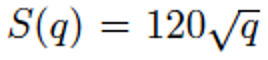
Question 3: A British consulting firm specialising in environmental management has chosen a graduate from the RMIT University to join their team. The task of finalising the employment contract, which should stipulate the number of billable tasks the graduate must complete daily and the corresponding remuneration, lies with the human resource team. While the HR team can review the graduate's outstanding academic achievements, they remain uncertain about the graduate's effort cost for billable tasks. However, they've estimated this cost to be 4 with a 75% chance and 10 with a 25% chance. The firm knows that the value of tasks completed by the graduate can be represented by:
Student 2 W P Student 2 W P W 3,4 2,2 Student 1 Student 1 W 3,-2 2,5 P 5,4 1,0 P 5,-1 1,0 Student 2 studious Student 2 lazy
Step by Step Solution
There are 3 Steps involved in it
SOLUTION Question 1 a Extensive Form of the Game Player 2 Studious W P W 34 22 Player 1 P 54 10 Player 2 Lazy W P W 32 25 Player 1 P 51 10 b Normal Form of the Bayesian Game Player 1 Student 1 Player ... View full answer

Get step-by-step solutions from verified subject matter experts
 Study Help