







Question: QUESTION: 1. Use the Maximum Likelihood method to estimate the parameters Kappa and Theta 2. Show that we cannot reach an analytical solution for the
QUESTION:
1. Use the Maximum Likelihood method to estimate the parameters "Kappa" and "Theta"
2. Show that we cannot reach an analytical solution for the maximum likelihood estimates
3. Write a function in "r" call it "NR.gam" that applies the Newton Raphson method to estimate the parameters "Kappa" and "Theta" using n = 100 observation generated by the above code. Set your initial values to be kappa_0 = sqrt(mean(y)) and theta_0 = sqrt(mean(y)). Use the convergence threshold eps = 1e-6 and max.iteration = 10000.
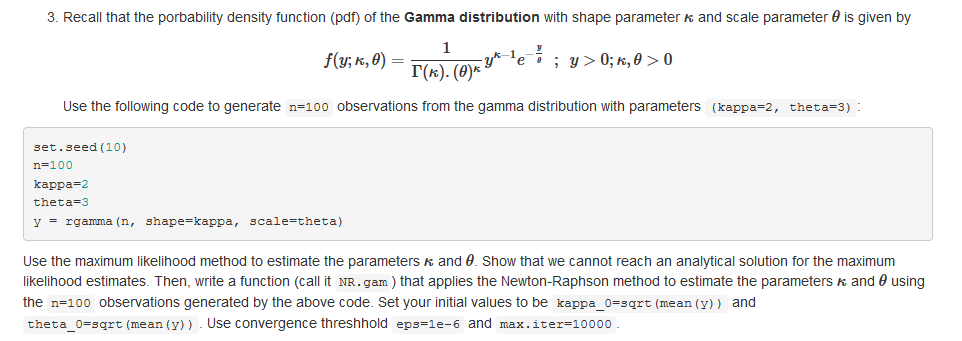
3. Recall that the porbability density function (pdf) of the Gamma distribution with shape parameter k and scale parameter 2 is given by f(y, k, ) = TG -y-le ey-1 ;y >0; k, 2 > 0 Use the following code to generate n=100 observations from the gamma distribution with parameters (kappa-2, theta=3): set.seed (10) n=100 kappa=2 theta=3 y = rgamma in, shape=kappa, scale=theta) Use the maximum likelihood method to estimate the parameters k and 0. Show that we cannot reach an analytical solution for the maximum likelihood estimates. Then, write a function (call it NR.gam ) that applies the Newton-Raphson method to estimate the parameters k and using the n=100 observations generated by the above code. Set your initial values to be kappa_0=sqrt (mean(y)) and theta_0-sqrt (mean (y)). Use convergence threshhold eps-le-6 and max. iter=10000 3. Recall that the porbability density function (pdf) of the Gamma distribution with shape parameter k and scale parameter 2 is given by f(y, k, ) = TG -y-le ey-1 ;y >0; k, 2 > 0 Use the following code to generate n=100 observations from the gamma distribution with parameters (kappa-2, theta=3): set.seed (10) n=100 kappa=2 theta=3 y = rgamma in, shape=kappa, scale=theta) Use the maximum likelihood method to estimate the parameters k and 0. Show that we cannot reach an analytical solution for the maximum likelihood estimates. Then, write a function (call it NR.gam ) that applies the Newton-Raphson method to estimate the parameters k and using the n=100 observations generated by the above code. Set your initial values to be kappa_0=sqrt (mean(y)) and theta_0-sqrt (mean (y)). Use convergence threshhold eps-le-6 and max. iter=10000
Step by Step Solution
There are 3 Steps involved in it

Get step-by-step solutions from verified subject matter experts
 Study Help