





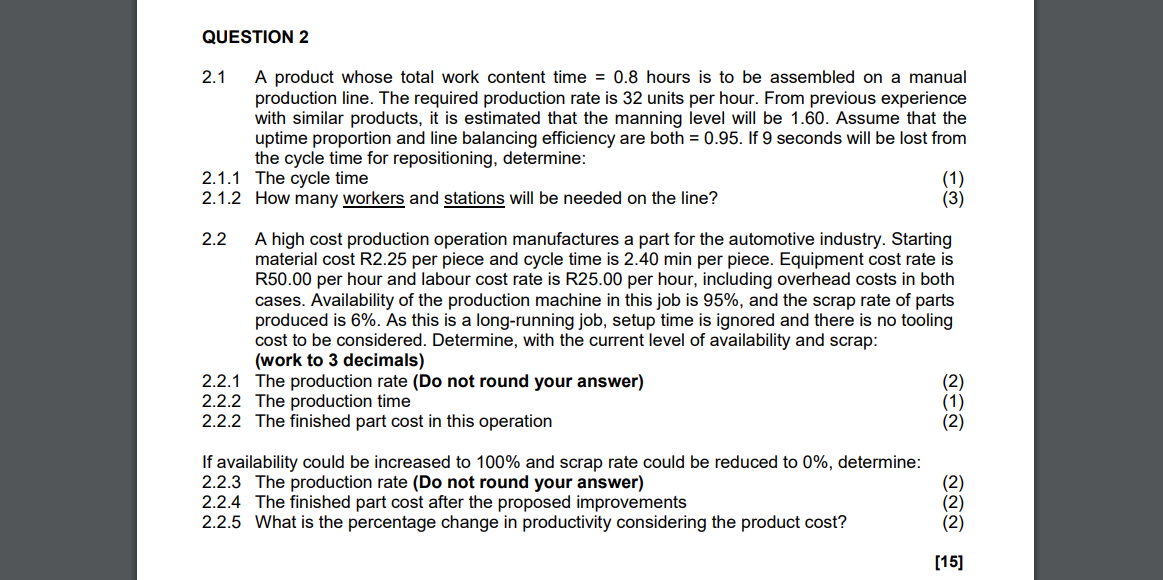
Question: QUESTION 2 2.1 A product whose total work content time = 0.8 hours is to be assembled on a manual production line. The required production
QUESTION 2 2.1 A product whose total work contentQUESTION 2 2.1 A product whose total work content

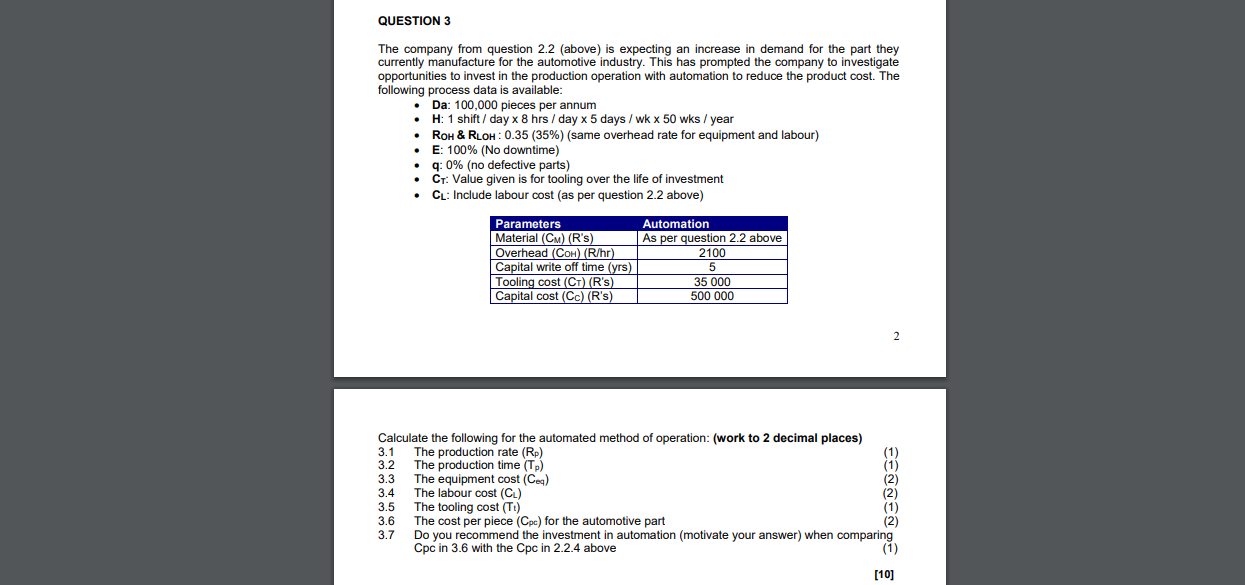
QUESTION 2 2.1 A product whose total work content time = 0.8 hours is to be assembled on a manual production line. The required production rate is 32 units per hour. From previous experience with similar products, it is estimated that the manning level will be 1.60. Assume that the uptime proportion and line balancing efficiency are both = 0.95. If 9 seconds will be lost from the cycle time for repositioning, determine: 2.1.1 The cycle time (1) 2.1.2 How many workers and stations will be needed on the line? (3) 2.2 A high cost production operation manufactures a part for the automotive industry. Starting material cost R2.25 per piece and cycle time is 2.40 min per piece. Equipment cost rate is R50.00 per hour and labour cost rate is R25.00 per hour, including overhead costs in both cases. Availability of the production machine in this job is 95%, and the scrap rate of parts produced is 6%. As this is a long-running job, setup time is ignored and there is no tooling cost to be considered. Determine, with the current level of availability and scrap: (work to 3 decimals) 2.2.1 The production rate (Do not round your answer) (2) 2.2.2 The production time (1) 2.2.2 The finished part cost in this operation (2) (2) If availability could be increased to 100% and scrap rate could be reduced %, determine: 2.2.3 The production rate (Do not round your answer) 2.2.4 The finished part cost after the proposed improvements 2.2.5 What is the percentage change in productivity considering the product cost? [15] QUESTION 3 The company from question 2.2 (above) is expecting an increase in demand for the part they currently manufacture for the automotive industry. This has prompted the company to investigate opportunities to invest in the production operation with automation to reduce the product cost. The following process data is available: Da: 100,000 pieces per annum H: 1 shift / day x 8 hrs/ day x 5 days / wk x 50 wks / year RoH & RLOH: 0.35 (35%) (same overhead rate for equipment and labour) E: 100% (No downtime) q: 0% (no defective parts) CT: Value given is for tooling over the life of investment CL: Include labour cost (as per question 2.2 above) Parameters Material (CM) (R's) Overhead (Coh) (R/hr) Capital write off time (yrs) Tooling cost (CT) (R's) Capital cost (Cc) (R's) Automation As per question 2.2 above 2100 5 35 000 500 000 W Calculate the following for the automated method of operation: (work to 2 decimal places) 3.1 The production rate (Rp) 3.2 The production time (Tp) 3.3 The equipment cost (Ce) 3.4 The labour cost (CL) 3.5 The tooling cost (Tt) 3.6 The cost per piece (Cp) for the automotive part 3.7 Do you recommend the investment in automation (motivate your answer) when comparing Cpc in 3.6 with the Cpc in 2.2.4 above (1) eeaaed.ee [10]

Step by Step Solution

There are 3 Steps involved in it

1 Expert Approved Answer
Step: 1 Unlock blur-text-image

Question Has Been Solved by an Expert!

Get step-by-step solutions from verified subject matter experts

Step: 2 Unlock
Step: 3 Unlock

Students Have Also Explored These Related General Management Questions!