







Question: A theoretical force balance for a control valve as the one shown below is described by a differential equation as dx follows PA, +
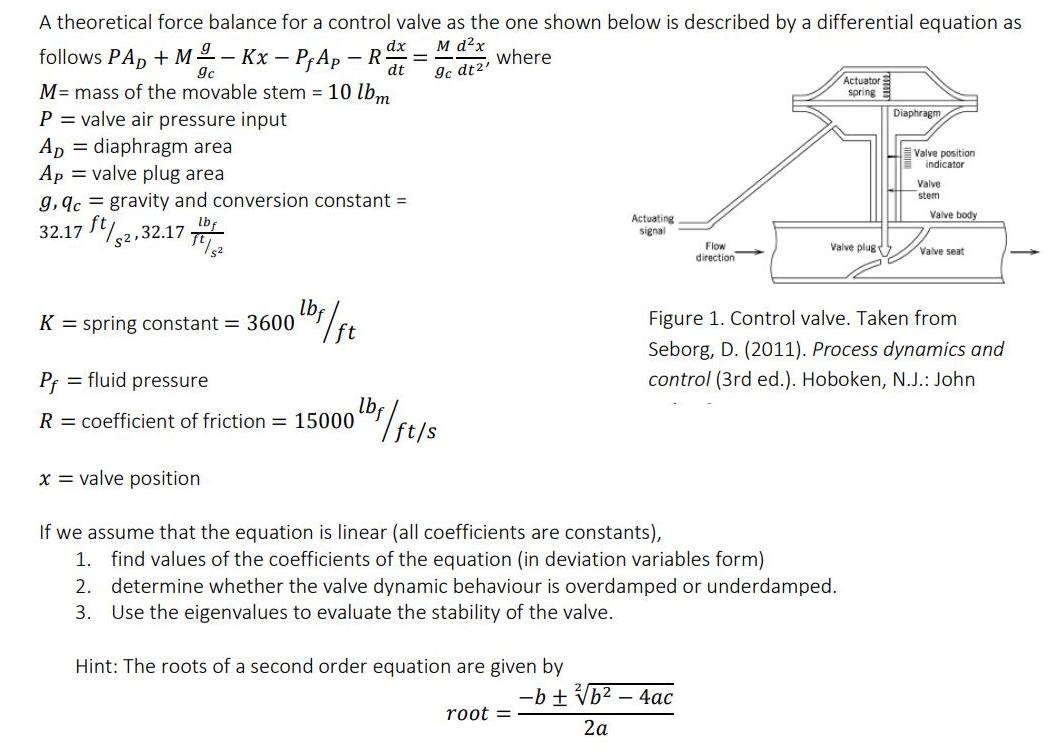
A theoretical force balance for a control valve as the one shown below is described by a differential equation as dx follows PA, + M- Kx PAp - R = " gc M= mass of the movable stem 10 lbm P = valve air pressure input where dt Ic dt2 Actuator spring Diaphragm Ap = diaphragm area Ap = valve plug area Valve position indicator Valve g,9c = gravity and conversion constant = stem Valve body 32.17 t Actuating signal s2,32.17 Valve plug Flow direction Valve seat K = spring constant = 3600 Figure 1. Control valve. Taken from ft Seborg, D. (2011). Process dynamics and = fluid pressure control (3rd ed.). Hoboken, N.J.: John R = coefficient of friction = 15000 x = valve position If we assume that the equation is linear (all coefficients are constants), 1. find values of the coefficients of the equation (in deviation variables form) 2. determine whether the valve dynamic behaviour is overdamped or underdamped. 3. Use the eigenvalues to evaluate the stability of the valve. Hint: The roots of a second order equation are given by -b + Vb2 4ac root = 2a
Step by Step Solution
3.39 Rating (155 Votes )
There are 3 Steps involved in it

Get step-by-step solutions from verified subject matter experts
 Study Help