







Question: Question 2 please 1. Explain each step in the synthesis and the purification process of the products for both types of SN reactions. 2. Give
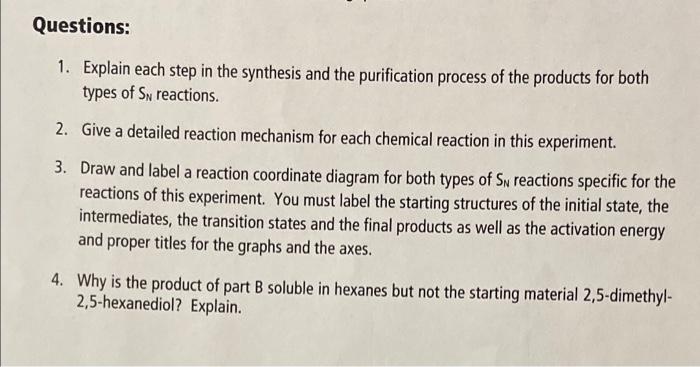
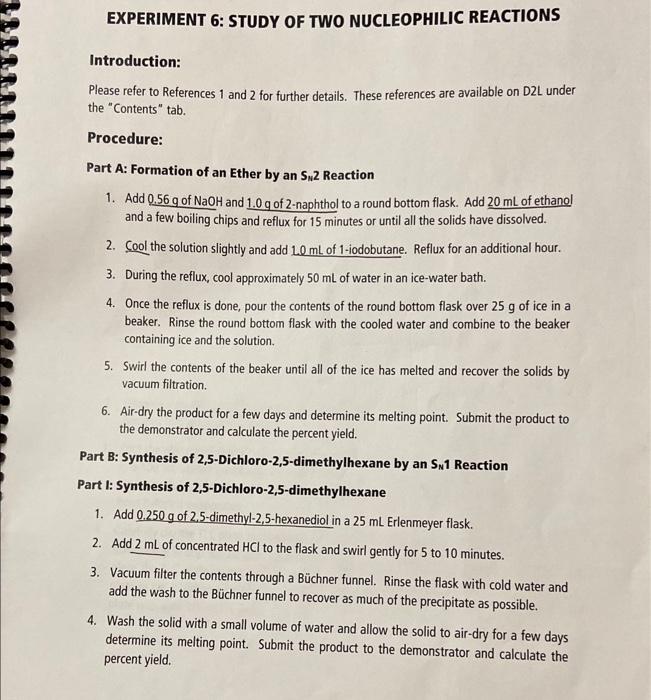
1. Explain each step in the synthesis and the purification process of the products for both types of SN reactions. 2. Give a detailed reaction mechanism for each chemical reaction in this experiment. 3. Draw and label a reaction coordinate diagram for both types of SN reactions specific for the reactions of this experiment. You must label the starting structures of the initial state, the intermediates, the transition states and the final products as well as the activation energy and proper titles for the graphs and the axes. 4. Why is the product of part B soluble in hexanes but not the starting material 2,5-dimethyl2,5-hexanediol? Explain. EXPERIMENT 6: STUDY OF TWO NUCLEOPHILIC REACTIONS Introduction: Please refer to References 1 and 2 for further details. These references are available on D2L under the "Contents" tab. Procedure: Part A: Formation of an Ether by an Sw2 Reaction 1. Add 0.56g of NaOH and 1.0g of 2 -naphthol to a round bottom flask. Add 20mL of ethanol and a few boiling chips and reflux for 15 minutes or until all the solids have dissolved. 2. Cool the solution slightly and add 10mL of 1 -iodobutane. Reflux for an additional hour. 3. During the reflux, cool approximately 50mL of water in an ice-water bath. 4. Once the reflux is done, pour the contents of the round bottom flask over 25g of ice in a beaker. Rinse the round bottom flask with the cooled water and combine to the beaker containing ice and the solution. 5. Swirl the contents of the beaker until all of the ice has melted and recover the solids by vacuum filtration. 6. Air-dry the product for a few days and determine its melting point. Submit the product to the demonstrator and calculate the percent yield. Part B: Synthesis of 2,5-Dichloro-2,5-dimethylhexane by an SN Reaction Part I: Synthesis of 2,5-Dichloro-2,5-dimethylhexane 1. Add 0.250g of 2,5 -dimethyl-2,5-hexanediol in a 25mL Erlenmeyer flask. 2. Add 2mL of concentrated HCl to the flask and swirl gently for 5 to 10 minutes. 3. Vacuum filter the contents through a Bchner funnel. Rinse the flask with cold water and add the wash to the Bchner funnel to recover as much of the precipitate as possible. 4. Wash the solid with a small volume of water and allow the solid to air-dry for a few days determine its melting point. Submit the product to the demonstrator and calculate the percent yield
Step by Step Solution
There are 3 Steps involved in it

Get step-by-step solutions from verified subject matter experts
 Study Help