







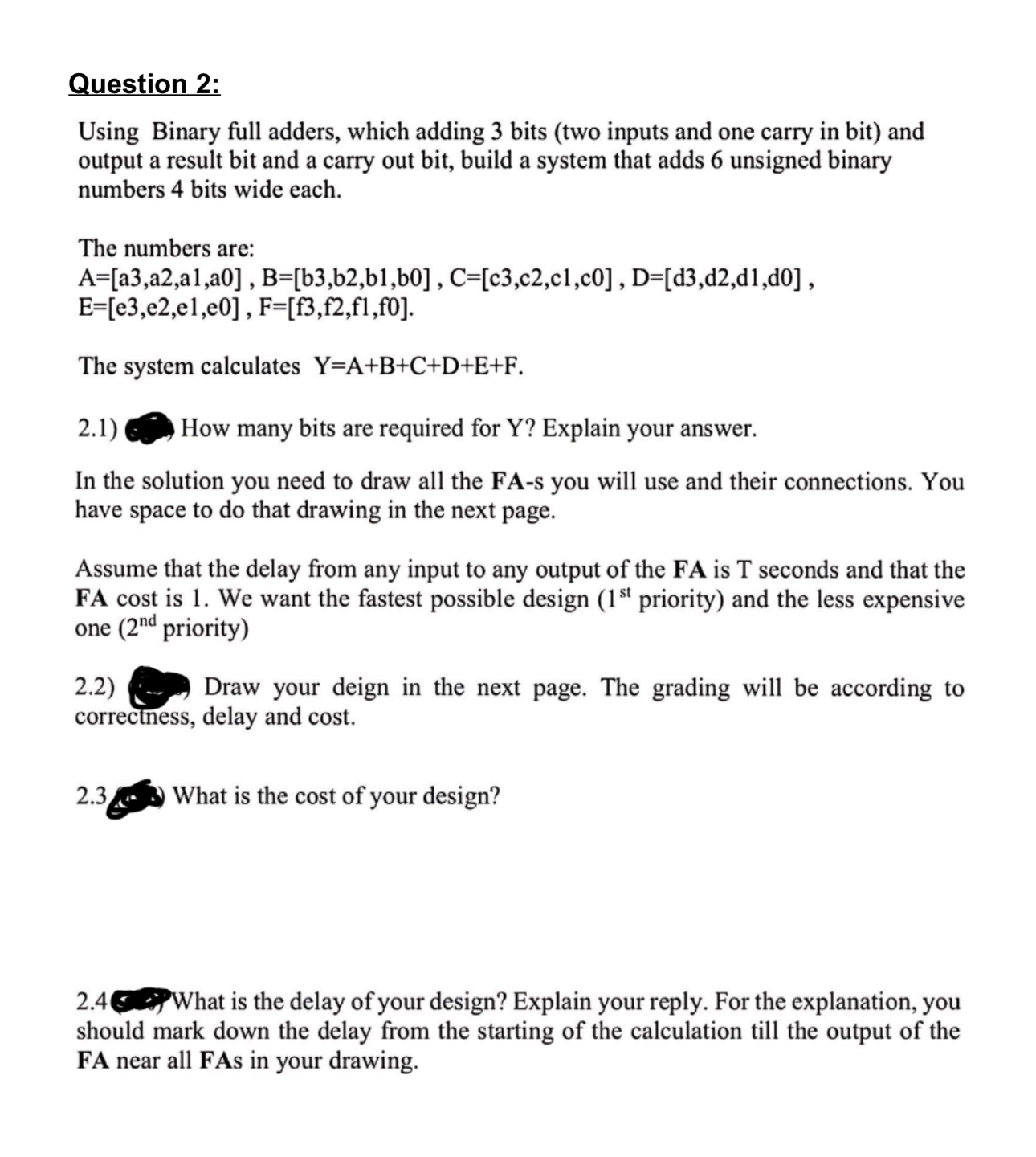
Question: Question 2 : Using Binary full adders, which adding 3 bits ( two inputs and one carry in bit ) and output a result bit
Question :
Using Binary full adders, which adding bits two inputs and one carry in bit and output a result bit and a carry out bit, build a system that adds unsigned binary numbers bits wide each.
The numbers are:
The system calculates
How many bits are required for Y Explain your answer.
In the solution you need to draw all the FAs you will use and their connections. You have space to do that drawing in the next page.
Assume that the delay from any input to any output of the FA is T seconds and that the FA cost is We want the fastest possible design priority and the less expensive one priority
Draw your deign in the next page. The grading will be according to correctness, delay and cost.
What is the cost of your design?
What is the delay of your design? Explain your reply. For the explanation, you should mark down the delay from the starting of the calculation till the output of the FA near all FAs in your drawing.
Step by Step Solution
There are 3 Steps involved in it
1 Expert Approved Answer
Step: 1 Unlock

Solution 21 How many bits are required for Y Explain your answer To determine the number of bits required for the sum Y A B C D E F consider the follo... View full answer
Question Has Been Solved by an Expert!
Get step-by-step solutions from verified subject matter experts
Step: 2 Unlock
Step: 3 Unlock
 Study Help