





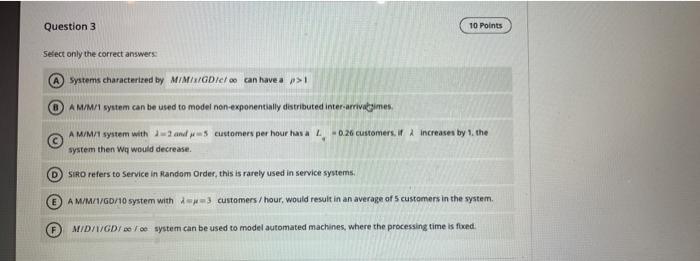
Question: Question 3 10 Points Select only the correct answers Systems characterized by M/M//GD/c/o can have a p>1 AM/M/1 system can be used to model non-exponentially
Question 3 10 Points Select only the correct
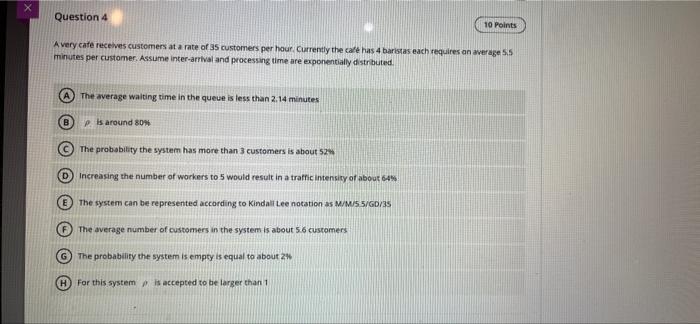
Question 3 10 Points Select only the correct answers Systems characterized by M/M//GD/c/o can have a p>1 AM/M/1 system can be used to model non-exponentially distributed inter-arrivetimes A M/M/T system with and customers per hou hasa 0.26 customers. If increases by the system then we would decrease. D SIRO refers to Service in Random Order, this is rarely used in service systems. A M/M/1/60/10 system with customers/hour, would result in an average of customers in the system. MID/W/GD/ DO / system can be used to model automated machines, where the processing time is foed X Question 4 10 Points A very cafe receives customers at a rate of 35 customers per hour Currently the cafe has 4 baristas each requires an average 55 minutes per customer. Assume inter-arrival and processing time are exponentially distributed The average waiting time in the queue is less than 2.14 minutes is around 80% The probability the system has more than 3 customers is about 52 Increasing the number of workers to 5 would result in a traffic intensity of about 64% The system can be represented according to Kindali Lee notation as M/M/55/60/35 The average number of customers in the system is about 56 customers The probability the system is empty is equal to about 2 H For this system is accepted to be larger than 1

Step by Step Solution

There are 3 Steps involved in it

1 Expert Approved Answer
Step: 1 Unlock blur-text-image

Question Has Been Solved by an Expert!

Get step-by-step solutions from verified subject matter experts

Step: 2 Unlock
Step: 3 Unlock

Students Have Also Explored These Related General Management Questions!