







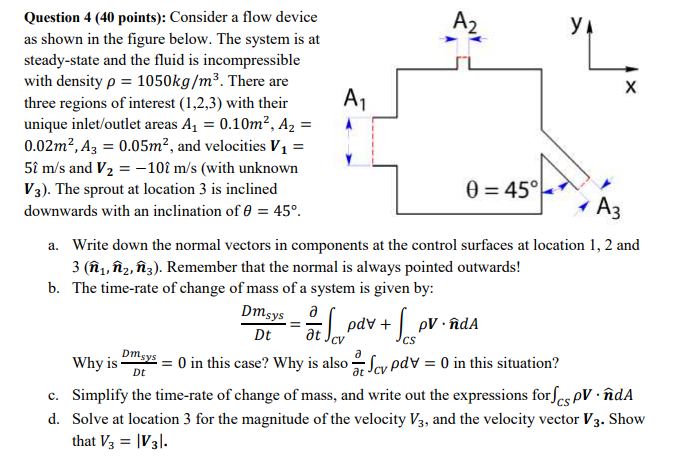
Question: Question 4 ( 4 0 points ) : Consider a flow device as shown in the figure below. The system is at steady - state
Question points: Consider a flow device
as shown in the figure below. The system is at
steadystate and the fluid is incompressible
with density rho kgm There are
three regions of interest with their
unique inletoutlet areas AmA
mAm and velocities V
hatms and VhatmsVtheta deg
a Write down the normal vectors in components at the control surfaces at location and
widehatnwidehatnwidehatn Remember that the normal is always pointed outwards!
b The timerate of change of mass of a system is given by:
DmsysDtdeldeltintCVrho dAAintCSrho VwidehatndA
Why is DmsysDt in this case? Why is also deldeltintCVrho dAA in this situation?
c Simplify the timerate of change of mass, and write out the expressions for intCSrho VhatndA
d Solve at location for the magnitude of the velocity V and the velocity vector V Show
that VV
Step by Step Solution
There are 3 Steps involved in it
1 Expert Approved Answer
Step: 1 Unlock

Question Has Been Solved by an Expert!
Get step-by-step solutions from verified subject matter experts
Step: 2 Unlock
Step: 3 Unlock
 Study Help