



Question: QUESTION 4 Consider a market with a demand curve given ( in inverse form ) by P ( Q ) = 6 0 - Q
QUESTION
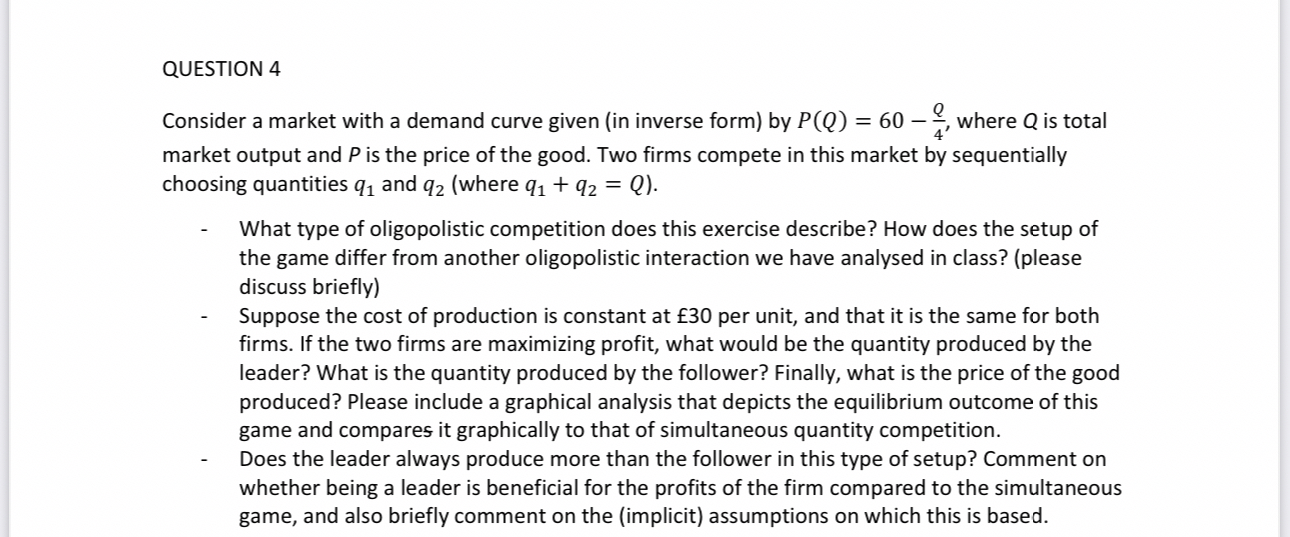
Consider a market with a demand curve given in inverse form by where is total market output and is the price of the good. Two firms compete in this market by sequentially choosing quantities and where
What type of oligopolistic competition does this exercise describe? How does the setup of the game differ from another oligopolistic interaction we have analysed in class? please discuss briefly
Suppose the cost of production is constant at per unit, and that it is the same for both firms. If the two firms are maximizing profit, what would be the quantity produced by the leader? What is the quantity produced by the follower? Finally, what is the price of the good produced? Please include a graphical analysis that depicts the equilibrium outcome of this game and compares it graphically to that of simultaneous quantity competition.
Does the leader always produce more than the follower in this type of setup? Comment on whether being a leader is beneficial for the profits of the firm compared to the simultaneous game, and also briefly comment on the implicit assumptions on which this is based.
Step by Step Solution
There are 3 Steps involved in it
1 Expert Approved Answer
Step: 1 Unlock

Question Has Been Solved by an Expert!
Get step-by-step solutions from verified subject matter experts
Step: 2 Unlock
Step: 3 Unlock