







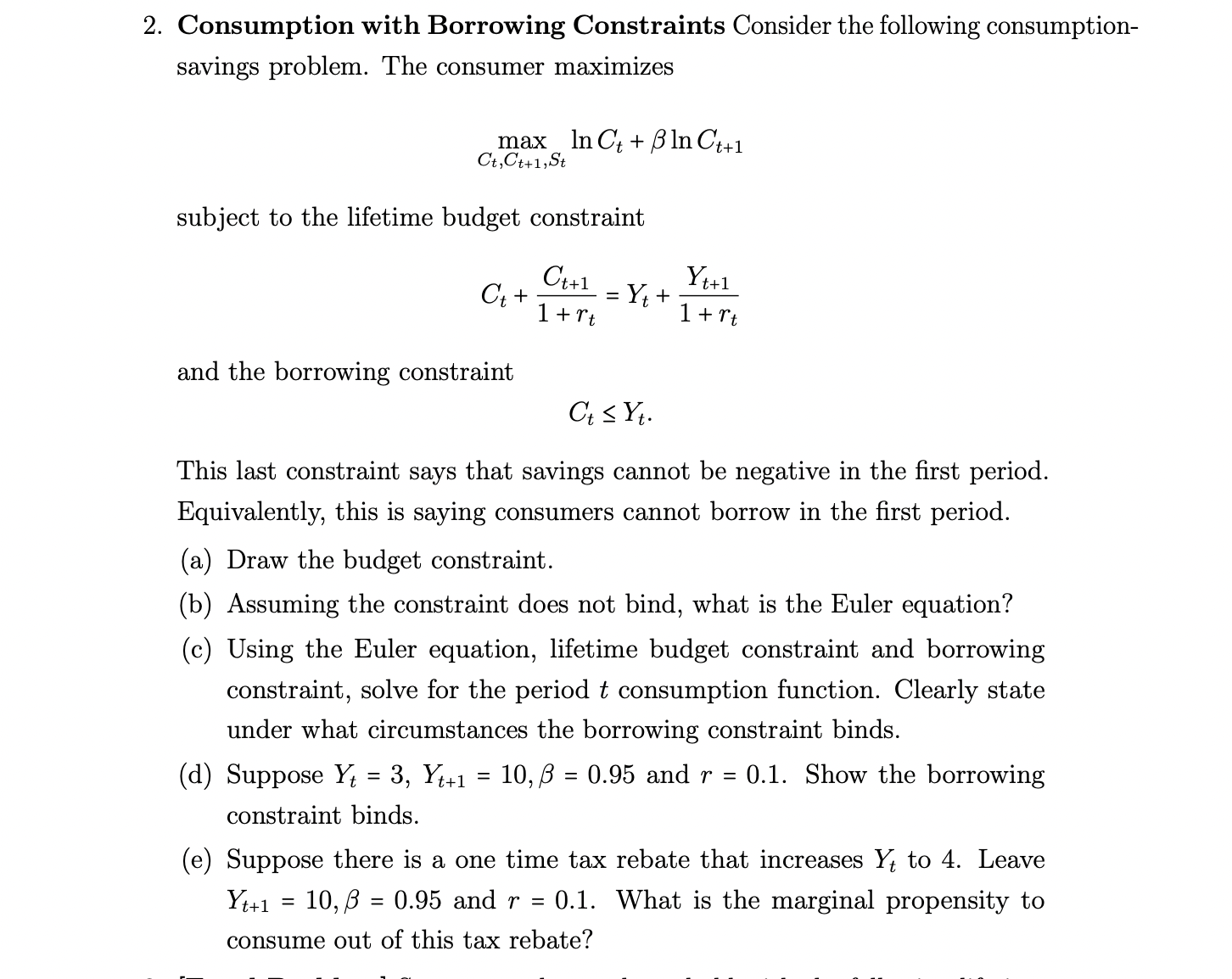
Question: Question A B C D E 2. Consumption with Borrowing Constraints Consider the following consumption- savings problem. The consumer maximizes max 1110: +lnCt 1 Cf10t+lasf
Question A B C D E
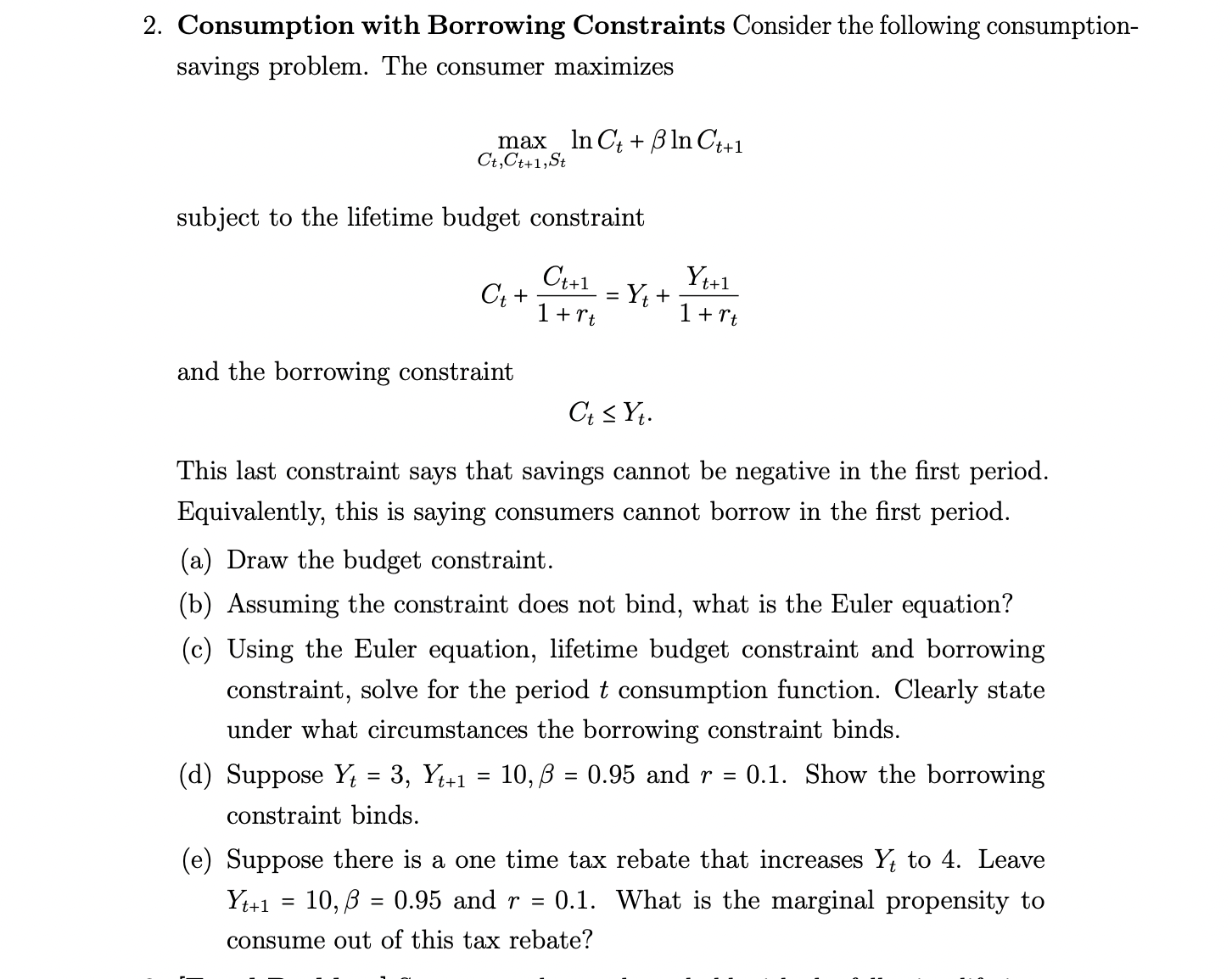
2. Consumption with Borrowing Constraints Consider the following consumption- savings problem. The consumer maximizes max 1110: +lnCt 1 Cf10t+lasf + subject to the lifetime budget constraint C Y at + t+1 : K + t+1 1 + n 1 + n and the borrowing constraint Ct g Y}. This last constraint says that savings cannot be negative in the rst period. Equivalently, this is saying consumers cannot borrow in the rst period. (a) Draw the budget constraint. (b) Assuming the constraint does not bind, what is the Euler equation? (c) Using the Euler equation, lifetime budget constraint and borrowing constraint, solve for the period t consumption function. Clearly state under what circumstances the borrowing constraint binds. (d) Suppose Y; = 3, Yt+1 2 10,0 = 0.95 and r = 0.1. Show the borrowing constraint binds. (e) Suppose there is a one time tax rebate that increases Y} to 4. Leave YE+1 2 10,3 = 0.95 and 1" = 0.1. What is the marginal prOpensity to consume out of this tax rebate
Step by Step Solution
There are 3 Steps involved in it

Get step-by-step solutions from verified subject matter experts
 Study Help