







Question: Question: Based on your reading of the case study Amazon's global supply chain, should Amazon have its own shipping platform? Do you think operating global
Question:
Based on your reading of the case study "Amazon's global supply chain", should Amazon have its own shipping platform?
Do you think operating global supply chains can be one of Amazons core competencies or should the company focus on simply connecting buyers and sellers online? Share your thoughts.
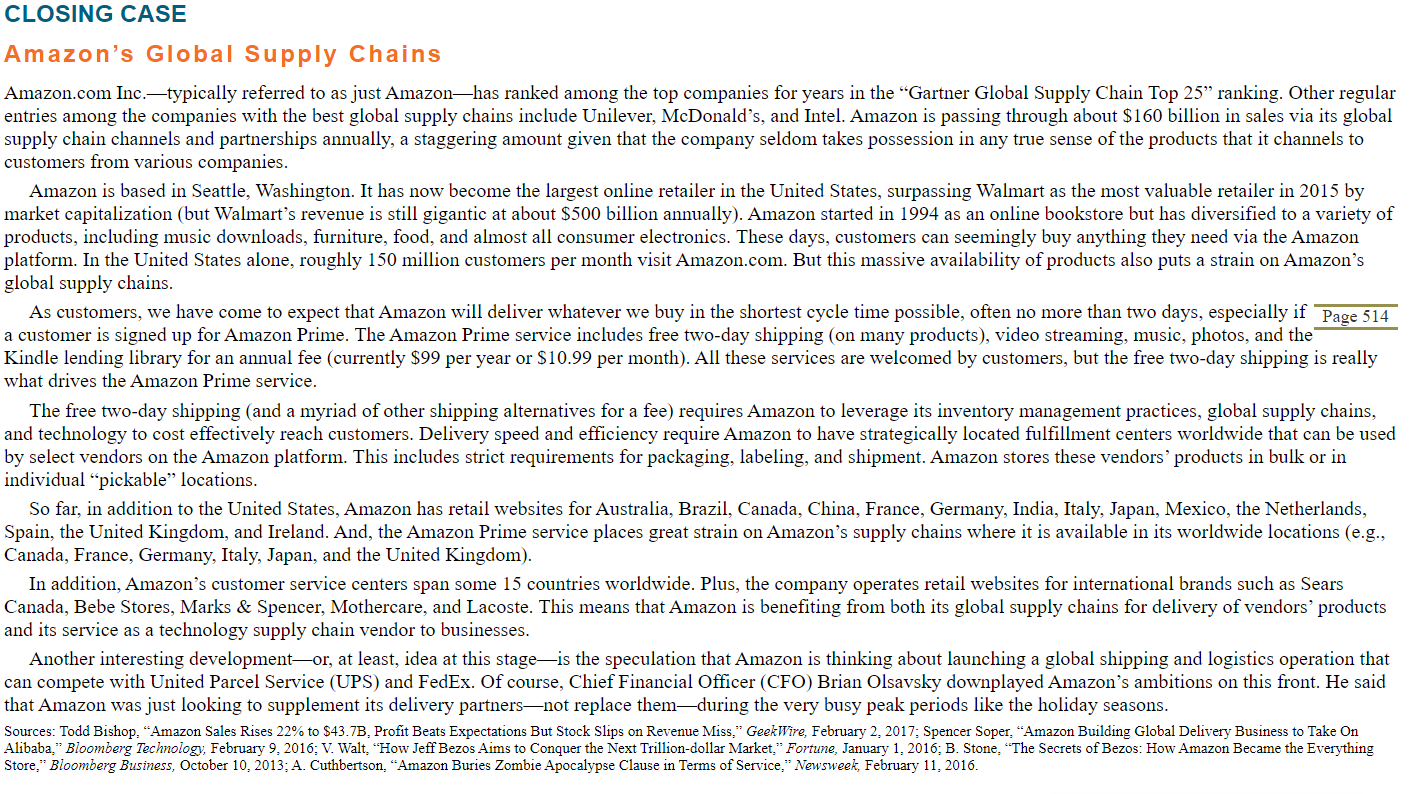
CLOSING CASE Amazon's Global Supply Chains Amazon.com Inc.typically referred to as just Amazon-has ranked among the top companies for years in the "Gartner Global Supply Chain Top 25 ranking. Other regular entries among the companies with the best global supply chains include Unilever, McDonald's, and Intel. Amazon is passing through about $160 billion in sales via its global supply chain channels and partnerships annually, a staggering amount given that the company seldom takes possession in any true sense of the products that it channels to customers from various companies. Amazon is based in Seattle, Washington. It has now become the largest online retailer in the United States, surpassing Walmart as the most valuable retailer in 2015 by market capitalization (but Walmart's revenue is still gigantic at about $500 billion annually). Amazon started in 1994 as an online bookstore but has diversified to a variety of products, including music downloads, furniture, food, and almost all consumer electronics. These days, customers can seemingly buy anything they need via the Amazon platform. In the United States alone, roughly 150 million customers per month visit Amazon.com. But this massive availability of products also puts a strain on Amazon's global supply chains. As customers, we have come to expect that Amazon will deliver whatever we buy in the shortest cycle time possible, often no more than two days, especially if Page 514 a customer is signed up for Amazon Prime. The Amazon Prime service includes free two-day shipping (on many products), video streaming, music, photos, and the Kindle lending library for an annual fee (currently $99 per year or $10.99 per month). All these services are welcomed by customers, but the free two-day shipping is really what drives the Amazon Prime service. The free two-day shipping (and a myriad of other shipping alternatives for a fee) requires Amazon to leverage its inventory management practices, global supply chains, and technology to cost effectively reach customers. Delivery speed and efficiency require Amazon to have strategically located fulfillment centers worldwide that can be used by select vendors on the Amazon platform. This includes strict requirements for packaging, labeling, and shipment. Amazon stores these vendors products in bulk or in individual pickable locations. So far, in addition to the United States, Amazon has retail websites for Australia, Brazil, Canada, China, France, Germany, India, Italy, Japan, Mexico, the Netherlands, Spain, the United Kingdom, and Ireland. And, the Amazon Prime service places great strain on Amazon's supply chains where it is available in its worldwide locations (e.g., Canada, France, Germany, Italy, Japan, and the United Kingdom). In addition, Amazon's customer service centers span some 15 countries worldwide. Plus, the company operates retail websites for international brands such as Sears Canada, Bebe Stores, Marks & Spencer, Mothercare, and Lacoste. This means that Amazon is benefiting from both its global supply chains for delivery of vendors' products and its service as a technology supply chain vendor to businesses. Another interesting developmentor, at least, idea at this stageis the speculation that Amazon is thinking about launching a global shipping and logistics operation that can compete with United Parcel Service (UPS) and FedEx. Of course, Chief Financial Officer (CFO) Brian Olsavsky downplayed Amazon's ambitions on this front. He said that Amazon was just looking to supplement its delivery partnersnot replace themduring the very busy peak periods like the holiday seasons. Sources: Todd Bishop, Amazon Sales Rises 22% to $43.7B, Profit Beats Expectations But Stock Slips on Revenue Miss," GeekWire, February 2, 2017; Spencer Soper, "Amazon Building Global Delivery Business to Take On Alibaba." Bloomberg Technology, February 9, 2016; V. Walt, "How Jeff Bezos Aims to Conquer the Next Trillion-dollar Market." Fortune, January 1, 2016; B. Stone, "The Secrets of Bezos: How Amazon Became the Everything Store." Bloomberg Business, October 10, 2013; A. Cuthbertson, "Amazon Buries Zombie Apocalypse Clause in Terms of Service," Newsweek, February 11, 2016Step by Step Solution
There are 3 Steps involved in it
1 Expert Approved Answer
Step: 1 Unlock

Question Has Been Solved by an Expert!
Get step-by-step solutions from verified subject matter experts
Step: 2 Unlock
Step: 3 Unlock
 Study Help