







Question: Question: Do you agree or disagree with the statement above? And why? Do you think cheating in high school, university or professional programs leads to
 Question:
Do you agree or disagree with the statement above? And why?
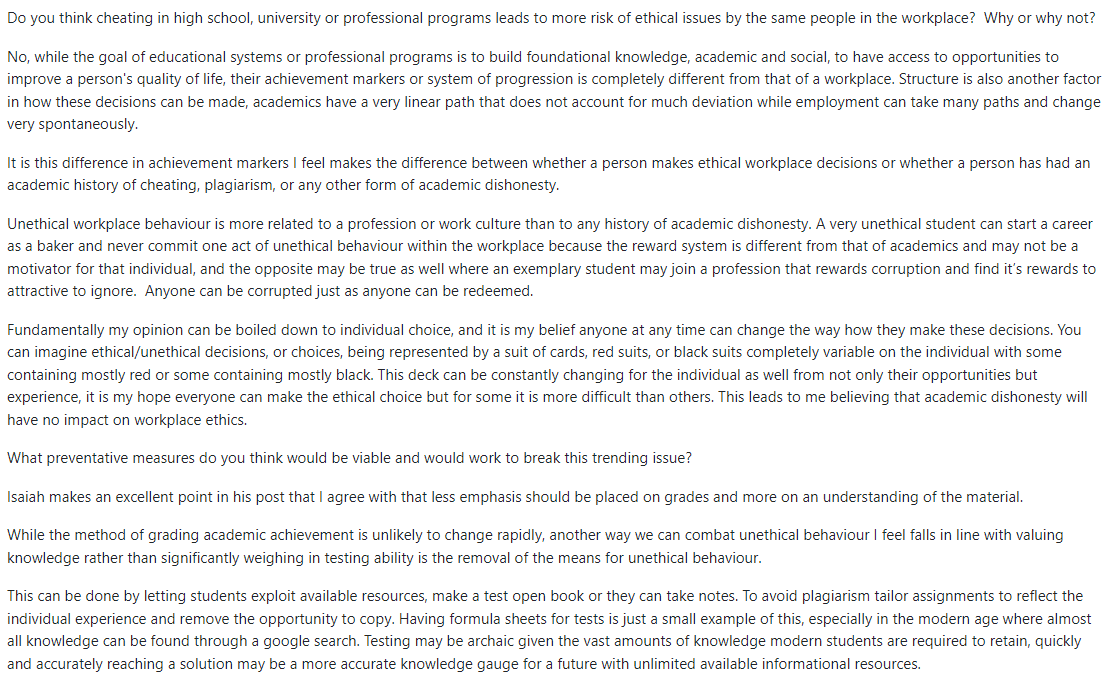
Do you think cheating in high school, university or professional programs leads to more risk of ethical issues by the same people in the workplace? Why or why not? No, while the goal of educational systems or professional programs is to build foundational knowledge, academic and social, to have access to opportunities to improve a person's quality of life, their achievement markers or system of progression is completely different from that of a workplace. Structure is also another factor in how these decisions can be made, academics have a very linear path that does not account for much deviation while employment can take many paths and change very spontaneously. It is this difference in achievement markers I feel makes the difference between whether a person makes ethical workplace decisions or whether a person has had an academic history of cheating, plagiarism, or any other form of academic dishonesty. Unethical workplace behaviour is more related to a profession or work culture than to any history of academic dishonesty. A very unethical student can start a career as a baker and never commit one act of unethical behaviour within the workplace because the reward system is different from that of academics and may not be a motivator for that individual, and the opposite may be true as well where an exemplary student may join a profession that rewards corruption and find it's rewards to attractive to ignore. Anyone can be corrupted just as anyone can be redeemed. Fundamentally my opinion can be boiled down to individual choice, and it is my belief anyone at any time can change the way how they make these decisions. You can imagine ethical/unethical decisions, or choices, being represented by a suit of cards, red suits, or black suits completely variable on the individual with some containing mostly red or some containing mostly black. This deck can be constantly changing for the individual as well from not only their opportunities but experience, it is my hope everyone can make the ethical choice but for some it is more difficult than others. This leads to me believing that academic dishonesty will have no impact on workplace ethics. What preventative measures do you think would be viable and would work to break this trending issue? Isaiah makes an excellent point in his post that I agree with that less emphasis should be placed on grades and more on an understanding of the material. While the method of grading academic achievement is unlikely to change rapidly, another way we can combat unethical behaviour I feel falls in line with valuing knowledge rather than significantly weighing in testing ability is the removal of the means for unethical behaviour. This can be done by letting students exploit available resources, make a test open book or they can take notes. To avoid plagiarism tailor assignments to reflect the individual experience and remove the opportunity to copy. Having formula sheets for tests is just a small example of this, especially in the modern age where almost all knowledge can be found through a google search. Testing may be archaic given the vast amounts of knowledge modern students are required to retain, quickly and accurately reaching a solution may be a more accurate knowledge gauge for a future with unlimited available informational resourcesStep by Step Solution
There are 3 Steps involved in it
1 Expert Approved Answer
Step: 1 Unlock

Question Has Been Solved by an Expert!
Get step-by-step solutions from verified subject matter experts
Step: 2 Unlock
Step: 3 Unlock
 Study Help