







Question: Question: Do you agree or disagree with the statement above? And why? When initially asked the question of if cheating in school leads to more
Question:
Do you agree or disagree with the statement above? And why?
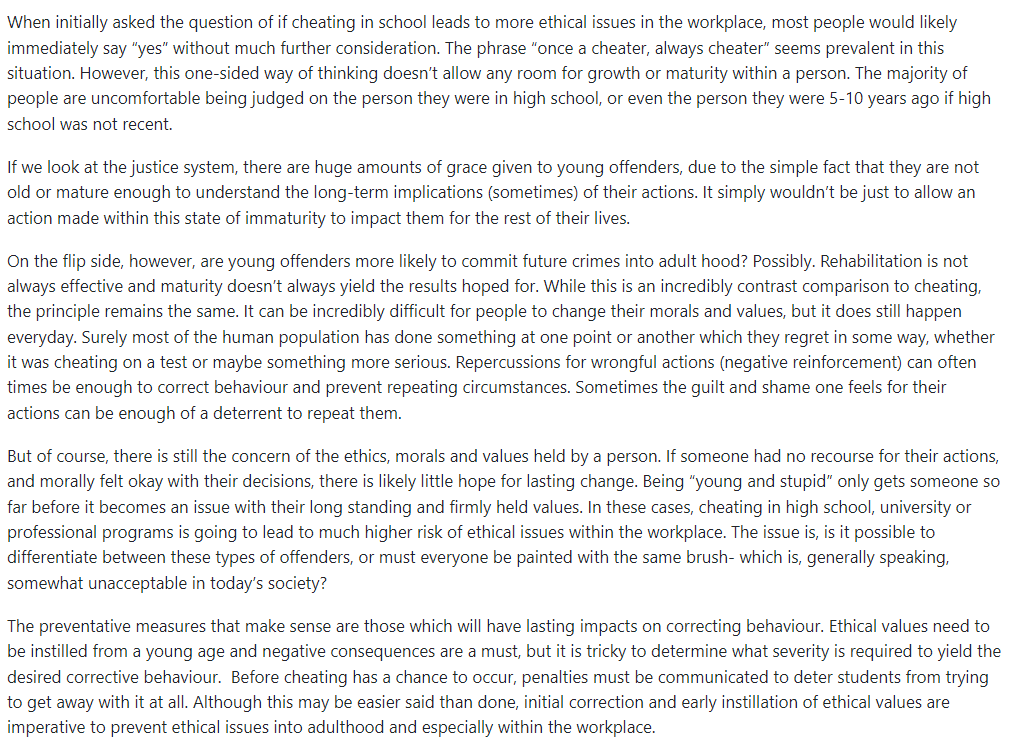
When initially asked the question of if cheating in school leads to more ethical issues in the workplace, most people would likely immediately say "yes" without much further consideration. The phrase "once a cheater, always cheater" seems prevalent in this situation. However, this one-sided way of thinking doesn't allow any room for growth or maturity within a person. The majority of people are uncomfortable being judged on the person they were in high school, or even the person they were 5-10 years ago if high school was not recent. If we look at the justice system, there are huge amounts of grace given to young offenders, due to the simple fact that they are not old or mature enough to understand the long-term implications (sometimes) of their actions. It simply wouldn't be just to allow an action made within this state of immaturity to impact them for the rest of their lives. On the flip side, however, are young offenders more likely to commit future crimes into adult hood? Possibly. Rehabilitation is not always effective and maturity doesn't always yield the results hoped for. While this is an incredibly contrast comparison to cheating, the principle remains the same. It can be incredibly difficult for people to change their morals and values, but it does still happen everyday. Surely most of the human population has done something at one point or another which they regret in some way, whether it was cheating on a test or maybe something more serious. Repercussions for wrongful actions (negative reinforcement) can often times be enough to correct behaviour and prevent repeating circumstances. Sometimes the guilt and shame one feels for their actions can be enough of a deterrent to repeat them. But of course, there is still the concern of the ethics, morals and values held by a person. If someone had no recourse for their actions, and morally felt okay with their decisions, there is likely little hope for lasting change. Being "young and stupid" only gets someone so far before it becomes an issue with their long standing and firmly held values. In these cases, cheating in high school, university or professional programs is going to lead to much higher risk of ethical issues within the workplace. The issue is, is it possible to differentiate between these types of offenders, or must everyone be painted with the same brush- which is, generally speaking, somewhat unacceptable in today's society? The preventative measures that make sense are those which will have lasting impacts on correcting behaviour. Ethical values need to be instilled from a young age and negative consequences are a must, but it is tricky to determine what severity is required to yield the desired corrective behaviour. Before cheating has a chance to occur, penalties must be communicated to deter students from trying to get away with it at all. Although this may be easier said than done, initial correction and early instillation of ethical values are imperative to prevent ethical issues into adulthood and especially within the workplaceStep by Step Solution
There are 3 Steps involved in it
1 Expert Approved Answer
Step: 1 Unlock

Question Has Been Solved by an Expert!
Get step-by-step solutions from verified subject matter experts
Step: 2 Unlock
Step: 3 Unlock
 Study Help