







Question: Question:- Given Below-- Please Do work in python or given in each part. I will really appreciate your Work. 1. An optical network operator is
Question:- Given Below-- Please Do work in python or given in each part. I will really appreciate your Work.
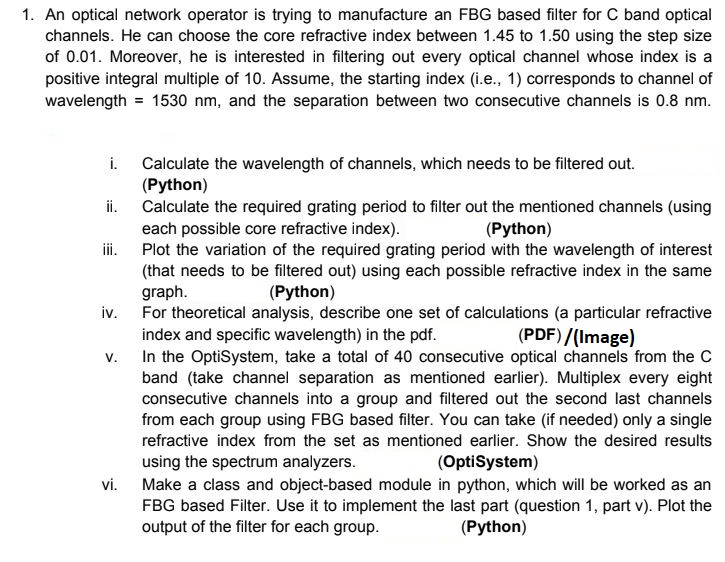
1. An optical network operator is trying to manufacture an FEtG based lter for C band optical channels. He can choose the core refractive index between 1.45 to 1.50 using the step size of 0.01. Moreover, he is interested in ltering out every optical channel whose index is a positive integral multiple of 10. Assume, the starting index [i.e., 1} corresponds to channel of wavelength = 153!) nm, and the separation between two consecutive channels is 0.3 nm. i. Calculate the wavelength of channels. which needs to be ltered out. (Python) ii. Calculate the required grating period to lter out the mentioned channels {using each possible core refractive index]. [Python] iii. Plot the variation of the required grating period with the wavelength of interest [that needs to be ltered out} using each possible refractive index in the same QBPh- {Python} iv. For theoretical analysis. describe one set of calculations {a particular refractive index and specic wavelength} in the pdf. (PDF) {[lmage] v. in the UptiSvstem, take a total of 40 consecutive optical channels from the C band {take channel separation as mentioned earlier}. Multiplex every eight consecutive channels into a group and ltered out the second last channels from each group using FBG based lter. You can take [if needed} only a single refractive index from the set as mentioned earlier. Show the desired results using the spectrum analyzers. {OptlSvstem} vi. Make a class and object-based module in python, which will be worked as an FBG based Filter. Use it to implement the last part [question 1, part v). Plot the output of the lter for each group. [Python]
Step by Step Solution
There are 3 Steps involved in it

Get step-by-step solutions from verified subject matter experts
 Study Help