







Question: Question V. Implementation/The Action Plan - How would you implement your plan? How would you track progress of your plans execution? Question VI. Conclusion 10
Question V. Implementation/The Action Plan - How would you implement your plan? How would you track progress of your plans execution?
Question VI. Conclusion
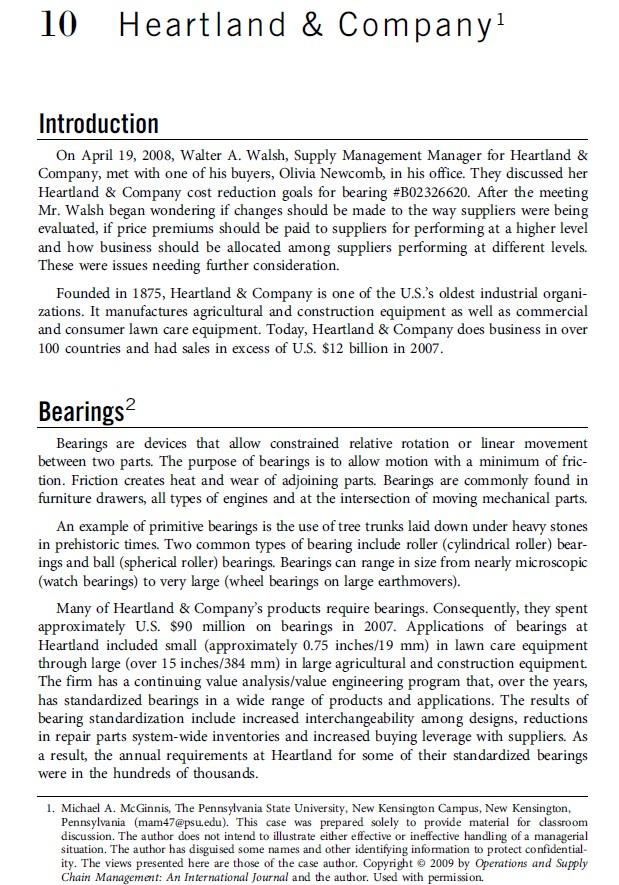
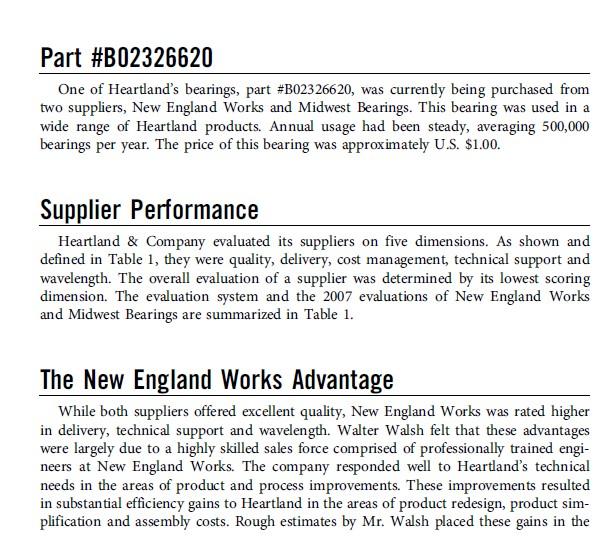
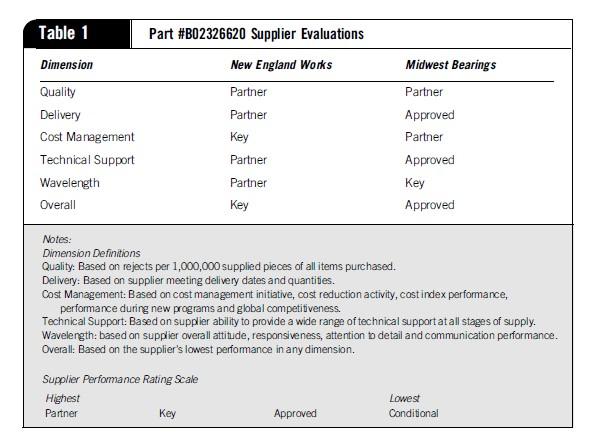
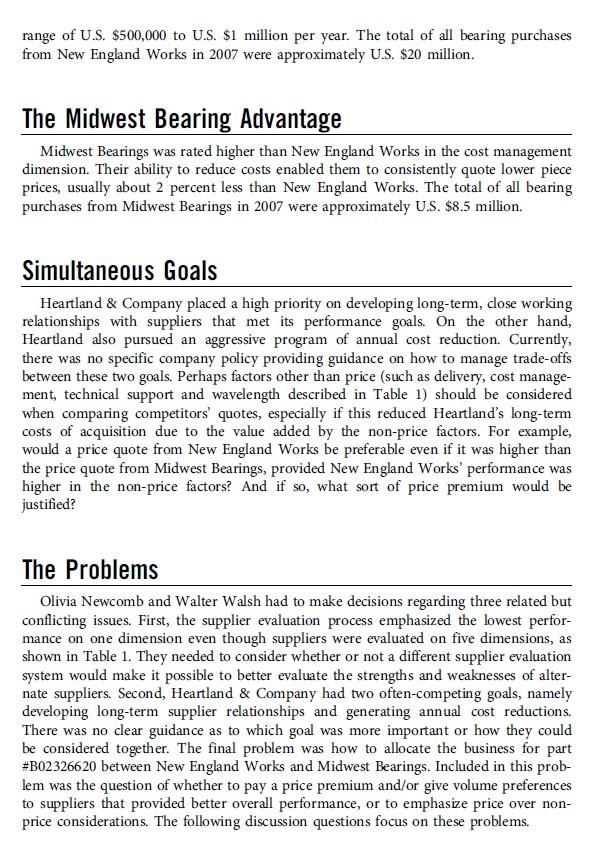
10 Heartland & Company] Introduction On April 19, 2008, Walter A. Walsh, Supply Management Manager for Heartland & Company, met with one of his buyers, Olivia Newcomb, in his office. They discussed her Heartland & Company cost reduction goals for bearing #B02326620. After the meeting Mr. Walsh began wondering if changes should be made to the way suppliers were being evaluated, if price premiums should be paid to suppliers for performing at a higher level and how business should be alocated among suppliers performing at different levels. These were issues needing further consideration. Founded in 1875, Heartland & Company is one of the U.S.'s oldest industrial organi- zations. It manufactures agricultural and construction equipment as well as commercial and consumer lawn care equipment. Today, Heartland & Company does business in over 100 countries and had sales in excess of U.S. $12 billion in 2007. 2 Bearings Bearings are devices that allow constrained relative rotation or linear movement between two parts. The purpose of bearings is to allow motion with a minimum of fric- tion. Friction creates heat and wear of adjoining parts. Bearings are commonly found in furniture drawers, all types of engines and at the intersection of moving mechanical parts. An example of primitive bearings is the use of tree trunks laid down under heavy stones in prehistoric times. Two common types of bearing include roler (cylindrical roller) bear- ings and ball (spherical roller) bearings. Bearings can range in size from nearly microscopic (watch bearings) to very large (wheel bearings on large earthmovers). Many of Heartland & Company's products require bearings. Consequently, they spent approximately U.S. $90 million on bearings in 2007. Applications of bearings at Heartland included small (approximately 0.75 inches/19 mm) in lawn care equipment through large (over 15 inches/384 mm) in large agricultural and construction equipment The firm has a continuing value analysis/value engineering program that, over the years, has standardized bearings in a wide range of products and applications. The results of bearing standardization include increased interchangeability among designs, reductions in repair parts system-wide inventories and increased buying leverage with suppliers. As a result, the annual requirements at Heartland for some of their standardized bearings were in the hundreds of thousands. 1. Michael A. McGinnis, The Pennsylvania State University, New Kensington Campus, New Kensington, Pennsylvania (mam47@psu.edu). This case was prepared solely to provide material for classroom discussion. The author does not intend to illustrate either effective or ineffective handling of a managerial situation. The author has disguised some names and other identifying information to protect confidential- ity. The views presented here are those of the case author. Copyright 2009 by Operations and Supply Chain Management: An International Journal and the author. Used with permission. Part #B02326620 One of Heartland's bearings, part #B02326620, was currently being purchased from two suppliers, New England Works and Midwest Bearings. This bearing was used in a wide range of Heartland products. Annual usage had been steady, averaging 500,000 bearings per year. The price of this bearing was approximately U.S. $1.00. Supplier Performance Heartland & Company evaluated its suppliers on five dimensions. As shown and defined in Table 1, they were quality, delivery, cost management, technical support and wavelength. The overall evaluation of a supplier was determined by its lowest scoring dimension. The evaluation system and the 2007 evaluations of New England Works and Midwest Bearings are summarized in Table 1. The New England Works Advantage While both suppliers offered excellent quality, New England Works was rated higher in delivery, technical support and wavelength. Walter Walsh felt that these advantages were largely due to a highly skilled sales force comprised of professionally trained engi- neers at New England Works. The company responded well to Heartland's technical needs in the areas of product and process improvements. These improvements resulted in substantial efficiency gains to Heartland in the areas of product redesign, product sim- plification and assembly costs. Rough estimates by Mr. Walsh placed these gains in the Table 1 Dimension Quality Delivery Cost Management Technical Support Wavelength Overall Part #B02326620 Supplier Evaluations New England Works Partner Partner Key Partner Partner Key Midwest Bearings Partner Approved Partner Approved Approved Notes: Dimension Definitions Quality: Based on rejects per 1,000,000 supplied pieces of all items purchased. Delivery: Based on supplier meeting delivery dates and quantities. Cost Management: Based on cost management initiative, cost reduction activity, cost index perfomance, performance during new programs and global competitiveness. Technical Support: Based on supplier ability to provide a wide range of technical support at all stages of supply. Wavelength: based on supplier overall attitude, responsiveness, attention detail and communication performance. Overall: Based on the supplier's lowest perfomance in any dimension. Supplier Performance Rating Scale Highest Partner Approved Lowest Conditional range of U.S. $500,000 to U.S. $1 million per year. The total of all bearing purchases from New England Works in 2007 were approximately U.S. $20 million. The Midwest Bearing Advantage Midwest Bearings was rated higher than New England Works in the cost management dimension. Their ability to reduce costs enabled them to consistently quote lower piece prices, usually about 2 percent less than New England Works. The total of all bearing purchases from Midwest Bearings in 2007 were approximately U.S. $8.5 million. Simultaneous Goals Heartland & Company placed a high priority on developing long-term, close working relationships with suppliers that met its performance goals. On the other hand, Heartland also pursued an aggressive program of annual cost reduction. Currently, there was no specific company policy providing guidance on how to manage trade-offs between these two goals. Perhaps factors other than price (such as delivery, cost manage- ment, technical support and wavelength described in Table 1) should be considered when comparing competitors' quotes, especially if this reduced Heartland's long-term costs of acquisition due to the value added by the non-price factors. For example, would a price quote from New England Works be preferable even if it was higher than the price quote from Midwest Bearings, provided New England Works' performance was higher in the non-price factors? And if so, what sort of price premium would be justified? The Problems Olivia Newcomb and Walter Walsh had to make decisions regarding three related but conflicting issues. First, the supplier evaluation process emphasized the lowest perfor- mance on one dimension even though suppliers were evaluated on five dimensions, as shown in Table 1. They needed to consider whether or not a different supplier evaluation system would make it possible to better evaluate the strengths and weaknesses of alter- nate suppliers. Second, Heartland & Company had two often-competing goals, namely developing long-term supplier relationships and generating annual cost reductions. There was no clear guidance as to which goal was more important or how they could be considered together. The final problem was how to allocate the business for part #B02326620 between New England Works and Midwest Bearings. Included in this prob- lem was the question of whether to pay a price premium and/or give volume preferences to suppliers that provided better overall performance, or to emphasize price over non- price considerations. The following discussion questions focus on these problemsStep by Step Solution
There are 3 Steps involved in it
1 Expert Approved Answer
Step: 1 Unlock

Question Has Been Solved by an Expert!
Get step-by-step solutions from verified subject matter experts
Step: 2 Unlock
Step: 3 Unlock
 Study Help