







Question: Read and analyze the current situation, do this by identifying the strategic managers and analyzing the strategic factors. Barriers to Entry and Imitation The barriers
Read and analyze the current situation, do this by identifying the strategic managers and analyzing the strategic factors.
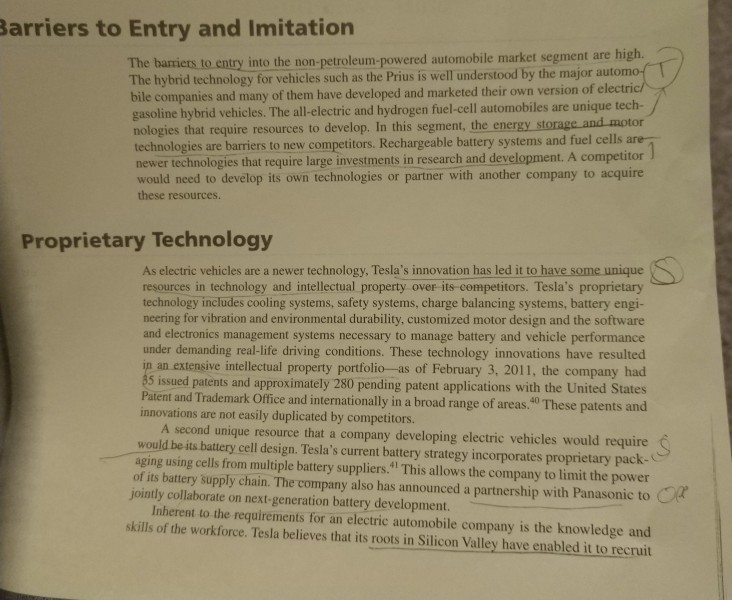
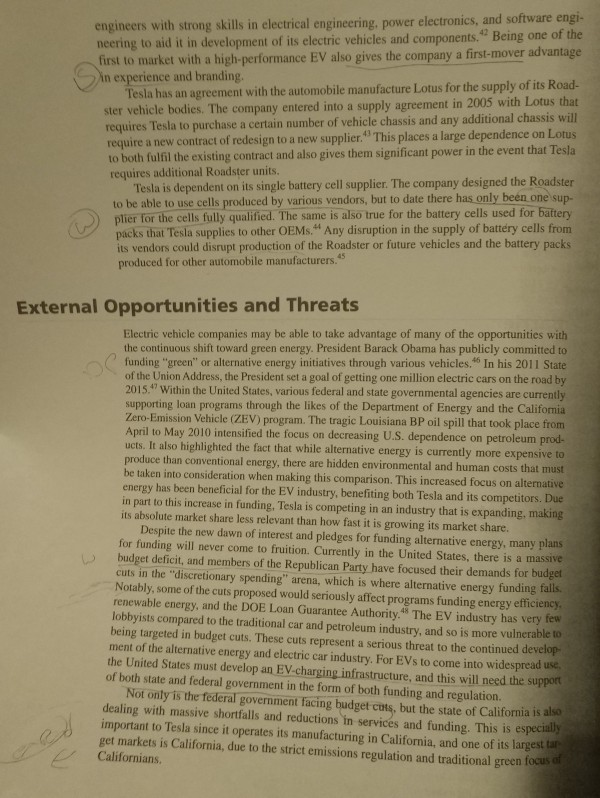
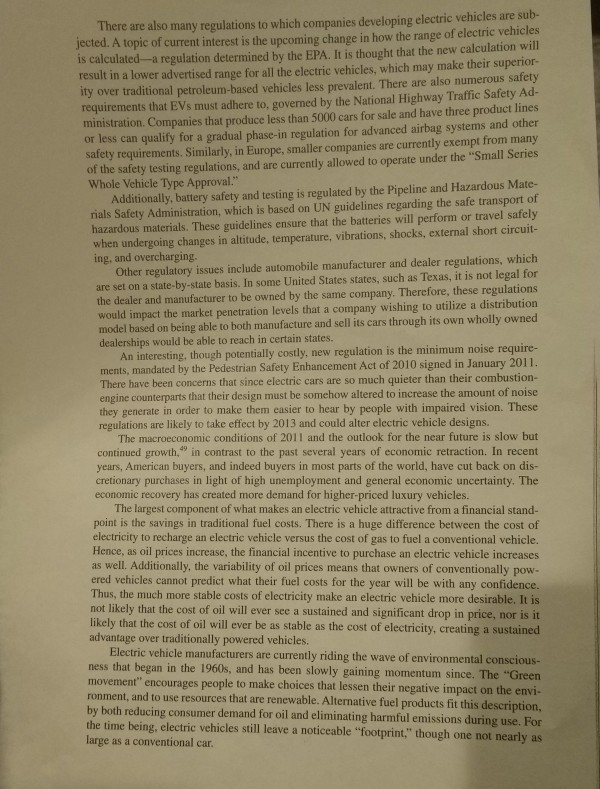
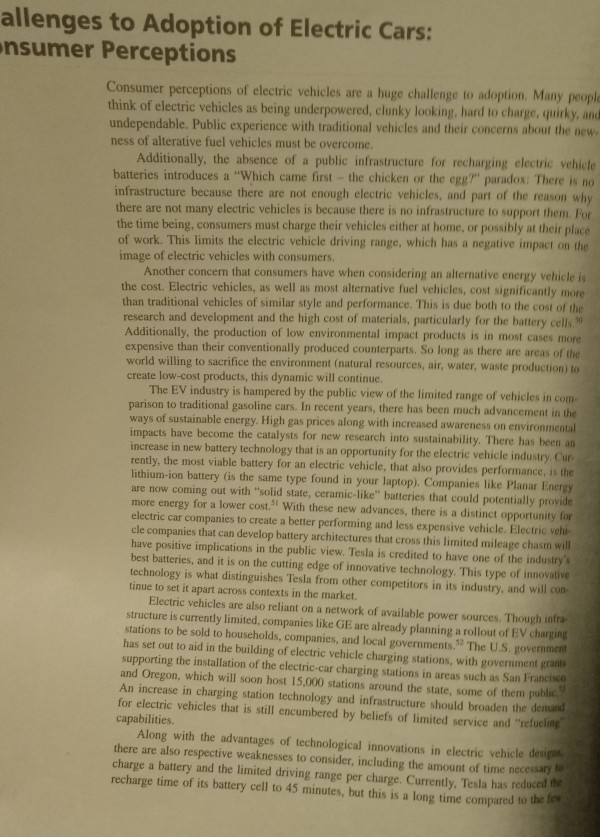
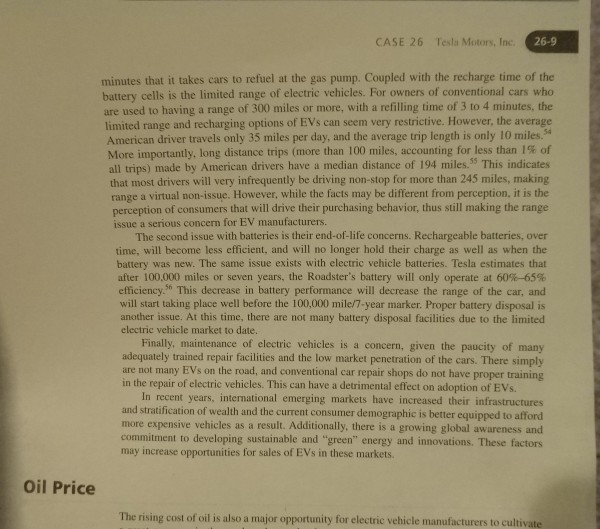
Barriers to Entry and Imitation The barriers to entry into the non-petroleum-powered automobile market segment are high. The hybrid technology for vehicles such as the Prius is well understood by the major automo- bile companies and many of them have developed and marketed their own version of electric gasoline hybrid vehicles. The all-electric and hydrogen fuel-cell automobiles are unique tech- nologies that require resources to develop. In this segment, the energy storage and motor technologies are barriers to new competitors. Rechargeable battery systems and fuel cells are newer technologies that require large investments in research and development. A competitor would need to develop its own technologies or partner with another company to acquire these resources. Proprietary Technology As electric vehicles are a newer technology, Tesla's innovation has led it to have some unique resources in technology and intellectual property over its competitors. Tesla's proprietary technology includes cooling systems, safety systems, charge balancing systems, battery engi- neering for vibration and environmental durability, customized motor design and the software and electronics management systems necessary to manage battery and vehicle performance under demanding real-life driving conditions. These technology innovations have resulted in an extensive intellectual property portfolio as of February 3, 2011, the company had 35 issued patents and approximately 280 pending patent applications with the United States Patent and Trademark Office and internationally in a broad range of areas. These patents and innovations are not easily duplicated by competitors. A second unique resource that a company developing electric vehicles would require would be its battery cell design. Tesla's current battery strategy incorporates proprietary pack- aging using cells from multiple battery suppliers." This allows the company to limit the power of its battery supply chain. The company also has announced a partnership with Panasonic to jointly collaborate on next-generation battery development. Inherent to the requirements for an electric automobile company is the knowledge and skills of the workforce. Tesla believes that its roots in Silicon Valley have enabled it to recruit engineers with strong skills in electrical engineering, power electronics, and software engi- neering to aid it in development of its electric vehicles and components. Being one of the first to market with a high-performance EV also gives the company a first-mover advantage An experience and branding. Tesla has an agreement with the automobile manufacture Lotus for the supply of its Road ster vehicle bodies. The company entered into a supply agreement in 2005 with Lotus that requires Tesla to purchase a certain number of vehicle chassis and any additional chassis will require a new contract of redesign to a new supplier." This places a large dependence on Lotus to both fulfil the existing contract and also gives them significant power in the event that Tesla requires additional Roadster units. Tesla is dependent on its single battery cell supplier. The company designed the Roadster to be able to use cells produced by various vendors, but to date there has only been one sup plier for the cells fully qualified. The same is also true for the battery cells used for battery packs that Tesla supplies to other OEMs. Any disruption in the supply of battery cells from its vendors could disrupt production of the Roadster or future vehicles and the battery packs produced for other automobile manufacturers. External Opportunities and Threats Electric vehicle companies may be able to take advantage of many of the opportunities with the continuous shift toward green energy. President Barack Obama has publicly committed to In his 2011 State alternative energy initiatives through various vehicles. of the Union Address, the President set a goal of getting one million electric cars on the road by 2015. Within the United States, various federal and state governmental agencies are currently supporting loan programs through the likes of the Department of Energy and the Califomia Zero-Emission Vehicle (ZEV) program. The tragic Louisiana BP oil spill that took place from April to May 2010 intensified the focus on decreasing U.S. dependence on petroleum prod- ucts. It also highlighted the fact that while alternative energy is currently more expensive to produce than conventional energy, there are hidden environmental and human costs that must be taken into consideration when making this comparison. This increased focus on alternative energy has been beneficial for the EV industry, benefiting both Tesla and its competitors. Dur in part to this increase in funding. Tesla is competing in an industry that is expanding, making its absolute market share less relevant than how fast it is growing its market share. Despite the new dawn of interest and pledges for funding alternative energy, many plans for funding will never come to fruition. Currently in the United States, there is a massive budget deficit, and members of the Republican Party have focused their demands for budge cuts in the "discretionary spending" arena, which is where alternative energy funding falls Notably, some of the cuts proposed would seriously affect programs funding energy efficiency renewable energy, and the DOE Loan Guarantee Authority." The EV industry has very few lobbyists compared to the traditional car and petroleum industry, and so is more vulnerable to being targeted in budget cuts. These cuts represent a serious threat to the continued develop ment of the alternative energy and electric car industry. For EVs to come into widespread use the United States must develop an EV-charging infrastructure, and this will need the support of both state and federal government in the form of both funding and regulation. Not only is the federal government facing budget cuts, but the state of California is also dealing with massive shortfalls and reductions in services and funding. This is especially important to Tesla since it operates its manufacturing in California, and one of its largest get markets is California, due to the strict emissions regulation and traditional green focus Californians. There are also many regulations to which companies developing electric vehicles are sub jected. A topic of current interest is the upcoming change in how the range of electric vehicles is calculated-a regulation determined by the EPA. It is thought that the new calculation will result in a lower advertised range for all the electric vehicles, which may make their superior my over traditional petroleum-based vehicles less prevalent. There are also numerous safety requirements that EVs must adhere to governed by the National Highway Traffic Safety Ad- ministration. Companies that produce less than 5000 cars for sale and have three product lines of less can quality for a gradual phase-in regulation for advanced airbag systems and other safety requirements. Similarly, in Europe, smaller companies are currently exempt from many of the safety testing regulations, and are currently allowed to operate under the "Small Series Whole Vehicle Type Approval." Additionally, battery safety and testing is regulated by the Pipeline and Hazardous Mate- rials Safety Administration, which is based on UN guidelines regarding the safe transport of hazardous materials. These guidelines ensure that the batteries will perform or travel safely when undergoing changes in altitude, temperature, vibrations, shocks, external short circuit ing, and overcharging. Other regulatory issues include automobile manufacturer and dealer regulations, which are set on a state-by-state basis. In some United States states, such as Texas, it is not legal for the dealer and manufacturer to be owned by the same company. Therefore, these regulations ould impact the market penetration levels that a company wishing to utilize a distribution model based on being able to both manufacture and sell its cars through its own wholly owned dealerships would be able to reach in certain states. An interesting, though potentially costly, new regulation is the minimum noise require- ments, mandated by the Pedestrian Safety Enhancement Act of 2010 signed in January 2011 There have been concerns that since electric cars are so much quieter than their combustion- engine counterparts that their design must be somehow altered to increase the amount of noise they generate in order to make them easier to hear by people with impaired vision. These regulations are likely to take effect by 2013 and could alter electric vehicle designs. The macroeconomic conditions of 2011 and the outlook for the near future is slow but continued growth." in contrast to the past several years of economic retraction. In recent years, American buyers, and indeed buyers in most parts of the world, have cut back on dis- cretionary purchases in light of high unemployment and general economic uncertainty. The economic recovery has created more demand for higher-priced luxury vehicles. The largest component of what makes an electric vehicle attractive from a financial stand- point is the savings in traditional fuel costs. There is a huge difference between the cost of electricity to recharge an electric vehicle versus the cost of gas to fuel a conventional vehicle. Hence, as oil prices increase, the financial incentive to purchase an electric vehicle increases as well. Additionally, the variability of oil prices means that owners of conventionally pow. ered vehicles cannot predict what their fuel costs for the year will be with any confidence. Thus, the much more stable costs of electricity make an electric vehicle more desirable. It is not likely that the cost of oil will ever see a sustained and significant drop in price, nor is it likely that the cost of oil will ever be as stable as the cost of electricity, creating a sustained advantage over traditionally powered vehicles. Electric vehicle manufacturers are currently riding the wave of environmental conscious ness that began in the 1960s, and has been slowly gaining momentum since. The "Green movement" encourages people to make choices that lessen their negative impact on the envi- ronment, and to use resources that are renewable. Alternative fuel products fit this description by both reducing consumer demand for oil and eliminating harmful emissions during use. For the time being, electric vehicles still leave a noticeable "footprint," though one not nearly as large as a conventional car. allenges to Adoption of Electric Cars: onsumer Perceptions Consumer perceptions of electric vehicles are a huge challenge to adoption. Many people think of electric vehicles as being underpowered, clunky looking, hard to charge quirky, and undependable. Public experience with traditional vehicles and their concerns about the new ness of alterative fuel vehicles must be overcome. Additionally, the absence of a public infrastructure for recharging electric vehicle batteries introduces a "Which came first - the chicken or the egg?" paradox: There is no infrastructure because there are not enough electric vehicles, and part of the reason why there are not many electric vehicles is because there is no infrastructure to support them. For the time being, consumers must charge their vehicles either at home, or possibly at their place of work. This limits the electric vehicle driving range, which has a negative impact on the image of electric vehicles with consumers. Another concern that consumers have when considering an alternative energy vehicle the cost Electric vehicles, as well as most alternative fuel vehicles, cost significantly more than traditional vehicles of similar style and performance. This is due both to the cost of the research and development and the high cost of materials, particularly for the battery cells. Additionally, the production of low environmental impact products is in most cases more expensive than their conventionally produced counterparts. So long as there are areas of the world willing to sacrifice the environment (natural resources, air, water, waste production to create low-cost products, this dynamic will continue. The EV industry is hampered by the public view of the limited range of vehicles in com parison to traditional gasoline cars. In recent years, there has been much advancement in the ways of sustainable energy. High gas prices along with increased awareness on environmental impacts have become the catalysts for new research into sustainability. There has been an increase in new battery technology that is an opportunity for the electric vehicle industry. Cur rently, the most viable battery for an electric vehicle, that also provides performance, is the lithium-ion battery is the same type found in your laptop). Companies like Planar Energy are now coming out with "solid state, ceramic-like" batteries that could potentially provide more energy for a lower cost." With these new advances, there is a distinct opportunity for electric car companies to create a better performing and less expensive vehicle. Electric veh cle companies that can develop battery architectures that cross this limited mileage charm will have positive implications in the public view. Tesla is credited to have one of the industry best batteries, and it is on the cutting edge of innovative technology. This type of innovative technology is what distinguishes Tesla from other competitors in its industry, and will con tinue to set it apart across contexts in the market. Electric vehicles are also reliant on a network of available power sources. Though intra structure is currently limited, companies like GE are already planning a rollout of EV changin stations to be sold to households, companies, and local governments. The U.S. Rover has set out to aid in the building of electric vehicle charging stations, with government grants supporting the installation of the electric car charging stations in areas such as San Francis and Oregon, which will soon host 15.000 stations around the state, some of them public An increase in charging station technology and infrastructure should broaden the demand for electric vehicles that is still encumbered by beliefs of limited service and reloc capabilities. Along with the advantages of technological innovations in electric vehicle desire there are also respective weaknesses to consider, including the amount of time necessa charge a battery and the limited driving range per charge. Currently, Tesla has reduced recharge time of its battery cell to 45 minutes, but this is a long time compared to the CASE 26 Tesla Motors, Inc. 26-9 minutes that it takes cars to refuel at the gas pump. Coupled with the recharge time of the battery cells is the limited range of electric vehicles. For owners of conventional cars who are used to having a range of 300 miles or more, with a refilling time of 3 to 4 minutes, the limited range and recharging options of EVs can seem very restrictive. However, the average American driver travels only 35 miles per day, and the average trip length is only 10 miles. More importantly, long distance trips (more than 100 miles, accounting for less than 1% of all trips) made by American drivers have a median distance of 194 miles. This indicates that most drivers will very infrequently be driving non-stop for more than 245 miles, making range a virtual non-issue. However, while the facts may be different from perception, it is the perception of consumers that will drive their purchasing behavior, thus still making the range issue a serious concern for EV manufacturers. The second issue with batteries is their end-of-life concerns. Rechargeable batteries, over time, will become less efficient, and will no longer hold their charge as well as when the battery was new. The same issue exists with electric vehicle batteries. Tesla estimates that after 100,000 miles or seven years, the Roadster's battery will only operate at 60%-659 efficiency. This decrease in battery performance will decrease the range of the car, and will start taking place well before the 100,000 mile/7-year marker. Proper battery disposal is another issue. At this time, there are not many battery disposal facilities due to the limited electric vehicle market to date. Finally, maintenance of electric vehicles is a concern, given the paucity of many adequately trained repair facilities and the low market penetration of the cars. There simply are not many EVs on the road, and conventional car repair shops do not have proper training in the repair of electric vehicles. This can have a detrimental effect on adoption of EVs. In recent years, international emerging markets have increased their infrastructures and stratification of wealth and the current consumer demographic is better equipped to afford more expensive vehicles as a result. Additionally, there is a growing global awareness and commitment to developing sustainable and "green" energy and innovations. These factors may increase opportunities for sales of EVs in these markets. Oil Price The rising cost of oil is also a major opportunity for electric vehicle manufacturers to cultivate
Step by Step Solution
There are 3 Steps involved in it
1 Expert Approved Answer
Step: 1 Unlock

Question Has Been Solved by an Expert!
Get step-by-step solutions from verified subject matter experts
Step: 2 Unlock
Step: 3 Unlock
 Study Help